

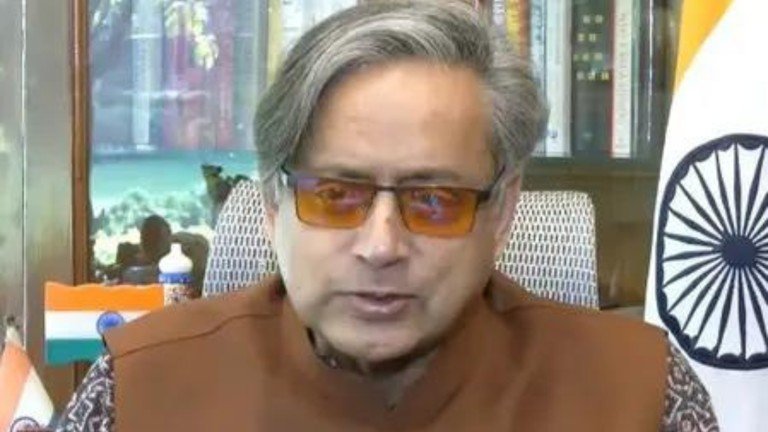
Senior Congress leader Shashi Tharoor has once again found himself at the center of a political debate within his own party. Just a day after facing criticism from some Congress members over remarks perceived as praise for Prime Minister Narendra Modi, Tharoor has come under fresh scrutiny for his comments related to Kashmir.
The latest controversy has reignited discussions about internal differences within the Congress party. It has also highlighted the challenges faced by opposition parties in maintaining a unified public position on sensitive national issues.
Tharoor’s remarks triggered reactions from several party leaders and supporters, some of whom questioned whether his views aligned with the party’s established stance. Others, however, defended his right to express opinions and engage in nuanced discussions on national matters.
The episode has once again brought attention to ideological debates within the Congress and the broader opposition landscape.
Kashmir Remarks Spark Debate
The controversy emerged after comments made by Tharoor regarding developments in Jammu and Kashmir. His observations quickly drew attention from both political supporters and critics.
Several Congress leaders expressed reservations about the remarks, arguing that statements on sensitive national issues should remain consistent with the party’s official position. Critics within the party suggested that differing public viewpoints could create confusion among party workers and supporters.
Supporters of Tharoor, however, argued that political discourse should allow room for individual perspectives and constructive debate. They maintained that discussions on national issues often require balanced analysis rather than rigid political positioning.
The differing reactions demonstrate the complexities involved in addressing subjects that carry both political and emotional significance.
As the debate intensified, the issue quickly became a talking point across political circles and social media platforms.
Back-to-Back Controversies Raise Questions
The latest criticism follows closely on the heels of another controversy involving Tharoor’s comments about Prime Minister Narendra Modi. Those remarks had already sparked discussions within Congress regarding messaging, political strategy, and party discipline.
Some party leaders reportedly viewed Tharoor’s comments as unusually appreciative of the Prime Minister’s role in certain areas of governance and diplomacy. The observations prompted criticism from sections of the party that believed opposition leaders should maintain a sharper political distinction from the ruling establishment.
The Kashmir remarks arriving soon afterward further amplified internal discussions. Political observers noted that the sequence of events has once again highlighted differing approaches within the Congress leadership.
While some leaders advocate a more confrontational stance against the ruling party, others favor issue-based engagement and nuanced political analysis. These contrasting approaches often become visible during public debates.
The developments have contributed to renewed conversations about the future direction of opposition politics.
Internal Differences Within Congress
Congress has long been known as a broad political platform that accommodates a range of viewpoints and ideological perspectives. This diversity has often been considered both a strength and a challenge.
Internal debates are not uncommon within large political parties, especially on complex national issues. Differences of opinion frequently emerge regarding political strategy, policy positions, and public communication.
The latest episode involving Tharoor reflects these broader dynamics. Some leaders believe party members should present a unified public message, particularly on issues that attract national attention.
Others argue that democratic political organizations benefit from open discussions and intellectual diversity. They contend that internal debate can strengthen policy formulation and encourage broader public engagement.
Political analysts note that managing such differences remains an ongoing challenge for major political parties across democracies.
Tharoor’s Distinct Political Style
Shashi Tharoor has often been regarded as one of the Congress party’s most prominent and independent-minded leaders. Known for his articulate communication style and international perspective, he has frequently expressed views that generate discussion across political lines.
Over the years, Tharoor has occasionally taken positions that differ in tone or emphasis from the official party narrative. While these interventions have earned him praise from some quarters, they have also attracted criticism from others.
Supporters view him as a leader willing to engage with complex issues in a nuanced manner. Critics, however, argue that such positions sometimes create unnecessary controversies and distract from broader political objectives.
His latest remarks have once again placed him at the center of a debate about the balance between individual expression and collective political messaging.
The discussion also reflects broader questions about leadership styles and communication strategies in contemporary politics.
Opposition Politics and Public Messaging
The controversy comes at a time when opposition parties are working to strengthen coordination and present a united front on national issues. Political messaging has become increasingly important in shaping public perception and influencing electoral outcomes.
Many opposition leaders emphasize the need for consistency and clarity in public statements. They argue that mixed messages can weaken political campaigns and create confusion among supporters.
At the same time, political organizations often contain leaders with diverse experiences and perspectives. Balancing individual viewpoints with collective messaging remains a complex task.
The debate surrounding Tharoor’s remarks highlights this challenge. It underscores the tension that can arise between personal expression and party discipline within democratic political structures.
Observers believe such discussions are likely to continue as parties adapt to evolving political realities and public expectations.
Reactions Across Political Spectrum
The issue has generated reactions not only within Congress but also from leaders across the political spectrum. Members of rival parties have commented on the controversy, with some pointing to it as evidence of divisions within the opposition.
Others have argued that differing opinions within political parties are a natural feature of democratic systems. They suggest that internal debate should not automatically be viewed as a sign of weakness.
Political commentators have also weighed in, offering varied interpretations of the developments. Some view the controversy as part of a larger conversation about the future direction of Congress and its leadership dynamics.
Others see it as an example of the challenges faced by public figures who attempt to navigate complex political issues while maintaining independent viewpoints.
The discussions continue to attract attention from political observers and media outlets alike.
What the Episode Means for Congress
The latest controversy involving Shashi Tharoor serves as a reminder of the ongoing debates within the Congress party regarding political messaging and strategic positioning. While differences of opinion remain a normal aspect of democratic politics, managing those differences effectively is often crucial for organizational cohesion.
The episode has once again highlighted the diverse voices that exist within the party and the varying approaches leaders adopt when addressing national issues. It also reflects broader questions about opposition politics, leadership communication, and public engagement.
As Congress prepares for future political challenges, maintaining a balance between internal diversity and collective messaging will remain an important consideration. The party’s ability to navigate such debates may influence its public image and political effectiveness in the coming years.
For now, the discussion surrounding Tharoor’s remarks continues to dominate political conversations, adding another chapter to the ongoing story of internal debates within one of India’s oldest political parties.