

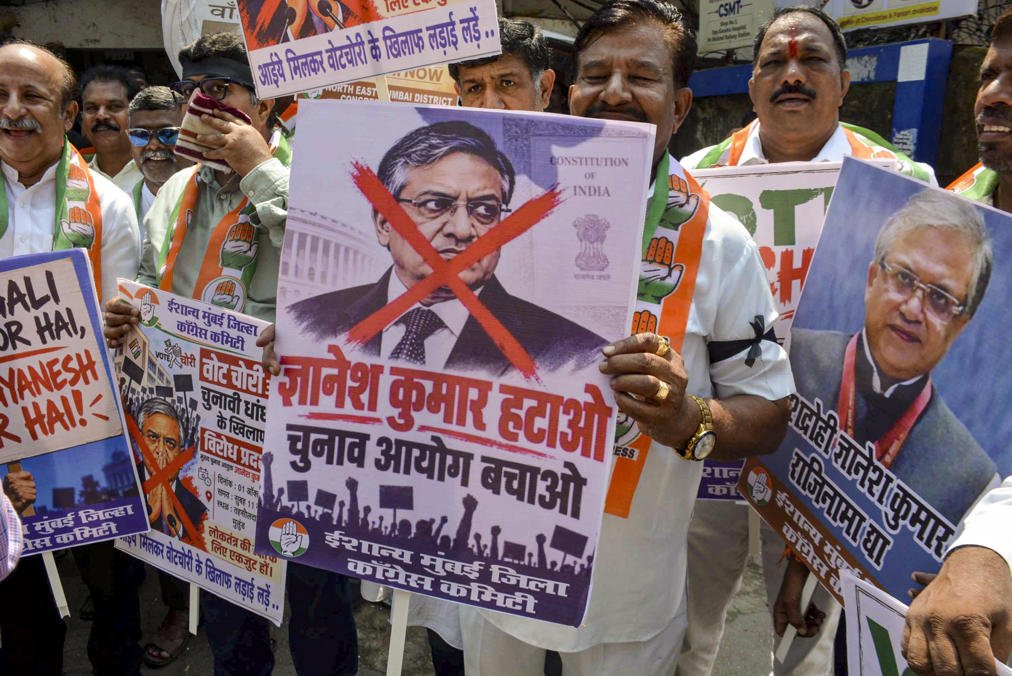
Debates in India’s Constituent Assembly reveal that the framers of the Constitution were deeply concerned about the independence of the Election Commission and the protection of voting rights.
An opinion article by journalist Piyush Babele, published in The Wire, revisits these discussions amid current controversies surrounding the Election Commission of India (ECI).
The article examines the arguments made by Dr BR Ambedkar and other Assembly members in 1949. It focuses on their concerns about executive interference, electoral roll preparation and the appointment of election commissioners.
The central constitutional question remains relevant: how can an institution responsible for conducting elections remain independent of the government of the day?
Ambedkar Warned Against Executive Influence
During the Constituent Assembly debates, Ambedkar acknowledged concerns about appointing an unsuitable person to lead the Election Commission.
He recognised the possibility of appointing someone who might be influenced by the executive.
Ambedkar admitted that the proposed constitutional provisions did not fully address the possibility of appointing an unfit person as Chief Election Commissioner.
His remarks reflected the difficulty of designing safeguards for an institution expected to operate independently of political power.
The Assembly’s discussions also highlighted the importance of protecting electoral administration from interference by governments.
Shibban Lal Saxena Proposed a Special Majority
Constituent Assembly member Shibban Lal Saxena proposed that appointments to the Election Commission should receive approval from a two-thirds majority of Parliament.
He argued that a simple majority could allow the ruling party to appoint a politically aligned candidate.
A special majority, he believed, would require broader political agreement and strengthen public confidence in the institution.
Saxena also warned that constitutional safeguards should account for future governments, rather than relying on the character of the political leadership at the time.
His argument was based on the principle that constitutional institutions must remain independent regardless of which party holds power.
The proposal, however, was not adopted in the form he suggested.
Electoral Rolls and the Right to Vote
The article also revisits Ambedkar’s arguments concerning the preparation of electoral rolls.
During the January 8, 1949 debate, members raised concerns about requiring written applications from people who could not read or write.
Ambedkar supported allowing oral declarations before authorised officials to address this difficulty.
The discussion reflected the Assembly’s concern about making electoral registration accessible to citizens across different educational and social backgrounds.
On June 15, 1949, Ambedkar also addressed the danger of local governments excluding eligible voters because of racial, cultural or linguistic differences.
He emphasised that no eligible citizen should lose voting rights because of an officer’s prejudice or a government’s arbitrary decision.
These debates established an important connection between electoral administration and democratic equality.
Why the Election Commission Was Given Independence
The Constitution’s framers considered electoral independence essential to representative democracy.
The original constitutional discussions recognised that election management should not remain under the direct control of the executive.
Article 324 consequently vested the Election Commission with the superintendence, direction and control of elections to Parliament, state legislatures, and the offices of President and Vice-President.
The constitutional framework also provided safeguards for the Chief Election Commissioner’s removal.
These provisions sought to protect the institution from direct political interference.
However, the appointment process continued to raise questions about how independence could be secured before commissioners assumed office.
Appointment Process and the Supreme Court
The appointment of election commissioners has remained an important subject of constitutional debate.
In March 2023, the Supreme Court directed that appointments should be made by a committee comprising the Prime Minister, the Leader of the Opposition in the Lok Sabha and the Chief Justice of India.
The arrangement was intended to operate until Parliament enacted a law governing appointments.
Parliament subsequently passed the Chief Election Commissioner and Other Election Commissioners (Appointment, Conditions of Service and Term of Office) Act, 2023.
The law provides for a selection committee comprising the Prime Minister, a Union Cabinet Minister nominated by the Prime Minister and the Leader of the Opposition in the Lok Sabha.
The change has generated debate over the balance between executive participation and institutional independence.
Current Electoral Controversies Revive Constitutional Questions
Babele’s article connects the historical debates with current criticism of the Election Commission, including allegations concerning electoral roll revisions and the conduct of Chief Election Commissioner Gyanesh Kumar.
Opposition leaders have raised concerns about the Special Intensive Revision (SIR) of electoral rolls and the poll body’s independence.
The Election Commission and government representatives have defended the process and its legal basis.
These remain contested political and institutional questions. The historical debates do not, by themselves, establish the validity of present-day allegations.
However, they offer context for understanding why the Constitution’s framers considered impartial electoral administration essential.
A Continuing Debate on Democratic Institutions
The Constituent Assembly’s discussions show that concerns about appointments, voter inclusion and executive influence existed at the foundation of India’s electoral system.
The framers sought to create an institution capable of conducting elections independently of the government.
The continuing debate over appointment procedures and electoral administration reflects the importance of those original constitutional questions.
The historical record therefore provides a framework for examining the Election Commission’s role in protecting voting rights and maintaining public confidence in elections.