

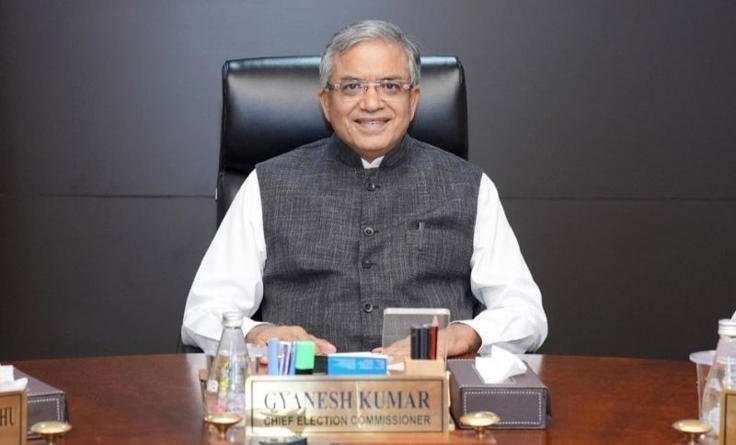
A Supreme Court advocate has sought the consent of Attorney General for India R. Venkataramani to initiate criminal contempt proceedings against Chief Election Commissioner (CEC) Gyanesh Kumar. Advocate Brajesh Singh submitted the request on September 24, alleging that Kumar’s actions violated Supreme Court judgments governing the functioning of the Election Commission of India (ECI).
However, no contempt case has been filed against the CEC at this stage. The advocate has only sought the Attorney General’s statutory consent, which is required before a private person can initiate criminal contempt proceedings in the Supreme Court.
Advocate invokes Contempt of Courts Act
Singh addressed his request to Attorney General R. Venkataramani and invoked Section 15(1)(b) read with Section 2(c) of the Contempt of Courts Act, 1971. He also referred to Rule 3 of the Rules to Regulate Proceedings for Contempt of the Supreme Court, 1975.
Under Section 15(1)(b), a person seeking to initiate criminal contempt proceedings in the Supreme Court generally requires the written consent of the Attorney General or Solicitor General. Therefore, Singh’s letter is currently a request for permission and does not itself amount to a pending contempt proceeding.
If the Attorney General grants consent, Singh could then move the Supreme Court with a criminal contempt petition. The court would subsequently consider whether the allegations meet the legal requirements for contempt.
Request follows reports of disagreements within ECI
The request follows a September 23 report in The Indian Express about disagreements among members of the Election Commission. According to reports cited by Singh, Election Commissioners Sukhbir Singh Sandhu and Vivek Joshi had recorded objections on at least 14 occasions during the previous 10 months.
The reported objections concerned several matters related to the functioning of the poll panel. These included changes to Form 6, the addition and deletion of names from electoral rolls and the centralisation of access to the electoral-roll database. The report said some decisions were allegedly taken without the knowledge or approval of the other commissioners.
Singh has relied on these reports in arguing that the Election Commission may have departed from the principle of collective functioning required of a multi-member constitutional body.
The allegations remain disputed. The Election Commission has rejected suggestions of a breakdown within the poll panel. It has described the issues raised by the commissioners as operational queries, inputs and suggestions made during the draft stage. The ECI has also maintained that final decisions of the Commission were unanimous.
T.N. Seshan judgment cited
A major part of Singh’s argument relies on the Supreme Court’s 1995 judgment in T.N. Seshan v. Union of India.
The judgment dealt with the status and functioning of the Election Commission as a multi-member body. The court held that the Chief Election Commissioner could not be treated as being above the institution. It also stated that when the Commission is multi-member, the CEC functions as its Chairman.
Singh has interpreted this judgment as establishing that the CEC is primus inter pares, or “first among equals”, rather than an authority with unilateral control over the Commission.
His contention is that decisions taken or communicated in the name of the full Commission without the involvement of the other Election Commissioners could conflict with this principle. Whether the reported actions actually violated the judgment would ultimately require judicial examination.
Anoop Baranwal judgment also cited
The advocate has also referred to the Supreme Court’s 2023 Constitution Bench judgment in Anoop Baranwal v. Union of India. That case examined the constitutional framework governing the appointment of the Chief Election Commissioner and Election Commissioners.
The Supreme Court emphasised the importance of an independent Election Commission in maintaining free and fair elections. It described the ECI as a central constitutional institution responsible for the conduct of elections and stressed the importance of its independence and neutrality.
Singh argues that the alleged bypassing of other commissioners in matters involving electoral databases and voter rolls raises questions about compliance with these constitutional principles. He has also alleged that such actions could affect ongoing electoral processes and judicial scrutiny of electoral transparency.
What happens if AG grants consent?
The immediate question is whether Attorney General Venkataramani will provide the requested consent.
If consent is granted, Singh can approach the Supreme Court with the proposed criminal contempt proceedings. The filing itself would not establish that the CEC committed contempt. The allegations would still have to be examined under the Contempt of Courts Act and relevant Supreme Court precedents.
If consent is not granted, the proposed private criminal contempt proceedings cannot proceed through this route. The requirement for prior consent acts as a procedural safeguard against individuals bringing criminal contempt proceedings without the necessary legal approval.
For now, therefore, the development remains at the consent stage. There is no judicial finding that CEC Gyanesh Kumar has committed contempt, and the allegations made by the advocate have not been adjudicated by the Supreme Court.
Broader debate over Election Commission functioning
The request comes amid wider scrutiny of the Election Commission’s functioning and independence. The disagreement reported between members of the poll panel has raised questions about how a multi-member constitutional body should take and communicate decisions.
The legal issue now depends on two separate questions: whether the reported conduct occurred as alleged and, if so, whether it amounts to wilful disobedience of binding Supreme Court judgments. Those questions can only be determined through the appropriate legal process.
For the moment, the Attorney General’s decision on the requested consent will determine whether the proposed contempt proceedings can move forward in the Supreme Court.