

The Delhi government is stepping up efforts to control pollution and build a more sustainable national capital. The focus includes cleaner transport, scientific waste management, recycling and stronger protection of the city’s natural environment.
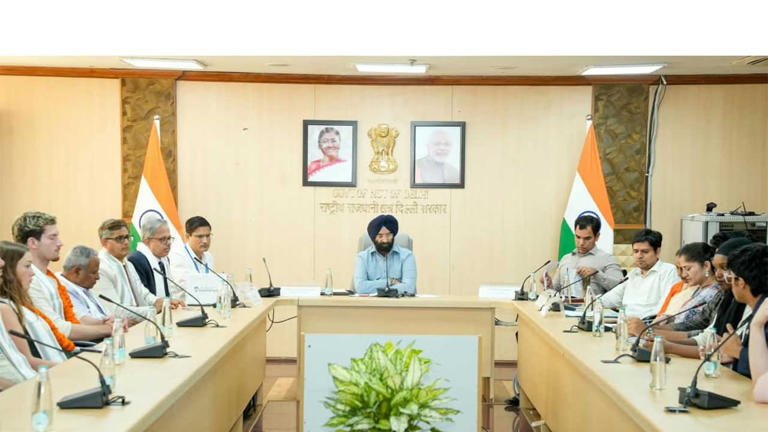
The government’s approach received fresh input from students of the University of Southampton and its Delhi branch. A multidisciplinary student delegation recently met Delhi Environment Minister Manjinder Singh Sirsa and presented a study on improving air quality across the National Capital Region.
The meeting also included Delhi Environment and Forest Secretary VK Bidhuri and academic representatives. The interaction gave the students an opportunity to discuss environmental challenges directly with policymakers.
Students Present Clean Air Study
The students presented a study titled “Promoting Clean Air in Delhi NCR.” The research examined pollution across the region and proposed measures based on international practices.
A key finding was that Delhi’s air pollution problem cannot be treated as an issue limited to the capital’s administrative boundaries. The study described pollution as an airshed-wide challenge, with emissions and their effects extending across Delhi-NCR.
As a result, the researchers recommended greater coordination between different authorities. They also called for stronger air-quality monitoring and measures targeted at specific pollution sources.
Study Calls for Regional Air-Quality Management
The Southampton study proposed a forecast-led approach to managing air pollution across the NCR. It recommended combining different sources of information to understand pollution patterns and respond more quickly.
The proposed system would bring together satellite observations, ground-level monitoring, weather forecasts and pollution source-apportionment data. Researchers suggested making such information publicly accessible as well.
This approach could help authorities identify emerging pollution episodes and coordinate responses across the wider region. The study also stressed that long-term planning should complement short-term measures.
Delhi Focuses on Clean Public Transport
The government is also focusing on sustainable mobility as part of its environmental strategy. Sirsa highlighted Delhi’s large electric bus fleet and said efforts were underway to increase the number of electric buses operating on city roads.
Clean public transport forms an important part of the government’s wider plan to reduce pollution from transportation. The Delhi government has also been pursuing electric mobility through its electric vehicle policy.
According to Chief Minister Rekha Gupta, the policy includes a phased transition towards electric vehicles in several high-use categories. The government has also outlined plans to expand charging infrastructure across the capital.
Waste Management Gets Greater Attention
Waste management was another major issue discussed during the interaction. Sirsa said Delhi generates around 13,000 metric tonnes of waste every day.
The city is also dealing with a large quantity of legacy waste accumulated over previous years. The minister said the government is working to process this waste while moving towards scientific waste management and greater resource recovery.
Moreover, the government wants to promote a circular-economy approach. Under this model, waste materials can be recovered and reused instead of being treated only as unwanted material.
Focus on Recycling and Emerging Waste
Delhi is also working to strengthen systems for handling newer categories of waste. These include electronic waste and discarded batteries.
The government wants better recycling and resource recovery systems for such materials. Proper management can reduce the environmental impact associated with unsafe disposal while allowing valuable materials to return to productive use.
At the same time, better waste systems can support wider sustainability goals. They can reduce pressure on landfills and improve the efficiency of resource use.
Industrial Pollution and the Yamuna
Industrial pollution remains another area of focus. Sirsa said the government is working to improve effluent treatment in industrial areas.
The minister stressed that untreated industrial effluent should not enter the Yamuna. Strengthening treatment systems is therefore part of the government’s broader environmental agenda.
The issue is linked to the wider challenge of protecting Delhi’s natural environment. Pollution control, waste management and river protection require sustained action rather than temporary measures.
Students Recommend Multiple Interventions
The Southampton study also proposed several specific interventions. These included emission-based transport regulations and stronger performance standards for brick kilns.
The researchers also suggested creating economic value from crop residue. They recommended formalising recycling systems that already involve informal networks and promoting cleaner cooking methods.
Most importantly, the study called for coordinated airshed management across Delhi-NCR. Such an approach recognises that pollution can move across administrative boundaries and requires cooperation between multiple agencies.
Youth and Academic Institutions Can Contribute
Sirsa welcomed the students’ work and emphasised the role of young people and academic institutions in addressing environmental challenges.
The minister said innovation, technology and collective action could help develop practical solutions for Delhi’s complex environmental problems. He also indicated that the government would remain open to constructive research and ideas from universities and young people.
The engagement reflects an effort to connect academic research with government policymaking. Such exchanges can provide authorities with additional perspectives while giving students a direct understanding of urban environmental challenges.
Delhi’s Wider Sustainability Plan
The Delhi government’s sustainability agenda extends beyond air pollution. It includes clean mobility, waste processing, recycling, industrial pollution control and protection of natural resources.
Recent initiatives also include a push for rooftop solar adoption through the Delhi PM Surya Ghar portal. The government has presented renewable energy and green infrastructure as part of its broader sustainability efforts.
Meanwhile, the clean-air study has added a regional dimension to the discussion. Its recommendations highlight the need to treat Delhi-NCR as one connected airshed.
For Delhi, the challenge now involves combining policy, technology, infrastructure and public participation. The interaction with Southampton students has provided another platform for discussing how research and innovation can support the capital’s long-term goal of becoming cleaner, greener and more sustainable.