

The functioning of the Election Commission of India has come under renewed public scrutiny amid reports of differences among its three members.
The latest debate follows an investigation by The Indian Express, which reported that Election Commissioners Sukhbir Singh Sandhu and Vivek Joshi recorded objections on at least 14 occasions over a 10-month period. The objections reportedly concerned decisions and administrative measures linked to electoral-roll revision.
Former Chief Election Commissioner S Y Quraishi has argued that the Election Commission is a collective constitutional institution. He said the institution should not be treated as another name for its chairman.
The remarks have brought attention to the legal framework governing decision-making within the poll panel.
Election Commission Has Three Members
The Election Commission derives its constitutional authority from Article 324 of the Constitution.
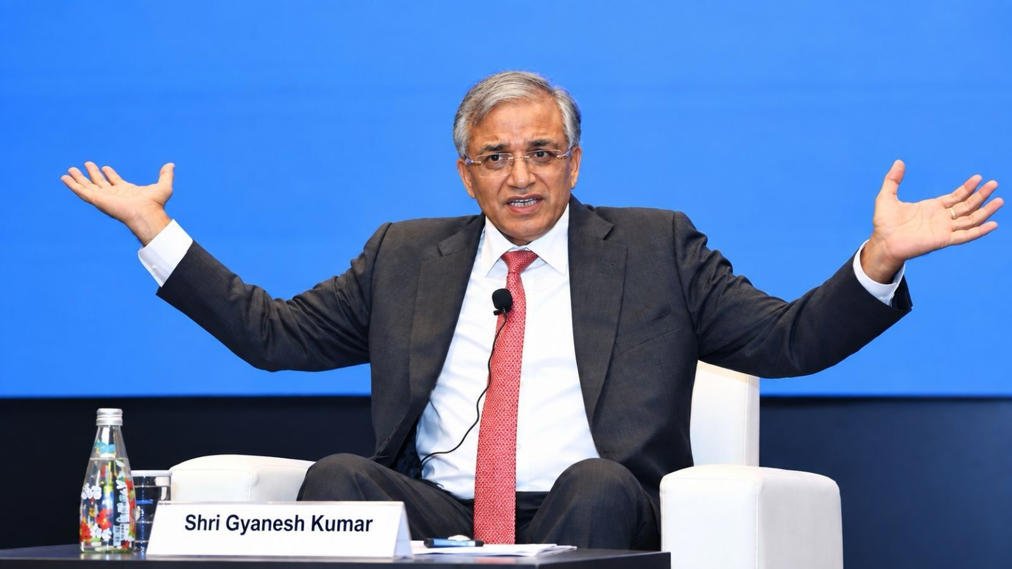
The current Commission consists of Chief Election Commissioner Gyanesh Kumar and Election Commissioners Sukhbir Singh Sandhu and Vivek Joshi. All three are members of the constitutional body.
The Constitution allows Parliament to determine the number of Election Commissioners. India has operated with both single-member and multi-member commissions at different points in its history.
The Commission has functioned as a three-member body since October 1993, following an earlier period when its composition changed.
This structure means that the Chief Election Commissioner leads the institution but does not constitute the institution alone.
Law Provides for Collective Decision-Making
The Chief Election Commissioner and other Election Commissioners Act, 2023 contains provisions governing how the Commission conducts its business.
Section 18 states that the Commission’s business should, as far as possible, be conducted unanimously. If the Chief Election Commissioner and other Election Commissioners differ, the matter is decided according to the majority view.
This framework is relevant to the current debate.
It means that disagreement among members does not automatically prevent the Commission from taking a decision. The law provides a mechanism for resolving differences.
At the same time, questions about whether particular matters were properly placed before the full Commission can become important when members raise formal objections.
Reported Objections Over Electoral-Role Decisions
The recent controversy centres partly on the Special Intensive Revision (SIR) of electoral rolls.
According to The Indian Express investigation, Sandhu and Joshi raised concerns about several matters involving voter registration, deletion of names, Form 6 and access to electoral databases.
Form 6 is used for applications seeking inclusion of names in electoral rolls.
The reported objections therefore relate to processes that directly affect voter registration and electoral-roll management.
The allegations and findings reported by the newspaper remain part of an ongoing public and political debate. They should not by themselves be treated as a judicial finding that the Election Commission acted unlawfully.
Election Commission Rejects Rift Narrative
The Election Commission has rejected suggestions that the reported objections demonstrate a breakdown within the institution.
According to reports, the Commission described such notes as part of its internal decision-making process. It also maintained that decisions taken during the relevant period, including those concerning SIR, received the approval of all three members.
The Commission’s response does not dispute the existence of the reported objection notes. Instead, it disputes the interpretation that the notes demonstrate an institutional split.
This distinction is important because internal disagreement and disagreement over final decisions are not necessarily the same thing.
Supreme Court Precedent on the Commission
The debate also refers to an earlier Supreme Court judgment.
In T N Seshan v Union of India (1995), the Supreme Court examined the relationship between the Chief Election Commissioner and other Election Commissioners.
The judgment stressed that Article 324 entrusts election-related powers to the Election Commission, rather than to an individual office-holder.
The principle has become relevant again because the present Commission operates as a three-member institution.
The legal question is therefore not simply about the authority of the CEC. It also concerns how the constitutional body exercises its collective powers.
SIR Has Intensified the Debate
The Special Intensive Revision has become one of the most closely watched electoral issues in recent months.
The exercise involves reviewing electoral rolls and verifying voter information. It has led to debates over additions, deletions, documentation requirements and the mechanisms available to voters seeking restoration of their names.
Opposition parties have raised concerns about possible exclusion of eligible voters. The Election Commission has maintained that electoral-roll revision falls within its constitutional responsibilities.
The latest institutional debate has added another layer to the wider discussion.
Questions Over Technology and Electoral Databases
The reported objections also involve the technology used to manage electoral information.
According to the Indian Express investigation, the two Election Commissioners raised concerns about access to electoral databases and the centralisation of certain functions. They also sought safeguards relating to the digital systems used for electoral rolls.
Technology now plays a major role in maintaining voter databases.
However, digital systems must operate within the legal framework governing elections. Questions about access, authorisation and responsibility therefore have both administrative and legal dimensions.
The Election Commission has continued to oversee these systems while rejecting claims that the institution has been divided.
Why Collective Functioning Matters
The controversy has renewed attention on the importance of collective functioning within constitutional bodies.
The Election Commission makes decisions that affect elections across the country. Its responsibilities include supervising electoral rolls and conducting elections to Parliament, state legislatures, and the offices of President and Vice-President.
Because of this role, the manner in which decisions are taken can attract significant public interest.
The three-member structure provides a system in which the CEC and Election Commissioners participate in institutional decision-making.
Political Reactions Grow
Several opposition leaders have responded to the reported objections.
Congress leaders have questioned the functioning of the Commission, while other opposition parties have also demanded greater transparency around the SIR process. Some leaders have called for further examination of the reported differences within the poll panel.
The BJP has taken a different position. BJP leader Sambit Patra described the reported differences as part of a functioning democratic institution and accused the opposition of running what he called a campaign against the Election Commission.
These statements reflect competing political interpretations of the same developments.
Institutional Questions Remain
The current debate raises questions about how a multi-member constitutional institution should document and communicate its decisions.
The legal framework provides for unanimity where possible and majority decision-making where members differ.
The Election Commission says its decisions have received the approval of all three members. Reports of formal objections, meanwhile, have prompted questions about how some administrative decisions were handled.
Further clarification from the Commission, Parliament or the courts could help resolve questions about specific decisions and procedures.
Focus on Constitutional Responsibility
The debate ultimately centres on the institutional character of the Election Commission.
The CEC is the head of the Commission, but the constitutional body includes the other Election Commissioners as well. Its statutory framework provides for collective decision-making and a majority mechanism when unanimity is not possible.
The recent controversy over SIR has placed that structure under renewed public attention.
As electoral-roll revision continues, scrutiny is likely to remain focused on transparency, statutory procedures and the respective roles of all three members of the Election Commission. The outcome of that discussion will depend on the evidence concerning specific decisions and the applicable constitutional and legal provisions.