

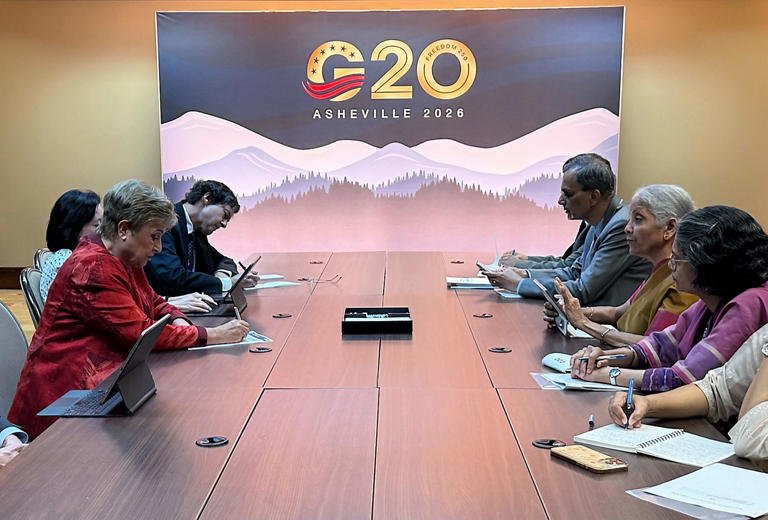
Union Finance and Corporate Affairs Minister Nirmala Sitharaman met International Monetary Fund (IMF) Managing Director Kristalina Georgieva to discuss the global economic outlook, India’s evolving growth trajectory and ways to further strengthen cooperation between India and the multilateral institution.
The meeting took place on the sidelines of the G20 Finance Ministers and Central Bank Governors (FMCBG) Meeting in Asheville, United States. The discussions focused on India’s economic performance, the structural changes taking place in the country and the importance of ensuring that macroeconomic assessments accurately reflect developments in emerging and developing economies.
Global Economic Outlook and India’s Growth Discussed
During the meeting, Sitharaman and Georgieva exchanged views on the global economic outlook at a time when countries are navigating an increasingly uncertain international economic environment.
The two leaders also discussed India’s evolving growth trajectory and the factors shaping the country’s economic transformation.
According to the Finance Ministry, the discussions covered the structural shifts underway in India and the importance of appropriately reflecting these developments in macroeconomic assessments and growth projections.
The meeting came as global policymakers continue to focus on issues including economic growth, debt pressures, trade imbalances and the need to strengthen resilience against external shocks. The broader G20 discussions in Asheville also highlighted the importance of structural reforms and sound fiscal and monetary policies in supporting stronger and more balanced global growth.
IMF Chief Appreciates India’s Economic Performance
IMF Managing Director Kristalina Georgieva appreciated India’s strong economic performance and track record during her meeting with the Finance Minister.
According to the Finance Ministry, Georgieva noted the strength and resilience built by the Indian economy over time.
Following the interaction, Georgieva described the meeting as an excellent exchange of views and referred to India’s strong growth performance, the global outlook and the shared commitment to continued cooperation.
Her remarks reflected the importance of India’s position among the world’s major economies and the country’s growing role in international economic discussions.
India’s economic performance has also increasingly drawn attention from global institutions as the country continues to pursue growth while managing the challenges posed by an uncertain global environment.
Sitharaman Highlights Strong Macroeconomic Fundamentals
During the discussions, Finance Minister Sitharaman highlighted India’s strong macroeconomic fundamentals.
She also emphasised the importance of robust and evidence-based surveillance frameworks that adequately capture structural changes taking place in Emerging Markets and Developing Economies, commonly referred to as EMDEs.
The issue is particularly relevant as developing economies undergo significant changes in areas such as infrastructure, digitalisation, productivity and institutional capacity.
Sitharaman stressed that macroeconomic assessments and growth projections should appropriately reflect these evolving structural realities.
The discussions indicate India’s interest in ensuring that global economic institutions continue to improve their analytical frameworks as emerging economies become increasingly important contributors to global growth.
Structural Changes in Emerging Economies in Focus
The meeting placed particular emphasis on the structural shifts taking place in India and other emerging markets.
Traditional macroeconomic assessments often rely on a range of historical indicators and economic models. However, economies undergoing rapid transformation can experience changes that require institutions to continuously update their analytical approaches.
India has been undertaking structural changes across multiple sectors, and the Finance Minister highlighted the importance of ensuring that these developments are adequately reflected in surveillance frameworks and growth projections.
The discussion on emerging markets also underlined a broader concern among developing economies regarding how their economic performance and future potential are assessed by international institutions.
A robust evidence-based approach, according to the discussions, can help improve the understanding of structural changes and strengthen the quality of economic policymaking.
IMF Capacity Development Initiatives Also Discussed
Sitharaman and Georgieva also discussed the IMF’s capacity development initiatives.
These initiatives include support for strengthening institutional capacity, improving macroeconomic policymaking and developing statistical systems in emerging markets and developing economies.
Strong institutions and reliable statistical systems play an important role in economic planning and policymaking. Accurate data can help governments assess economic conditions, identify emerging challenges and formulate appropriate policy responses.
The discussions highlighted the potential value of continued cooperation in strengthening analytical and institutional capabilities.
For developing economies, capacity development can complement financial and policy engagement by helping governments build stronger systems for macroeconomic management and long-term planning.
Continued India-IMF Engagement Emphasised
Both Sitharaman and Georgieva emphasised the importance of continued engagement between India and the IMF.
According to the Finance Ministry, the two sides highlighted cooperation in strengthening analytical capabilities, supporting sound macroeconomic policies and contributing to global economic resilience.
The continued India-IMF engagement is expected to remain important as the global economy faces multiple challenges, including geopolitical uncertainty, debt vulnerabilities and changing trade patterns.
The IMF has also stressed the importance of international cooperation in helping countries address debt challenges, manage cross-border spillovers and deal with global economic imbalances.
The institution has argued that structural reforms and sound fiscal and monetary policies remain essential for strengthening growth in an increasingly shock-prone global environment.
Meeting Held on Sidelines of G20 Finance Gathering
The Nirmala Sitharaman IMF meeting was held alongside the G20 Finance Ministers and Central Bank Governors Meeting in Asheville.
The G20 gathering brought together finance ministers, central bank governors and representatives of international financial institutions to discuss major global economic priorities.
The agenda included issues such as economic growth, global imbalances, sovereign debt, financial-sector matters and private sector-led innovation.
The discussions in Asheville reflected a broader recognition that stronger international cooperation remains important despite differences in national economic priorities and policy approaches.
India’s Role in the Global Economic Landscape
The meeting with the IMF chief highlighted India’s growing importance in the global economic landscape.
As one of the world’s major economies, India’s growth trajectory and policy choices have implications beyond its domestic economy.
The country’s economic transformation, expanding infrastructure, digital development and institutional reforms have increasingly become part of discussions involving global financial institutions.
Sitharaman’s emphasis on ensuring that structural changes are appropriately reflected in macroeconomic assessments also points towards India’s broader interest in contributing to discussions on how emerging economies are analysed and represented within the global financial system.
Continued engagement with institutions such as the IMF provides an opportunity for India to participate in discussions on global economic policy while sharing its experience as a large and rapidly evolving economy.
Nirmala Sitharaman IMF Meeting Signals Continued Cooperation
The Nirmala Sitharaman IMF meeting with Kristalina Georgieva underlined the continued importance of cooperation between India and the International Monetary Fund.
The discussions covered a broad range of issues, including the global economic outlook, India’s growth trajectory, structural transformations, macroeconomic surveillance and institutional capacity development.
With Georgieva acknowledging India’s strong economic performance and Sitharaman highlighting the country’s macroeconomic fundamentals, the meeting reflected a shared interest in strengthening analytical capabilities and supporting sound economic policymaking.
As global economies continue to face uncertainty and new structural challenges, continued India-IMF engagement is expected to remain important in supporting economic resilience, strengthening policy frameworks and contributing to wider discussions on the future direction of the global economy.