

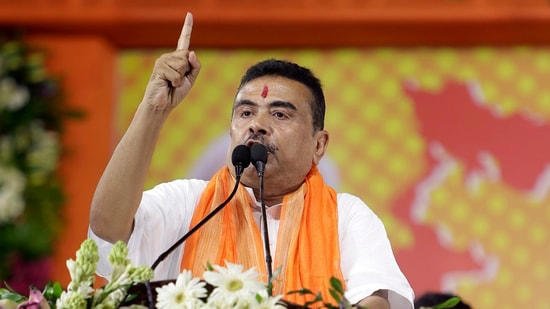
West Bengal Chief Minister Suvendu Adhikari on Tuesday announced a series of welfare and regulatory initiatives, including subsidised fish-rice meals for ₹5, restrictions on liquor shops near educational and religious institutions, and expansion of social welfare programmes across the state. The announcements came during an administrative meeting in Kalyani and formed part of the government’s broader push towards public welfare, social regulation, and grassroots development.
The Chief Minister said the new measures aim to support economically weaker sections, improve public welfare delivery, and strengthen social safeguards in urban and rural areas. According to officials, the government plans to implement these initiatives in phases while coordinating with district administrations and relevant departments.
The announcements have already generated political discussion in the state because they combine welfare expansion with regulatory decisions affecting public spaces and local administration.
Government to Launch ₹5 Fish-Rice Meal Programme
One of the major announcements involved the introduction of subsidised fish-rice meals priced at ₹5 through dedicated canteens across the state. Chief Minister Suvendu Adhikari stated that the initiative aims to provide affordable meals to economically weaker sections, workers, and daily wage earners.
According to reports, the meals will be served at around 400 canteens twice every week as part of the programme’s initial rollout. Officials stated that the scheme seeks to improve food accessibility while also reflecting Bengal’s cultural preference for fish-based meals.
The administration believes affordable food programmes can support vulnerable groups during periods of rising living costs and economic pressure. Authorities also indicated that the initiative may expand further depending on implementation and public response.
The move has drawn attention because it combines welfare delivery with region-specific food preferences, making it distinct from similar subsidised meal schemes in other states.
Liquor Shops to Face New Restrictions Near Schools and Temples
The Chief Minister also announced stricter rules governing the location of liquor shops in the state. According to him, liquor outlets will not be allowed within a one-kilometre radius of schools, colleges, and religious institutions.
Officials stated that the decision aims to address social concerns and create safer environments around educational and religious spaces. The government believes such restrictions can improve public surroundings and reduce complaints related to liquor outlets operating near sensitive institutions.
Authorities indicated that district administrations and regulatory departments will oversee implementation of the new norms. Existing establishments may also come under review depending on location and compliance requirements.
The announcement forms part of the government’s broader attempt to strengthen social regulation while balancing public welfare and administrative oversight.
Annapurna Yojana and Welfare Expansion Also Announced
Alongside the food initiative, the Chief Minister announced that forms for the Annapurna Yojana would begin distribution from May 27. Under the scheme, eligible women are expected to receive monthly financial assistance of ₹3,000.
Officials stated that the programme aims to strengthen financial support for women and improve household-level economic security. The administration described women-led welfare initiatives as an important component of the state’s social development strategy.
According to the Chief Minister, the government intends to expand welfare outreach and improve accessibility to support systems through streamlined implementation.
The announcement has added to the government’s recent series of welfare-oriented decisions following the formation of the new administration in the state.
Government Announces Separate AYUSH Department
Chief Minister Suvendu Adhikari also announced that the state government would create a separate AYUSH department by delinking it from the health department.
Officials stated that the move aims to strengthen focus on traditional systems of medicine and improve administrative management related to AYUSH services.
The government believes that a dedicated department can improve policy attention and support expansion of healthcare alternatives involving Ayurveda, Yoga, Unani, Siddha, and Homeopathy.
Authorities also indicated that institutional restructuring may help improve coordination and service delivery in the sector.
The decision reflects growing policy attention towards traditional healthcare systems across multiple states.
Welfare and Administrative Reforms Become Key Focus
Since assuming office earlier this month, Chief Minister Suvendu Adhikari has announced several administrative and welfare measures covering immigration management, recruitment reforms, and governance-related issues.
Political observers believe the latest announcements reflect the government’s attempt to combine welfare programmes with regulatory measures aimed at visible administrative impact.
Officials stated that affordable food access, women’s welfare, healthcare restructuring, and social regulation remain central to the government’s policy direction.
The administration also emphasised that district-level implementation and coordination will play an important role in ensuring the effectiveness of the newly announced schemes.
New Initiatives Expected to Shape Government’s Welfare Agenda
The ₹5 fish-rice meal scheme and restrictions on liquor shops have emerged as two of the most discussed announcements made by the Bengal government in recent days.
Officials stated that the initiatives aim to improve welfare delivery, strengthen social safeguards, and support economically weaker groups while maintaining administrative discipline.
As the government begins implementation of these measures, attention will remain focused on execution, public response, and the broader impact of the initiatives on welfare and governance in West Bengal.