

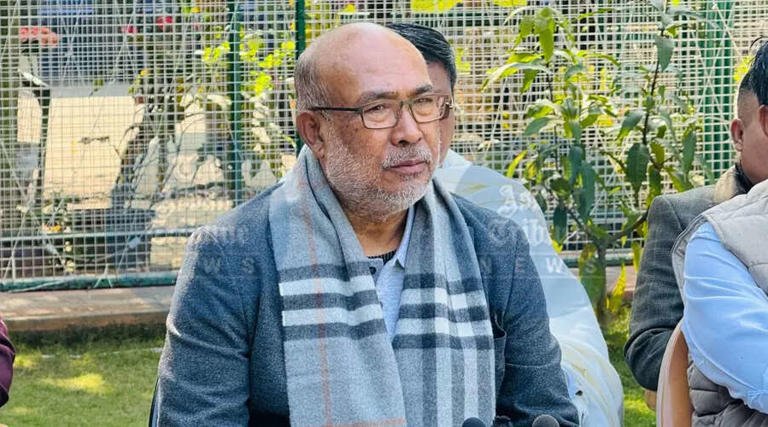
Former Chief Minister of Manipur, Okram Ibobi Singh, has expressed deep concern over the worsening situation of Manipur displaced persons who continue to suffer months after being uprooted from their homes. During a recent press interaction in Imphal, the senior leader urged the state and central governments to take swift and coordinated action to address the humanitarian crisis.
He stated that despite several promises of rehabilitation and assistance, thousands of people remain in temporary shelters with limited access to food, healthcare, and education. Calling the situation “a blot on humanity,” he said the displaced families must not be forgotten amid ongoing political and administrative discussions.
Read More: Tripura Rises as a Model of Development under CM Manik Saha
According to the former Chief Minister, displacement has caused severe psychological distress, especially among children and older residents. He added that the government’s relief measures have fallen short of ensuring long-term stability and dignity for the affected people.
A Humanitarian Crisis Demanding Urgent Action
During his address, Ibobi Singh emphasized that the Manipur displaced persons issue is no longer just a law-and-order problem but a full-scale humanitarian crisis. He explained that the internally displaced have lost not only their homes but also their livelihoods, community connections, and access to essential services.
He pointed out that overcrowded relief camps lack proper sanitation and healthcare facilities. Many families are living in makeshift shelters made from tarpaulin sheets that offer little protection against rain and cold. “It is heartbreaking to see children studying under plastic roofs and the elderly sleeping on bare ground,” he said.
The former CM appealed to both state and central authorities to prioritize rehabilitation efforts. He suggested establishing a dedicated task force that includes civil society organizations, local bodies, and government officials to streamline the relief process.
Long-Term Rehabilitation Plans Needed
Highlighting the gap between short-term relief and permanent rehabilitation, Ibobi Singh urged policymakers to create a comprehensive plan for the Manipur displaced persons. He said that temporary shelters should not become permanent settlements and that every family deserves a safe return or proper relocation.
He proposed the development of new housing colonies for the displaced population, with basic amenities like schools, healthcare centers, and livelihood support. He also recommended involving local communities in decision-making to promote reconciliation and peaceful coexistence.
The former Chief Minister noted that without sustainable rehabilitation, displaced persons would remain vulnerable to poverty and exploitation. He stressed that rebuilding lives requires more than financial aid—it needs empathy, policy consistency, and inclusive dialogue among all communities.
Education and Health Remain Major Challenges
Ibobi Singh drew attention to the plight of children who have been out of school since the conflict began. Many of them, he said, are missing months of education, which could affect their future prospects. He appealed to the education department to set up temporary schools near relief camps and ensure that teachers are regularly deployed.
Healthcare was another major concern he highlighted. Many Manipur displaced persons are reportedly suffering from malnutrition, infections, and stress-related illnesses. He said mobile medical teams should visit camps regularly to provide medical check-ups, vaccinations, and counseling.
Women in relief camps face additional hardships, including a lack of privacy and healthcare facilities. Ibobi Singh urged the government to strengthen protection measures for women and children, ensuring their safety and dignity.
Political Unity Needed for a Humanitarian Cause
The former CM called for political unity in addressing the crisis, saying that the issue of Manipur displaced persons must rise above party politics. He appealed to all legislators, regardless of political affiliation, to work together in bringing relief and peace to affected communities.
He also urged civil society organizations, church groups, and NGOs to expand their support efforts. Many volunteer groups have already been providing essential supplies, but the scale of the crisis requires coordinated action from every section of society.
“Politics can wait, but humanity cannot,” he said, calling for a collective approach that prioritizes compassion and accountability.
Government’s Role and Accountability
Ibobi Singh questioned the state government’s slow response in addressing the rehabilitation process. He stated that while funds had been announced, ground-level implementation remains poor. He suggested creating a transparent monitoring system to ensure that every rupee spent reaches the displaced families.
He also called on the Centre to release additional financial support to the state. He said that rehabilitation in a conflict-affected region like Manipur requires special attention and long-term investment. “It is not enough to announce relief packages; what matters is how they are executed,” he remarked.
The former CM also encouraged international humanitarian organizations to extend technical and financial assistance to strengthen relief operations.
A Call for Peace and Reconciliation
Beyond relief and rehabilitation, Ibobi Singh stressed the importance of reconciliation among communities. He said that the root cause of displacement lies in mistrust and tension, which must be resolved through dialogue and confidence-building efforts.
He proposed community-level peace talks facilitated by religious and social leaders to restore mutual trust. “We must heal the wounds of division before we can rebuild our homes,” he said.
The former Chief Minister reaffirmed his belief that Manipur’s diversity is its strength and that harmony can be restored through empathy and cooperation.
Rebuilding Hope for the Displaced
As the Manipur displaced persons continue to struggle, Ibobi Singh’s appeal serves as a reminder of the urgent need for compassion and action. His message resonated with citizens who believe that long-term peace in Manipur depends on how the state treats its most vulnerable people.
He concluded by saying that rebuilding homes is important, but rebuilding lives is even more critical. With the combined effort of the government, civil society, and the people of Manipur, he believes hope can return to those who have lost everything.
Read More: PM Modi to Flag Off Four New Vande Bharat Trains from Varanasi Today