

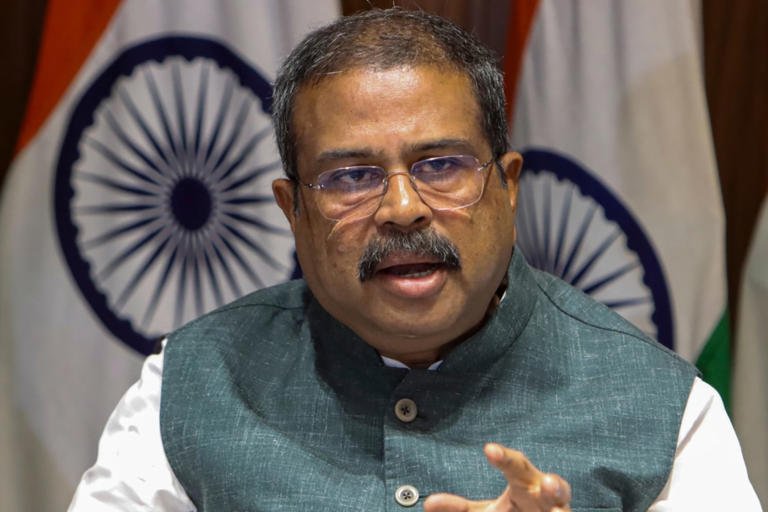
Dharmendra Pradhan has been one of the Bharatiya Janata Party’s (BJP) most prominent leaders for more than three decades, rising from student politics to hold some of the most important portfolios in the Union government. However, his long political career took a dramatic turn after nationwide protests over alleged irregularities in the NEET examination culminated in his resignation as Union Education Minister.
Pradhan, who began his political journey as an activist of the Akhil Bharatiya Vidyarthi Parishad (ABVP), played a key role in implementing the National Education Policy (NEP) 2020 and overseeing reforms in India’s education system. Yet, the controversy surrounding alleged examination paper leaks and growing student unrest placed him at the centre of one of the biggest political crises faced by the Modi government in recent years.
Here is a closer look at the political journey of the man who became one of the BJP’s most influential leaders.
Early Life and Entry Into Student Politics
Born on June 26, 1969, in Talcher, Odisha, Dharmendra Pradhan hails from a political family. His father, Debendra Pradhan, served as a Union Minister of State in the Atal Bihari Vajpayee government, giving him early exposure to public life.
Pradhan entered politics in 1983 through the Akhil Bharatiya Vidyarthi Parishad (ABVP), the student wing affiliated with the Rashtriya Swayamsevak Sangh (RSS). While studying at Talcher College, he became actively involved in student movements and was elected president of the students’ union before later serving as its secretary.
His leadership in campus politics laid the foundation for his future role within the BJP.
Rise Through the BJP Organisation
Pradhan steadily climbed the organisational ladder within the BJP after establishing himself as an energetic youth leader.
In 1995, he became National Secretary of the ABVP before taking on responsibilities within the Bharatiya Janata Yuva Morcha (BJYM), eventually serving as its National President. He later held several important organisational positions in the BJP, including National Secretary and General Secretary, while managing election campaigns and party affairs in multiple states.
His organisational skills earned him the confidence of the party leadership, making him one of the BJP’s key strategists.
Electoral Success and Parliamentary Career
Dharmendra Pradhan entered electoral politics by winning the Pallahara Assembly seat in Odisha in 2000.
He was later elected to the Lok Sabha from Deogarh in 2004 before serving two terms in the Rajya Sabha, representing Bihar and Madhya Pradesh. In 2024, he returned to the Lok Sabha after winning from Sambalpur in Odisha.
Throughout his parliamentary career, Pradhan remained one of the BJP’s prominent leaders from eastern India.
Key Roles in the Modi Government
After the BJP formed the government under Prime Minister Narendra Modi in 2014, Pradhan was inducted into the Union Cabinet.
Over the years, he handled several important ministries, including Petroleum and Natural Gas, Skill Development and Entrepreneurship, and Steel. His tenure as Petroleum Minister was marked by initiatives aimed at expanding LPG coverage, energy access, and reforms in the energy sector.
In July 2021, he assumed charge as Union Education Minister, succeeding Ramesh Pokhriyal. The appointment placed him in charge of one of the government’s most significant reform agendas.
Leading the Education Ministry
As Education Minister, Pradhan oversaw the implementation of the National Education Policy (NEP) 2020, one of the most ambitious education reforms introduced in recent decades.
His ministry focused on curriculum reforms, digital education, skill development, multilingual learning, and efforts to modernise India’s higher education system.
He also supervised the functioning of the National Testing Agency (NTA), responsible for conducting major competitive examinations, including NEET and JEE.
Supporters credit him with pushing structural reforms intended to improve accessibility and quality in education.
The NEET Protest Storm
Pradhan’s tenure came under intense scrutiny following allegations of irregularities and paper leaks in the National Eligibility-cum-Entrance Test (NEET).
The controversy triggered nationwide student protests demanding accountability, examination reforms, and Pradhan’s resignation. As demonstrations expanded across several states, public pressure on the government intensified.
The protests eventually evolved into a broader youth movement seeking greater transparency in India’s examination system, making the Education Minister the focal point of the political crisis.
Resignation Amid Growing Pressure
Following weeks of sustained protests, Dharmendra Pradhan resigned as Union Education Minister, stating that he was accepting moral responsibility for the controversy.
His resignation came after extensive discussions within the government and negotiations with protest representatives. The move was followed by the withdrawal of nationwide demonstrations after the Centre agreed to consider several key demands relating to education reforms and examination transparency.
The resignation marked one of the most significant political consequences arising from the NEET controversy.
Legacy Beyond the Controversy
Despite the circumstances surrounding his resignation, Dharmendra Pradhan remains one of the BJP’s most experienced and influential leaders.
Over four decades in public life, he built a reputation as a capable organiser, election strategist, and senior Cabinet minister. His contributions to energy policy, skill development, and education reforms continue to be recognised within the party.
Political observers believe his long administrative experience and organisational strengths are likely to keep him relevant in national politics despite the setback caused by the NEET controversy.
A Career Defined by Both Achievement and Challenge
Dharmendra Pradhan’s political journey—from an ABVP activist in Odisha to one of the country’s most powerful Union ministers—reflects decades of steady growth within the BJP. His rise through student politics, organisational leadership, Parliament, and the Union Cabinet made him a central figure in the Modi government.
However, the nationwide protests over alleged NEET irregularities also demonstrated how public accountability can reshape political careers. While his resignation marked a defining moment in India’s education debate, Pradhan’s long record in governance ensures that he will remain an important figure in the country’s political landscape in the years ahead.