

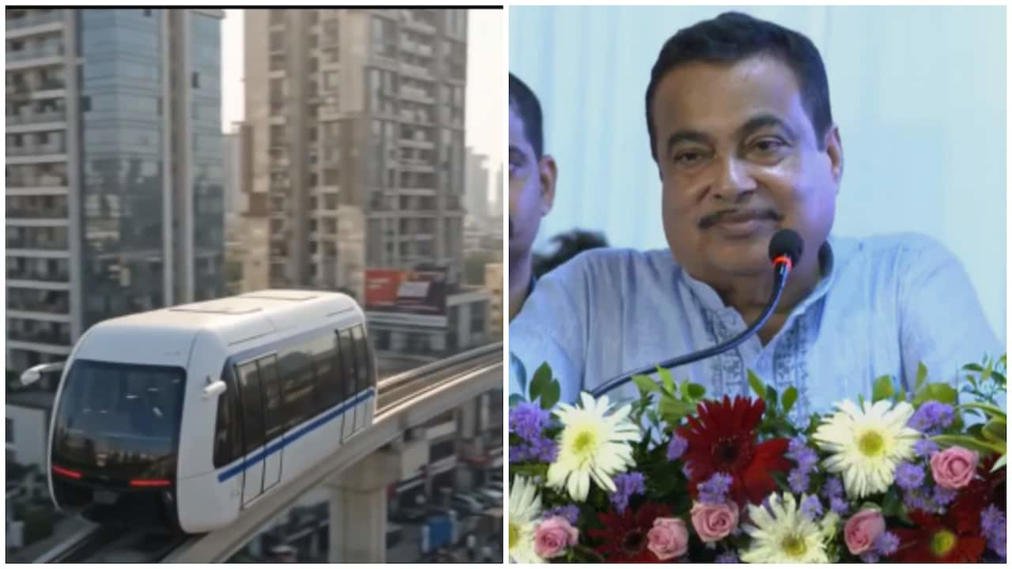
Union Road Transport and Highways Minister Nitin Gadkari has revived his long-standing vision of introducing a Skybus transport system in India. He shared a concept video on October 1, bringing renewed attention to the proposed technology.
The video shows a pod-like vehicle moving along an elevated track above a busy road junction. Gadkari described the Skybus as more than a new transport technology, highlighting its potential role in public convenience, innovation and urban mobility.
The minister has discussed variations of the flying bus concept since 2022. However, the latest social media post did not announce a confirmed route, project cost or construction timeline.
What Is the Skybus or Flying Bus?
Despite its popular name, the Skybus is not an aircraft. It refers to an elevated public transport system in which electric vehicles or passenger pods travel on a dedicated guideway above existing roads.
Depending on the proposed technology, the system may use suspended vehicles, elevated rails or cable-based infrastructure.
The central idea is to create a separate transport corridor without occupying additional road space at ground level.
Some proposed systems use driverless electric pods that can carry passengers between stations. Others involve larger vehicles operating on elevated tracks.
Such systems are being discussed as possible alternatives for cities facing traffic congestion and limited land availability.
How Would the Flying Bus Work?
The proposed Skybus system would operate on a specially constructed elevated structure supported by pillars.
Passengers would board the vehicles at designated stations. The pods would then travel along the elevated route, keeping them separate from road traffic.
Depending on the technology selected, the system could offer automated operations and electric mobility.
Its proposed benefits include:
- Reduced dependence on existing road space.
- An additional public transport option for congested cities.
- Electric-powered passenger movement.
- Potential connectivity between important urban locations.
- Less disruption to traffic at ground level during operations.
However, construction costs, safety standards, passenger capacity and maintenance requirements would need detailed assessment before implementation.
Gadkari Has Been Pitching the Idea Since 2022
Gadkari’s interest in Skybus technology dates back several years.
In February 2022, during an election campaign in Prayagraj, he spoke about preparing a detailed project report to examine Skybus connectivity between Delhi and Prayagraj.
In September 2022, he discussed the possibility of introducing Skybus or trolley-bus technology in Bengaluru. He referred to international examples while discussing ways to address the city’s traffic congestion.
A month later, he proposed a cable-operated Skybus system for Amritsar. The proposal focused particularly on congested areas around the Golden Temple, where road expansion can be difficult.
These announcements placed elevated transport systems among the alternatives being discussed for Indian cities.
Delhi-Manesar Corridor Among the Proposed Routes
One of the corridors associated with the flying bus concept is the stretch between Dhaula Kuan in Delhi and Manesar in Haryana.
The proposal has an earlier history. In 2015, the Haryana government approved a feasibility study for a Personal Rapid Transit system connecting Dhaula Kuan with IMT Manesar.
The project, then associated with the Metrino concept, involved small automated electric pods operating on elevated guideways.
In 2016, the project was discussed as an approximately 70-km corridor with an estimated cost of Rs 4,000 crore.
However, the proposal faced delays and did not enter commercial operation on the timeline discussed at the time.
Gadkari returned to the corridor in later statements, describing plans for an aerial pod system. Similar studies have also been discussed for Bengaluru and Pune.
Skybus Mentioned Again in 2026
The flying bus concept returned to public discussion in July 2026, when Gadkari spoke about it during the inauguration of the Kanpur-Lucknow Expressway.
He referred to new transport technologies as possible ways to address urban congestion and reduce dependence on conventional fossil-fuel-based transport.
His October 1 video has now brought the concept back into focus.
Nevertheless, the latest announcement does not establish that a particular Skybus project has received final approval or entered construction.
India’s Earlier Skybus Experiment in Goa
India has previously experimented with a different Skybus technology.
Konkan Railway developed an indigenous Skybus Metro system in the early 2000s. The technology featured coaches suspended beneath an elevated track.
A test track measuring approximately 1.6 kilometres was constructed in Madgaon, Goa. Public trials began in 2004.
However, a fatal accident during a trial run in September 2004 led to further safety scrutiny. Although trials resumed after modifications, the system never entered commercial service.
Konkan Railway eventually decided to dismantle the test infrastructure in 2013 after efforts to take the technology forward failed to produce a commercial project.
The technology shown in Gadkari’s latest video has not been identified as a direct revival of that earlier system.
What Happens Next?
The Skybus concept remains part of discussions around future urban mobility in India. Its implementation would require feasibility studies, engineering assessments, safety approvals, funding arrangements and coordination between government agencies.
For now, Gadkari’s latest video has renewed attention on elevated passenger transport, but it has not confirmed a launch date or an approved construction plan.
If introduced, the technology would represent another approach to moving people through congested urban areas while using space above existing roads.