

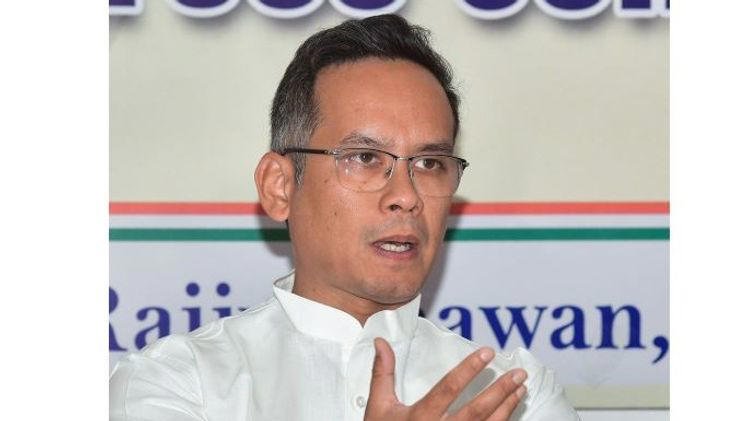
Congress leader and Lok Sabha MP Gaurav Gogoi has accused the Bharatiya Janata Party (BJP) of weakening democratic institutions and exerting influence over sections of the media in Assam. The allegations were made during a political address where Gogoi criticized the functioning of the state government and raised concerns about the condition of democratic processes in the state.
The Congress leader claimed that democratic values are facing increasing challenges and alleged that political opposition voices are not receiving adequate space in public discourse. His remarks have triggered fresh political debate in Assam, with leaders from both the Congress and BJP exchanging sharp reactions over the claims.
The allegations come amid an intensifying political atmosphere in the state as parties prepare for future electoral contests and seek to strengthen their respective support bases.
Gaurav Gogoi Raises Concerns Over Democracy
During his address, Gaurav Gogoi alleged that democratic institutions are being weakened under BJP rule. He argued that healthy democracies depend on strong institutions, independent oversight mechanisms, and the ability of citizens to freely express their opinions.
According to Gogoi, political opposition parties must be given sufficient opportunities to raise public issues and hold governments accountable. He claimed that democratic systems function effectively only when diverse viewpoints are allowed to participate in public debate.
The Congress leader expressed concern that institutions responsible for ensuring accountability should remain independent and free from political influence. He stated that preserving democratic values is essential for maintaining public trust in governance.
Gogoi’s remarks were directed at what he described as a broader challenge to democratic norms and political transparency.
Allegations Regarding Media Freedom
A major focus of Gogoi’s criticism was the role of the media in Assam. He alleged that sections of the media are facing increasing pressure and are not able to operate with complete independence.
According to the Congress leader, a vibrant democracy requires a free and independent media capable of reporting on public issues without fear or external influence. He argued that journalists and media organizations play an important role in informing citizens and facilitating public debate.
Gogoi claimed that media institutions should have the freedom to question governments and present multiple perspectives on political and social issues. He suggested that limitations on media independence can weaken democratic accountability and reduce public access to diverse viewpoints.
His comments have added to ongoing national and regional discussions regarding media freedom and the role of journalism in democratic societies.
BJP Yet to Accept Allegations
The BJP has consistently rejected accusations that it undermines democratic institutions or interferes with media functioning. Party leaders have repeatedly argued that democratic processes remain strong and that media organizations operate independently.
BJP representatives have often maintained that allegations made by opposition leaders are politically motivated and aimed at generating public attention. They have pointed to electoral participation, institutional functioning, and governance initiatives as evidence of democratic vitality.
Political observers note that disputes regarding media freedom and institutional independence have become recurring themes in political debates across India. Such issues frequently feature in exchanges between ruling parties and opposition leaders.
The latest remarks by Gogoi are expected to draw responses from BJP leaders in Assam and at the national level.
Political Atmosphere Intensifies in Assam
The exchange of allegations comes at a time when political activity in Assam is intensifying. Major political parties are actively engaging with voters and highlighting governance issues as they prepare for future electoral challenges.
The Congress has been seeking to position itself as a strong opposition force by raising concerns regarding governance, economic issues, and democratic accountability. Meanwhile, the BJP continues to emphasize its development agenda and governance achievements.
Political analysts suggest that debates surrounding democracy, media freedom, and institutional functioning are likely to remain prominent themes in the state’s political discourse.
Such discussions often resonate with voters because they relate to broader questions about governance, transparency, and public participation in democratic processes.
Importance of Democratic Institutions
Democratic institutions play a crucial role in ensuring accountability, transparency, and effective governance. These institutions include legislative bodies, independent agencies, courts, and various mechanisms designed to uphold constitutional principles.
Experts argue that strong institutions contribute to stability and public confidence by ensuring that decisions are subject to oversight and review. The functioning of democratic institutions is often viewed as an important indicator of governance quality.
Gogoi emphasized that protecting institutional independence should remain a priority regardless of political affiliation. He argued that democratic systems are strengthened when institutions operate impartially and in accordance with established legal frameworks.
The discussion reflects broader debates about the balance between political authority and institutional autonomy.
Media’s Role in Democratic Governance
The role of the media remains central to discussions about democracy and governance. Journalists and media organizations are often viewed as key participants in public discourse because they provide information, investigate issues, and facilitate debate.
Media freedom advocates argue that independent journalism helps ensure accountability by scrutinizing government actions and highlighting matters of public interest. At the same time, media organizations face challenges related to financial sustainability, technological change, and political polarization.
Gogoi’s remarks have brought renewed attention to these issues within the context of Assam’s political landscape. The debate is likely to continue as different stakeholders present their perspectives on media independence and public communication.
Observers note that discussions about media freedom are increasingly significant in modern democratic societies.
Opposition’s Role in Governance
The Congress leader also emphasized the importance of a strong opposition in democratic systems. Opposition parties play a critical role in questioning government policies, presenting alternative viewpoints, and representing diverse sections of society.
According to Gogoi, effective opposition contributes to better governance by encouraging transparency and accountability. He argued that democratic systems function most effectively when multiple voices are heard and respected.
Political scientists often describe opposition parties as essential components of representative democracy because they help ensure that governments remain responsive to public concerns.
The Congress has sought to highlight this role as part of its broader political messaging in Assam.
Looking Ahead
Gaurav Gogoi’s allegations that the BJP is weakening democracy and influencing sections of the media in Assam have added a new dimension to the state’s political debate. While the Congress leader has expressed concerns regarding democratic institutions and media freedom, BJP leaders are expected to strongly contest these claims.
The controversy reflects broader discussions about governance, accountability, and the functioning of democratic systems. As political competition intensifies in Assam, issues related to institutional independence, public discourse, and media freedom are likely to remain prominent topics of debate.
For voters and observers, the discussion underscores the importance of democratic participation and informed public engagement. The coming months are expected to witness further exchanges between political parties as they seek to shape public opinion and advance their respective visions for the state’s future.
Whether through political speeches, legislative debates, or public discussions, questions concerning democracy and media freedom are likely to continue influencing Assam’s evolving political landscape.