

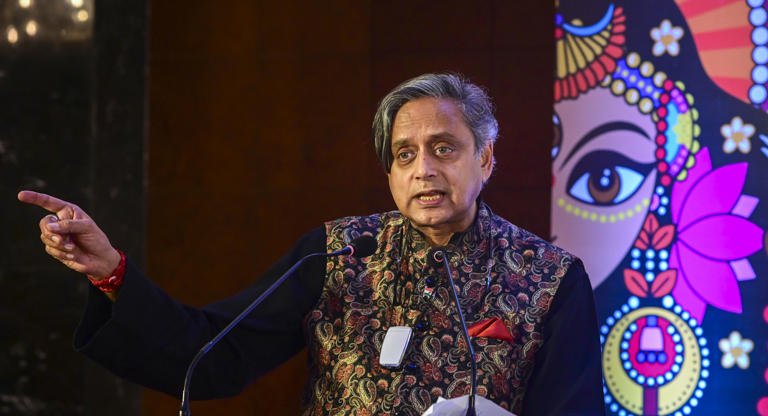
Congress MP Shashi Tharoor has urged the Union government to amend the existing legal framework so that passports and Aadhaar cards can be recognised as valid proof of Indian citizenship. Presenting his proposal, Tharoor argued that citizens should not face uncertainty regarding documentation when they already possess government-issued identity documents that are widely accepted for numerous official purposes.
The senior parliamentarian said that legislative changes could simplify administrative processes while reducing confusion surrounding the documents accepted as proof of citizenship in specific legal and administrative contexts.
His remarks have contributed to the ongoing public discussion on citizenship documentation, identity verification, and the broader legal framework governing proof of citizenship in India.
Proposal Seeks Legal Amendments
According to Tharoor, the existing legal framework should be revised to explicitly recognise passports and Aadhaar as acceptable evidence of citizenship wherever appropriate under the law.
He argued that since both documents are issued through government processes involving verification procedures, they should carry greater legal weight in matters concerning citizenship identification.
The Congress leader emphasised that any such change would require amendments to the relevant laws and regulations rather than administrative decisions alone.
He suggested that Parliament could consider updating the statutory framework to reflect evolving administrative practices and technological advancements in identity verification.
Discussion on Citizenship Documentation
The issue of citizenship documentation has remained a subject of public and legal discussion in India for several years, particularly in relation to verification procedures, government databases, and various administrative exercises.
Different government-issued documents currently serve different legal purposes depending on the applicable legislation and administrative requirements.
While passports, Aadhaar cards, voter identity cards, birth certificates, and other documents are widely used for identity verification, their legal status as proof of citizenship varies according to existing statutory provisions.
Tharoor argued that greater clarity within the legal framework would reduce uncertainty for ordinary citizens.
Passport and Aadhaar in Administrative Processes
Passports and Aadhaar cards are among the most commonly used government-issued documents in India for identification and access to public and private services.
Passports are issued under the Passport Act following prescribed verification procedures and primarily function as travel documents issued to Indian citizens.
Aadhaar, issued under the Aadhaar Act, serves as a unique digital identity linked to biometric and demographic information and is widely used for welfare delivery, banking, taxation, and various administrative purposes.
However, existing legal provisions distinguish between identity verification and proof of citizenship in specific contexts.
Tharoor’s proposal seeks legislative changes addressing this distinction.
Need for Legal Clarity
The Congress MP argued that clearer legal provisions regarding acceptable citizenship documents would reduce administrative complexity while improving convenience for citizens interacting with government agencies.
He stated that individuals possessing officially issued government documents should not face uncertainty regarding documentary requirements when establishing their legal status.
According to Tharoor, legislative reform should focus on simplifying procedures without compromising legal safeguards or administrative integrity.
He emphasised that Parliament remains the appropriate forum for debating and implementing such policy changes.
Balancing Administrative Efficiency and Legal Requirements
The proposal also raises broader questions regarding how governments balance administrative efficiency with statutory requirements governing citizenship.
Legal experts note that citizenship in India is governed primarily by the Constitution, the Citizenship Act, 1955, and related rules, while various identity documents operate under separate legal frameworks.
Changes to the evidentiary value of particular documents would therefore require careful legislative consideration to ensure consistency across different laws.
Tharoor suggested that updating the legal framework could strengthen administrative efficiency while reducing procedural complications faced by citizens.
Debate on Identity and Citizenship
The relationship between identity documents and citizenship has periodically been discussed in legal, political, and policy circles. Experts have pointed out that different documents are created for different statutory purposes and therefore carry varying legal implications.
Identity verification, residence confirmation, age verification, and citizenship determination often involve distinct legal standards depending on the applicable legislation.
Tharoor’s proposal seeks to align certain identity documents more closely with citizenship verification through legislative amendments.
Whether such changes are adopted would depend upon parliamentary debate, government policy, and future legislative decisions.
Government Yet to Respond
At present, the Union government has not announced any decision regarding the proposal put forward by Tharoor.
Any amendment affecting the legal recognition of citizenship documents would require legislative action and may involve consultation with relevant ministries, legal experts, and parliamentary committees before implementation.
Officials have not indicated whether such reforms are under consideration.
The proposal nevertheless contributes to broader discussions concerning administrative reforms, digital governance, and legal documentation systems in India.
Potential Impact on Citizens
If legislative changes of the kind suggested by Tharoor were ever enacted, they could potentially simplify documentary requirements in various administrative processes involving citizenship verification.
Supporters argue that clearer legal recognition of widely used government documents could reduce bureaucratic hurdles and improve public convenience.
However, legal experts also note that any reform would require careful drafting to ensure compatibility with existing constitutional provisions, citizenship laws, and administrative procedures.
Balancing simplicity with legal certainty would remain an important consideration in any future legislative exercise.
Proposal Adds to Ongoing Policy Discussion
Shashi Tharoor’s call for amending the legal framework to recognise passports and Aadhaar cards as valid proof of citizenship has added a new dimension to the broader debate on citizenship documentation in India. By advocating legislative reform, he has argued for greater legal clarity and administrative simplicity while emphasising Parliament’s role in addressing the issue.
The proposal has not been adopted and remains a policy suggestion requiring legislative consideration before any changes could take effect. As discussions on identity documentation, digital governance, and citizenship verification continue, the issue is likely to remain an important subject of legal and public policy debate. Any future changes in this area would ultimately depend on parliamentary deliberation, government policy decisions, and compliance with India’s constitutional and statutory framework governing citizenship.