

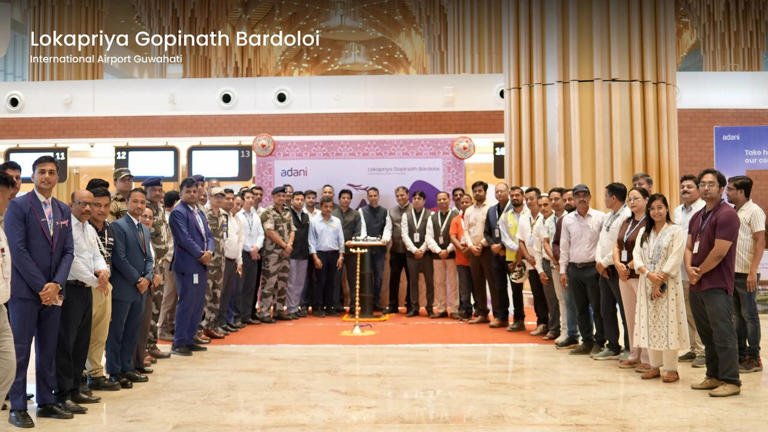
In a significant milestone for aviation infrastructure in Northeast India, Guwahati’s Lokpriya Gopinath Bordoloi International Airport has commenced international flight operations from its newly developed Terminal 2. The launch marks a major step towards strengthening Assam’s global connectivity, enhancing passenger convenience, and positioning Guwahati as a key aviation hub for the northeastern region.
The commencement of international services from Terminal 2 reflects the growing demand for air travel and the government’s continued efforts to modernise airport infrastructure across the country. Equipped with state-of-the-art facilities and improved passenger amenities, the new terminal is expected to significantly improve operational efficiency while accommodating the increasing number of international travellers.
The development is also expected to boost tourism, trade, investment, and cultural exchanges by providing faster and more seamless connectivity between Northeast India and overseas destinations.
Terminal 2 Begins International Operations
The inauguration of international operations from Terminal 2 represents an important advancement in the expansion of Guwahati Airport. The new terminal has been designed to handle international passengers with modern immigration counters, customs facilities, enhanced security systems, spacious waiting areas, and improved baggage handling infrastructure.
Passengers departing from or arriving at the airport are expected to benefit from quicker processing, smoother movement within the terminal, and upgraded passenger services. The modern infrastructure has been developed to meet international aviation standards while ensuring greater comfort and convenience for travellers.
Airport authorities stated that shifting international operations to Terminal 2 will also help optimise traffic management by enabling better separation of domestic and international passenger flows.
Strengthening Northeast India’s Global Connectivity
The launch of international operations from Terminal 2 is expected to significantly improve the global connectivity of Assam and the wider Northeast region. Guwahati serves as the principal aviation gateway to the eight northeastern states, making the airport a strategic hub for passengers travelling for business, tourism, education, healthcare, and cultural exchanges.
Improved international connectivity will make travel more convenient for residents while encouraging greater inflow of tourists, investors, and business delegations. The enhanced aviation infrastructure is also expected to facilitate stronger links with neighbouring countries in South Asia and Southeast Asia, supporting India’s Act East Policy.
Officials believe that expanding international flight services from Guwahati will contribute to the region’s economic integration with global markets.
Modern Infrastructure Enhances Passenger Experience
Terminal 2 has been developed with a strong emphasis on passenger comfort and operational efficiency. The terminal features advanced check-in systems, automated baggage handling, improved security screening, comfortable lounges, retail outlets, food and beverage facilities, digital information systems, and accessible infrastructure for elderly and differently-abled passengers.
The upgraded facilities are designed to reduce waiting times while ensuring a seamless travel experience from arrival to departure. Modern technology integrated into airport operations is expected to improve service quality, enhance safety, and increase overall operational capacity.
Airport authorities have also incorporated sustainable design features wherever possible to improve energy efficiency and support environmentally responsible airport operations.
Boost for Tourism and Hospitality
The expansion of international operations is expected to provide a major boost to Assam’s tourism industry. Improved connectivity can encourage greater numbers of international visitors to explore the state’s rich cultural heritage, wildlife sanctuaries, tea gardens, religious sites, and natural attractions.
Tourism stakeholders anticipate increased demand for hotels, transport services, restaurants, tour operators, and local handicrafts as international arrivals grow. Better accessibility also supports the promotion of festivals, cultural events, and eco-tourism initiatives that showcase the unique identity of Northeast India.
The development is expected to strengthen Guwahati’s position as a gateway for travellers visiting destinations across the northeastern states.
Facilitating Trade and Business Growth
Enhanced international aviation connectivity is also expected to benefit businesses operating in Assam and the Northeast. Improved flight services can facilitate faster movement of business travellers, investors, professionals, and high-value cargo, strengthening commercial ties with international markets.
Industries such as tea, handicrafts, agriculture, food processing, pharmaceuticals, information technology, and logistics stand to benefit from improved connectivity and easier access to overseas markets.
Business leaders have welcomed the development, noting that world-class airport infrastructure plays an important role in attracting investment and supporting regional economic growth.
Supporting the Act East Policy
The expansion of Guwahati Airport aligns with India’s Act East Policy, which seeks to strengthen economic, cultural, and strategic engagement with countries in Southeast Asia and neighbouring regions. Assam’s geographical location makes it an important gateway for enhancing international trade and connectivity.
Improved airport infrastructure supports broader efforts to develop multimodal transport networks linking road, rail, waterways, and aviation. Such integration is expected to improve regional mobility while encouraging cross-border tourism and commerce.
Officials believe that Guwahati’s growing aviation capabilities will reinforce its importance as one of the leading transportation hubs in eastern India.
Economic Opportunities for the Region
The commencement of international operations from Terminal 2 is expected to generate substantial economic benefits through increased employment, business activity, and infrastructure development. Airport expansion creates opportunities across sectors including aviation services, hospitality, retail, logistics, maintenance, and tourism.
The increased movement of passengers is likely to stimulate demand for ancillary services such as hotels, taxi operators, travel agencies, cargo handling, and airport support businesses. These developments contribute to broader economic growth while creating new livelihood opportunities for local communities.
As international connectivity expands further, Guwahati is expected to attract greater investment in commercial and industrial activities.
A New Era for Aviation in Northeast India
The launch of international operations from Terminal 2 marks a significant chapter in the evolution of Guwahati Airport and the broader aviation landscape of Northeast India. The upgraded terminal not only enhances passenger experience but also strengthens Assam’s position as a major regional gateway connecting India with international destinations.
With modern infrastructure, improved operational capacity, and growing international connectivity, Guwahati Airport is well positioned to support the region’s aspirations for greater economic growth, tourism development, and global engagement. As flight networks continue to expand, the new terminal is expected to play a pivotal role in transforming air travel and unlocking fresh opportunities for the people and businesses of Northeast India.