

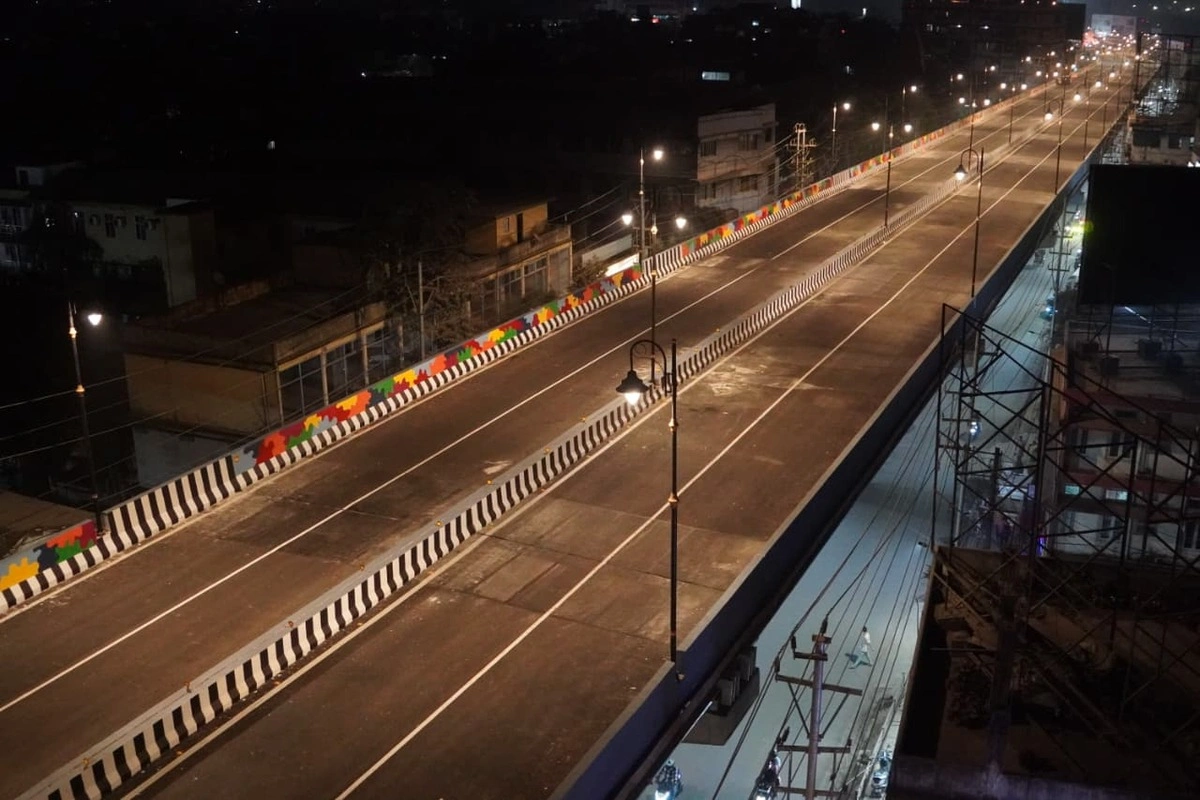
The Guwahati flyover project has reached a major milestone with the completion and opening of the Maharaj Prithu Flyover, a key elevated corridor designed to ease traffic congestion across the city. The four-lane structure connects Dighalipukhuri with Noonmati through one of Guwahati’s busiest routes.
The flyover was inaugurated by Assam Chief Minister Himanta Biswa Sarma on March 10, 2026. Although construction had originally been planned for 36 months, officials completed the project in about 28 months.
The project forms part of Assam’s broader effort to improve urban mobility in Guwahati. Moreover, its route covers several major traffic points, including GNB Road, Chandmari and areas toward Noonmati.
Sikkim Artists Win Ustad Bismillah Khan Yuva Puraskar 2024
Guwahati Flyover Project Connects Major Traffic Corridors
The Guwahati flyover project centres on the Maharaj Prithu Flyover, which provides an elevated connection between Dighalipukhuri and Noonmati. The four-lane structure measures about 4.2 kilometres, according to reports following its inauguration.
The corridor runs along GNB Road and links central Guwahati with the eastern part of the city. Consequently, vehicles using the elevated route can avoid several signal-controlled stretches on the surface road.
The project cost more than ₹852 crore. Officials said construction took around 28 months, despite an original construction schedule of 36 months. The structure includes 129 pillars and uses steel girders for its superstructure.
Furthermore, the elevated route passes through areas that regularly experience heavy traffic. These include Dighalipukhuri, Chandmari and the wider Noonmati corridor.
Before the flyover opened, these routes carried substantial volumes of local and through traffic. Therefore, the elevated connection was planned to separate longer-distance movement from vehicles using the surface roads.
The project also represents a significant addition to Guwahati’s expanding network of grade-separated roads. Other flyovers across the city serve different corridors, while the Maharaj Prithu Flyover provides a longer east-west connection.
Project Aims to Reduce Congestion in Guwahati
The Guwahati flyover project was developed primarily to improve traffic movement along a heavily used urban corridor. The Maharaj Prithu Flyover allows vehicles to travel above several busy junctions instead of negotiating every surface-level intersection.
According to reports, the structure is expected to reduce travel time and improve traffic flow between eastern and central Guwahati.
The improvement is particularly relevant for commuters travelling between Noonmati and central areas. Additionally, the elevated route can reduce pressure on portions of GNB Road and nearby surface streets.
However, a flyover cannot eliminate congestion across an entire city by itself. Traffic volumes continue to increase as Guwahati expands, while bottlenecks can shift to junctions at the beginning or end of an elevated corridor.
That makes traffic management equally important. In July 2026, the Kamrup (Metro) district administration ordered periodic inspections of newly built flyovers, including the Maharaj Prithu Flyover. Officials wanted to monitor road conditions during the monsoon and address potential safety risks.
Meanwhile, the administration has also reviewed broader road safety measures across Guwahati. These include traffic management, enforcement against dangerous driving and coordination among departments.
Therefore, the long-term impact of the flyover will depend not only on the structure itself but also on how authorities manage connected roads and intersections.
Construction Completed Ahead of Original Schedule
The Guwahati flyover project achieved an important construction milestone by finishing significantly earlier than its original timeline. Reports before the inauguration said the project had been completed nearly a year ahead of schedule.
Construction began after the Assam government approved the project in June 2023. The foundation stone was laid in November that year. Officials initially planned a 36-month construction period.
Instead, construction concluded in approximately 28 months. The accelerated schedule allowed the government to open the corridor to the public in March 2026.
The construction process presented major logistical challenges because the route passes through densely populated parts of Guwahati. Work had to take place while normal traffic continued on surrounding roads.
Reports noted that much of the construction activity took place during night hours to minimise disruption to daytime traffic. The project therefore required coordination between construction teams, traffic authorities and other agencies.
Moreover, the elevated structure had to accommodate existing roads and urban infrastructure along its route. The use of steel girders and elevated construction helped the project maintain traffic movement beneath and around the work zones.
The early completion consequently allowed commuters to begin using the new corridor before the original construction deadline.
New Flyover Faces Ongoing Road Safety Monitoring
The Guwahati flyover project has also entered a different phase since its inauguration. Instead of construction monitoring, authorities now have to focus on maintenance, traffic regulation and commuter safety.
The Kamrup (Metro) administration ordered regular inspections of the Maharaj Prithu Flyover during the monsoon. The directive followed a meeting of the District Road Safety Committee in July.
Officials were asked to maintain close watch over the structure and respond quickly to rain-related problems. The administration also directed departments to address open manholes and other hazards across the city.
Road safety has become an important consideration because elevated corridors can experience different driving conditions from surface roads. Rainfall, visibility and road surface conditions can affect vehicle movement, particularly during the monsoon.
Additionally, authorities have to manage traffic at entry and exit points. A flyover can move vehicles more quickly across its elevated section, but congestion may still develop where traffic merges back onto surface roads.
Consequently, regular inspections and coordinated traffic management remain necessary even after construction ends.
The administration’s monitoring measures indicate that the project is now part of Guwahati’s operational road network rather than simply an ongoing construction project.
Guwahati’s Wider Infrastructure Network Expands
The Guwahati flyover project is one element of a much larger infrastructure programme aimed at improving connectivity in and around Assam’s largest city.
The city has seen several major road and bridge projects in recent years. In March 2026, the Prime Minister inaugurated an elevated corridor connecting Pandu Port with National Highway 27. The project was designed to strengthen the connection between the river port and the highway network.
Meanwhile, the proposed Guwahati–Tezpur Corridor is expected to create another major connectivity link. The Union Cabinet approved a 135.87-kilometre four-lane, access-controlled corridor on NH-15 in August 2026. The project includes 19 flyovers, 15 major bridges, 30 minor bridges and several underpasses.
The corridor will also include bypasses around Baihata Chariali, Sipajhar, Kharupetia, Dhekiajuli and Tezpur. Those components are intended to divert through traffic away from densely populated areas.
Within Guwahati itself, the Maharaj Prithu Flyover provides an urban solution to a different problem. Rather than bypassing entire towns, it separates traffic flows along a busy city corridor.
Furthermore, Assam’s road authorities continue to maintain a broader programme of national highways, state roads and urban infrastructure. The Public Works Department lists ongoing works and road-safety initiatives among its responsibilities.
Therefore, the flyover’s impact should be viewed as part of a wider network rather than as a standalone solution to Guwahati’s traffic challenges.
Traffic Benefits Depend on Connected Roads
The Guwahati flyover project has created a faster elevated connection, but its overall traffic benefits will depend on how surrounding roads function.
A major elevated road can reduce delays on the corridor it serves. However, traffic can accumulate at intersections where vehicles enter or leave the structure. Effective signal management and road design therefore remain important.
The city already uses traffic-management technology to monitor major junctions. The Integrated Traffic Management System was designed to improve traffic control, surveillance and signal management across Guwahati.
Such systems can complement physical infrastructure by helping authorities monitor traffic conditions and respond to congestion.
Similarly, regular road maintenance can protect the benefits created by large infrastructure projects. The district administration’s decision to inspect newly constructed flyovers during the monsoon reflects this requirement.
The Maharaj Prithu Flyover has already become a significant part of the city’s road network. Its continued effectiveness will depend on maintenance, safe driving practices and coordination across connected roads.
For commuters, the key benefit remains the availability of an elevated route between central and eastern Guwahati. For authorities, the next challenge is ensuring that traffic improvements continue beyond the flyover itself.
Conclusion
The Guwahati flyover project has moved from construction to operation with the opening of the Maharaj Prithu Flyover. The 4.2-kilometre, four-lane structure connects Dighalipukhuri and Noonmati and was built at a cost of more than ₹852 crore.
The project reached completion in about 28 months against an original 36-month schedule. Its main objective is to improve traffic flow along one of Guwahati’s busiest corridors and reduce pressure on surface roads.
Meanwhile, authorities have shifted attention toward maintenance and road safety. Periodic inspections, effective traffic management and proper maintenance will remain important to ensure that the infrastructure delivers sustained benefits.
FAQs
What is the Guwahati flyover project?
The Guwahati flyover project refers here to the Maharaj Prithu Flyover, an elevated four-lane corridor connecting Dighalipukhuri and Noonmati in Guwahati.
How long is the Maharaj Prithu Flyover?
The flyover is about 4.2 kilometres long and has four lanes. It runs along the GNB Road corridor.
How much did the flyover cost?
The project was constructed at a cost of more than ₹852 crore. Reports put the project cost at approximately ₹852.68 crore.
When was the flyover inaugurated?
Assam Chief Minister Himanta Biswa Sarma inaugurated and dedicated the Maharaj Prithu Flyover to the public on March 10, 2026.
Is the flyover still under construction?
No. The Maharaj Prithu Flyover was completed and opened in March 2026. Authorities have since focused on maintenance, inspections and road safety.
[…] Guwahati Flyover Project Reaches Major Milestone in Traffic Decongestion […]
[…] Guwahati Flyover Project Reaches Major Milestone in Traffic Decongestion […]
[…] Guwahati Flyover Project Reaches Major Milestone in Traffic Decongestion […]
[…] Guwahati Flyover Project Reaches Major Milestone in Traffic Decongestion […]