

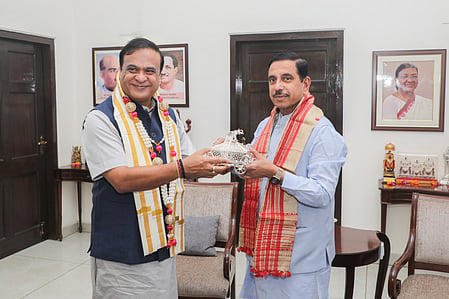
Assam Chief Minister Himanta Biswa Sarma held discussions with Union Minister Pralhad Joshi on expanding access to higher education and strengthening renewable energy initiatives in the state. The meeting focused on key areas of development, including the implementation of schemes aimed at improving educational infrastructure and supporting the transition towards cleaner sources of energy.
The discussions reflect Assam’s efforts to strengthen its higher education ecosystem while also exploring opportunities to expand renewable energy capacity. Both sectors are increasingly important for the state’s long-term development, with improved access to quality education expected to support human resource development and renewable energy initiatives contributing to India’s wider clean energy goals.
Sarma’s meeting with Joshi brought together two important areas of policy that can influence Assam’s future growth. While higher education remains essential for creating opportunities for young people, the development of renewable energy infrastructure can support energy security, sustainability and economic expansion.
The state government is expected to continue working with the Centre to ensure effective implementation of central schemes and programmes related to these sectors.
Focus on Expanding Access to Higher Education
One of the key issues discussed during the meeting was improving access to higher education in Assam.
For students, particularly those living in remote and underserved regions, access to quality colleges and universities can be affected by distance, infrastructure and the availability of courses. Strengthening the higher education network can help address these challenges and provide young people with greater opportunities to pursue advanced studies.
The discussions reportedly focused on initiatives aimed at supporting educational institutions and improving access to higher learning.
Central government schemes can play an important role by providing financial and institutional support for the development of universities and colleges.
Better infrastructure, modern classrooms, research facilities and digital resources can improve the overall quality of education and create a stronger academic environment.
For Assam, expanding higher education opportunities is also important because of the state’s geographical diversity and the needs of students living in rural and remote areas.
Strengthening Educational Infrastructure
The development of educational infrastructure is essential for improving the quality and reach of higher learning.
Colleges and universities require adequate classrooms, laboratories, libraries, hostels and digital facilities to meet the changing needs of students.
The increasing importance of technology has also transformed the way higher education is delivered. Digital learning platforms and online resources can help students access educational materials beyond traditional classrooms.
However, the success of digital education depends on reliable internet connectivity and access to devices.
Government support can help educational institutions strengthen their infrastructure and introduce new teaching methods.
The meeting between Sarma and Joshi highlighted the importance of coordination between the state and central governments in ensuring that development schemes reach institutions effectively.
PM-USHA and Higher Learning Opportunities
The Pradhan Mantri Uchchatar Shiksha Abhiyan, or PM-USHA, is aimed at supporting the development and improvement of higher education institutions.
Through such initiatives, states can receive support for strengthening educational infrastructure and improving institutional capacity.
The discussions on higher learning access could help Assam identify areas where additional support is needed.
The focus is likely to remain on improving the reach and quality of higher education while ensuring that students from different backgrounds have access to opportunities.
Investment in universities and colleges can also contribute to research and innovation.
A stronger higher education ecosystem can prepare students for employment while supporting entrepreneurship, scientific research and other areas of development.
Renewable Energy Schemes Also Discussed
Apart from higher education, Sarma and Joshi also discussed renewable energy-related schemes and initiatives.
The expansion of renewable energy has become an important national priority as India seeks to increase the share of cleaner energy sources in its overall energy mix.
For Assam, renewable energy development can create opportunities to diversify energy sources and reduce dependence on conventional fuels.
Solar energy, in particular, has the potential to support households, businesses and public institutions.
Government schemes can encourage the installation of renewable energy systems and make clean energy technologies more accessible.
The discussions with the Union Minister are expected to support greater coordination in implementing such programmes across the state.
Potential of Renewable Energy in Assam
Assam has opportunities to expand its renewable energy capacity, particularly through solar power and other sustainable sources.
The development of renewable energy infrastructure can support electricity access and reduce pressure on conventional energy systems.
Solar power can be deployed through large projects as well as decentralised systems such as rooftop installations.
Such systems can allow households, businesses and institutions to generate a part of their own electricity requirements.
Renewable energy projects can also create employment opportunities during installation, maintenance and related activities.
However, the expansion of clean energy requires investment, suitable infrastructure and effective policy implementation.
Central schemes can provide important support in overcoming some of these challenges.
Centre-State Coordination Key to Implementation
The meeting underlined the importance of coordination between the Assam government and the Centre.
Major education and energy programmes often require cooperation at multiple levels to ensure that funds, infrastructure and other resources are effectively utilised.
State governments play an important role in identifying local needs and implementing projects on the ground, while central ministries can provide policy guidance and financial support under national schemes.
Regular discussions between state and Union ministers can help identify implementation challenges and explore opportunities for expanding successful programmes.
For Assam, stronger coordination could help accelerate the development of both higher education and renewable energy infrastructure.
Benefits for Students and Young People
Improving access to higher education can have long-term benefits for Assam’s young population.
Students with access to quality colleges and universities are better positioned to develop skills and pursue careers in different sectors.
The expansion of educational opportunities can also reduce the need for students to move outside the state solely because of limited access to specialised courses.
At the same time, a growing renewable energy sector could create new employment opportunities.
As India expands its clean energy capacity, demand is expected to grow for professionals with technical skills in areas such as solar technology, energy management and sustainable infrastructure.
The development of education and renewable energy can therefore complement each other by preparing young people for emerging economic opportunities.
Supporting Sustainable Development
The discussions on renewable energy are also connected to the broader goal of sustainable development.
Clean energy can help reduce the environmental impact associated with conventional energy generation.
As electricity demand continues to grow, expanding renewable sources can support long-term energy security.
For Assam, the transition towards cleaner energy can form part of a broader strategy that balances economic development with environmental considerations.
The implementation of renewable energy schemes will depend on factors such as funding, public participation, land availability and technical capacity.
Effective planning will therefore be important to ensure that projects deliver long-term benefits.
A Step Towards Assam’s Long-Term Development Goals
Chief Minister Himanta Biswa Sarma’s meeting with Union Minister Pralhad Joshi highlighted Assam’s focus on two important areas of development: higher education and renewable energy.
Expanding access to quality education can create new opportunities for students and strengthen the state’s human resource base. At the same time, renewable energy initiatives can support cleaner growth and help meet future energy requirements.
The discussions also underline the role of central government schemes in supporting state-level development.
The success of these initiatives will depend on effective implementation and coordination between government departments and institutions.
Focus on Education and Clean Energy for Future Growth
The meeting between Himanta Biswa Sarma and Pralhad Joshi represents another step in Assam’s efforts to strengthen its education and sustainable development sectors.
By focusing on greater access to higher learning and the implementation of renewable energy schemes, the state is seeking to address both immediate development needs and long-term challenges.
Improved educational infrastructure can help students access better opportunities, while renewable energy programmes can support cleaner and more sustainable economic growth.
As Assam continues to work with the Centre on these initiatives, the focus will remain on translating policy discussions into practical projects that can benefit students, communities and the wider economy across the state.