

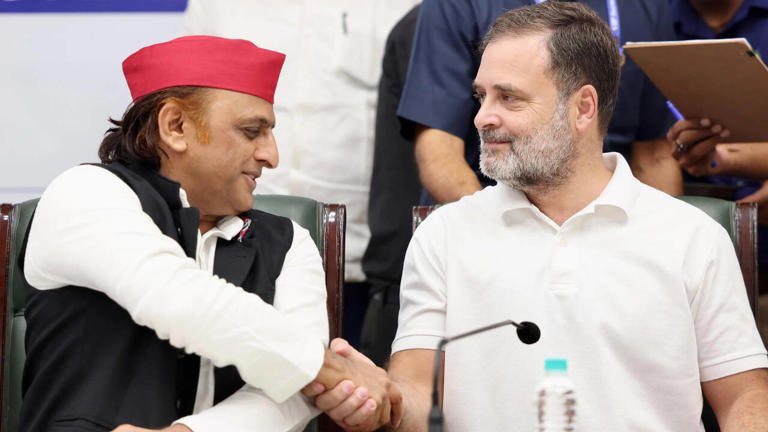
Signs of friction have emerged within the opposition INDIA bloc in Uttar Pradesh after a Samajwadi Party (SP) Member of Parliament strongly responded to the Congress’ demand for an equal share of seats in the state for future elections. The remarks have once again brought the spotlight on the challenges of maintaining opposition unity, particularly in states where regional parties command a significantly larger electoral presence than their national allies.
The disagreement centres on the Congress’ reported demand for a more balanced seat-sharing arrangement in Uttar Pradesh, a proposal that has drawn criticism from sections of the Samajwadi Party. The SP leader argued that electoral alliances should be based on the ground strength and performance of individual parties rather than on equal numerical distribution of constituencies.
The exchange has fuelled speculation over the future dynamics of the opposition alliance in India’s politically crucial state.
SP leader rejects demand for equal seat distribution
Responding to the Congress’ position, the Samajwadi Party MP asserted that seat-sharing negotiations must reflect political realities and electoral performance rather than symbolic parity between alliance partners.
The leader maintained that the Samajwadi Party remains the principal opposition force in Uttar Pradesh and therefore deserves a proportionately larger share of seats in any electoral understanding.
According to the SP MP, alliances are formed with the objective of maximising electoral success, and decisions regarding constituency allocation should be guided by organisational strength, grassroots presence, and past electoral outcomes.
The remarks underline the party’s position that practical political considerations should take precedence during alliance negotiations.
Congress pushes for greater role in Uttar Pradesh
The Congress has been seeking a stronger presence in Uttar Pradesh as it attempts to revive its organisation in the politically significant state.
Party leaders have indicated that equitable participation in alliance arrangements is important for strengthening the Congress’ long-term electoral prospects while ensuring effective cooperation among opposition parties.
The reported demand for a larger share of seats reflects the Congress’ efforts to expand its political footprint and rebuild its support base in Uttar Pradesh ahead of future elections.
However, the proposal has generated differing views among alliance partners, particularly the Samajwadi Party, which remains one of the state’s dominant regional political forces.
Uttar Pradesh remains crucial to national politics
Uttar Pradesh continues to occupy a central position in Indian politics due to its large parliamentary representation and significant influence on national electoral outcomes.
Political parties have traditionally attached considerable importance to alliance strategies in the state, recognising that seat-sharing arrangements can substantially affect electoral performance.
The INDIA bloc has consistently emphasised opposition unity as an important strategy to challenge the ruling National Democratic Alliance (NDA). However, balancing the interests of national and regional parties remains one of the alliance’s key organisational challenges.
Political observers note that negotiations in Uttar Pradesh are likely to play a significant role in shaping the broader strategy of the opposition alliance.
Alliance arithmetic versus ground realities
The latest exchange highlights the recurring debate between alliance arithmetic and political realities on the ground.
Regional parties such as the Samajwadi Party argue that constituency allocation should primarily reflect electoral strength, organisational networks, and voter support in individual states.
On the other hand, national parties often seek broader representation within alliances to strengthen their organisational presence and maintain political relevance across different regions.
Analysts believe achieving a mutually acceptable balance between these competing considerations remains one of the most complex aspects of opposition coalition politics.
SP emphasises performance-based negotiations
The Samajwadi Party leader reiterated that future seat-sharing discussions should be based on objective political assessments rather than predetermined formulas.
He argued that electoral data, organisational reach, and previous election results provide the most appropriate basis for deciding constituency allocation among alliance partners.
According to the SP MP, every party should contest in areas where it possesses the strongest organisational network and the highest probability of electoral success.
The leader suggested that such an approach would strengthen the overall prospects of the alliance rather than weaken it.
Congress seeks stronger organisational revival
For the Congress, expanding its electoral participation in Uttar Pradesh forms part of a broader strategy aimed at organisational revival.
The party has been working to strengthen its grassroots presence through membership drives, outreach programmes, and organisational restructuring.
Political observers note that contesting a greater number of seats may help the Congress rebuild its cadre base and increase visibility, even if immediate electoral gains remain limited.
The differing perspectives between the Congress and the Samajwadi Party therefore reflect both electoral calculations and longer-term political objectives.
INDIA bloc faces coordination challenges
The latest disagreement underscores the challenges facing the INDIA bloc as it attempts to maintain cohesion among parties with varying regional strengths and political ambitions.
While alliance leaders have repeatedly emphasised unity against the ruling alliance, negotiations over seat-sharing continue to require careful balancing of competing interests.
Regional parties often seek to preserve their dominant position within their respective states, whereas national parties aim to maintain visibility and political relevance across multiple regions.
Managing these expectations remains critical for sustaining cooperation within the alliance framework.
Political dialogue expected to continue
Despite the exchange of remarks, political observers believe discussions between alliance partners are likely to continue before any final decisions on seat-sharing are taken.
Alliance negotiations traditionally involve multiple rounds of consultations, during which parties attempt to reconcile differences while focusing on broader electoral objectives.
Leaders from various constituent parties have consistently maintained that dialogue remains the preferred mechanism for resolving disagreements and strengthening opposition coordination.
Future discussions are expected to focus on evolving a consensus acceptable to all stakeholders.
Seat-sharing debate highlights evolving opposition dynamics
The latest remarks by the Samajwadi Party MP have once again brought attention to the complexities of alliance politics in Uttar Pradesh. As the Congress seeks a greater electoral role and the Samajwadi Party insists that seat allocation should reflect political strength on the ground, the debate highlights the delicate balance required to maintain unity within the INDIA bloc.
With Uttar Pradesh continuing to play a decisive role in national politics, negotiations over seat-sharing are expected to remain closely watched in the coming months. The outcome of these discussions will not only influence the opposition’s electoral strategy in the state but also shape the broader dynamics of cooperation within the INDIA alliance as it prepares for future political contests.