

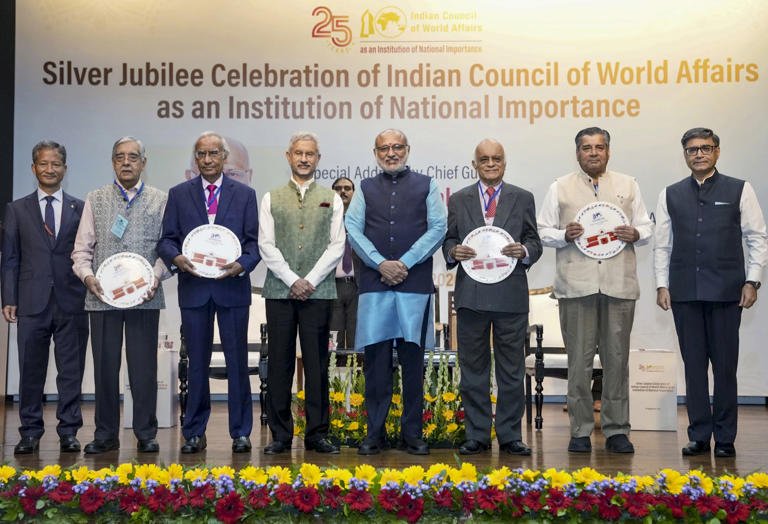
External Affairs Minister S. Jaishankar said India is destined to rise in a “very turbulent world” as he outlined the challenges facing Indian diplomacy in the coming decades.
Jaishankar made the remarks on Tuesday while addressing the valedictory session of the Silver Jubilee celebrations of the Indian Council of World Affairs (ICWA) in New Delhi.
The event marked 25 years since Parliament granted ICWA the status of an Institution of National Importance. Jaishankar said India’s growing capabilities would increase its global footprint, international relationships and role in major global debates.
“India is destined to rise in a very turbulent world,” Jaishankar said. He added that the intellectual demands linked to this process would also be significant.
His remarks came shortly after India hosted the 18th BRICS Summit in New Delhi on September 12 and 13. The summit brought together leaders and representatives from BRICS member and partner countries.
India’s Growing Global Footprint
Jaishankar said India’s rise involves more than economic growth or population size. He linked the country’s growing capabilities to a wider international role.
According to the minister, India’s GDP has doubled over the past decade. He also pointed to improvements in capabilities across several areas.
He said these changes have altered how other countries view India. They also affect the intensity of India’s relations with other nations.
Jaishankar stressed that greater influence also brings greater responsibility. India, he said, will have to deal with more international expectations as its global role expands.
He also said the foreign policy implications of the Viksit Bharat by 2047 vision would require greater attention as India’s position develops.
The minister’s remarks placed India’s growth within a rapidly changing international environment. He said the country must prepare for a world that is becoming more uncertain and complex.
Six Areas for Indian Diplomacy
Jaishankar outlined six broad issues that Indian diplomacy will need to address in the coming years.
The first concerns the consequences of India’s rapid growth. A larger economy and stronger capabilities will expand the country’s international responsibilities.
The second involves the global movement of talent and skills. Jaishankar said a globalised workplace requires a globalised workforce.
This development has implications for Indian consular services and community welfare. It also affects rapid response mechanisms and agreements that support the mobility of Indian workers and professionals.
The third issue relates to communication and narrative building. Jaishankar said technology and social media have changed the way countries communicate with global audiences.
The arrival of artificial intelligence adds another layer to this challenge. He said diplomacy will become more complicated as AI changes communication and information flows.
Global South Remains Important
Jaishankar also highlighted India’s relationship with the Global South.
He said shared histories and common challenges have created strong bonds between India and many developing countries. These relationships remain an important part of India’s international engagement.
India has increasingly positioned itself as a voice for developing countries in global discussions. The minister linked this engagement with India’s broader approach to international affairs.
He also discussed culture and history as important factors in international relations. According to Jaishankar, relationships between countries do not depend only on strategic or economic calculations.
Historical experiences and cultural connections can also shape how nations understand each other.
Strategic Autonomy and Multipolarity
Strategic autonomy formed another major part of Jaishankar’s address.
He described India’s independent approach to international affairs as a fundamental feature of its foreign policy. He said India would continue to value flexibility in dealing with different countries and global issues.
Jaishankar also linked strategic autonomy with a multipolar international system.
He said India’s response to an era of intense competition was to support multipolarity. This approach seeks to avoid excessive dependence on any single power or grouping.
The minister argued that India is naturally suited to a multipolar world because of its independent foreign policy approach.
Peace and Development at the Centre
Jaishankar also spoke about India’s approach to conflict and international cooperation.
He said Indian diplomacy would continue to place peace and development at the centre of its agenda. He connected this approach with India’s preference for dialogue and diplomacy.
According to Jaishankar, India believes that prolonged conflicts should eventually give way to peace. He described this not only as an ideal but also as a practical approach to promoting global progress and prosperity.
His comments come at a time when international relations face several competing pressures. Conflicts, trade tensions, technological competition and shifting alliances have created uncertainty across regions.
Technology, Energy and Supply Chains
Jaishankar also identified several emerging challenges for the international system.
He said technology rivalry could fragment global cooperation. At the same time, the spread of new technologies could create unexpected opportunities.
He also pointed to energy security, connectivity and global supply chains as important areas for India.
According to the minister, India can respond to such challenges through de-risking and diversification. He also stressed the importance of self-reliance and trusted international partners.
Jaishankar said these approaches could strengthen India’s strategic autonomy. He pointed to Make in India as an important part of this broader strategy.
India’s Civilisational Identity
The minister also discussed India’s identity as a civilisation with a long history.
He described India’s return to a larger role on the global stage as an unusual development. He said this process could lead to discussion and, at times, misunderstanding.
Jaishankar argued that India would develop its own approach rather than simply copy the experiences of other countries.
He said India would need to explain its approach clearly to the wider world. He also suggested that a civilisational state would naturally take a long-term view of international affairs.
This perspective, he said, would influence India’s approach to global issues and diplomacy.
ICWA’s Role in India’s Foreign Policy Debate
Jaishankar said institutions such as ICWA could contribute to India’s understanding of the changing global environment.
He described ICWA as a meeting point for the think tank, academic and policy communities. He said deeper discussion would become increasingly important as the international system undergoes major changes.
The minister also stressed the importance of intellectual debate as India takes on a larger international role.
His remarks highlighted the challenges that could accompany India’s growing influence. They also pointed to the need for diplomacy to adapt to changes in technology, global economics, international security and geopolitical relationships.
India Faces a Changing Global Order
Jaishankar’s address presented India’s growing global role alongside a rapidly changing international landscape.
He identified economic growth, talent mobility, artificial intelligence, the Global South, civilisational identity and strategic autonomy as major areas for Indian diplomacy.
He also highlighted the importance of peace, development, multipolarity and trusted partnerships.
As global competition increases, India will face new diplomatic and strategic questions. Jaishankar said the country’s rise would therefore require careful thinking and sustained engagement.
The minister’s central message was that India’s growing international role will bring both greater influence and greater responsibility.