

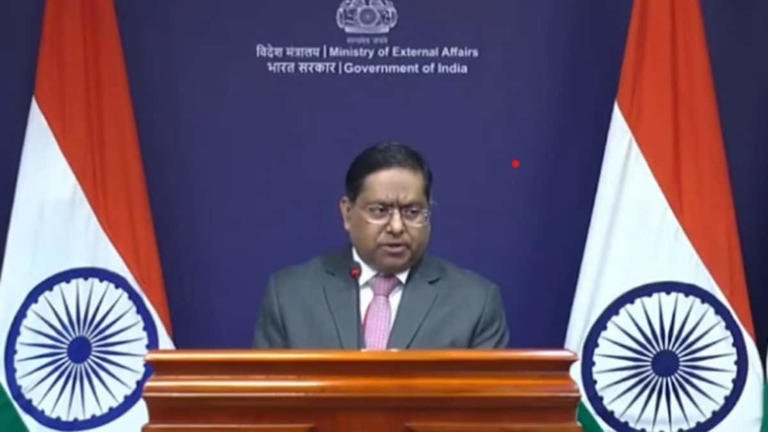
India has called on Pakistan to take credible and concrete action against cross-border terrorism. The Ministry of External Affairs said Islamabad needs to demonstrate a firm commitment before its assurances can gain international confidence.
MEA spokesperson Randhir Jaiswal made the remarks during a media briefing on September 22. He was responding to comments by Pakistan’s Chief of Defence Forces, Field Marshal Asim Munir, who had said that the country’s armed forces remained determined to defeat terrorism.
Jaiswal said Pakistan must demonstrate action and firm commitment. He added that credible steps against cross-border terrorism were necessary for the world to believe Islamabad would act on its stated commitments.
India’s Position on Cross-Border Terrorism
New Delhi has consistently raised concerns about terrorism originating from or operating across Pakistan’s borders. The Indian government has maintained that Pakistan should take verifiable measures against such activities.
The latest remarks came as Pakistan faces continuing militant violence within its territory. Pakistani authorities have blamed militant groups operating from or linked to Afghan territory for some recent attacks. Afghanistan’s Taliban authorities have rejected allegations that Afghan soil is being used to launch attacks against Pakistan.
Meanwhile, Pakistan’s military leadership has reiterated its stated commitment to counterterrorism operations. The country’s authorities have also called on Kabul to take action against militant groups.
India Condemns Pakistani Airstrikes in Afghanistan
Alongside its comments on terrorism, India strongly condemned recent Pakistani airstrikes in Afghanistan.
The strikes targeted areas in Afghanistan’s Kunar and Paktika provinces. Jaiswal said the attacks resulted in civilian deaths and described such aggression against a sovereign neighbour as harmful to regional peace and security.
India expressed condolences to the families of those killed and wished a speedy recovery to those injured.
The Afghan Taliban government reported that three civilians were killed and four others were injured in the strikes. Pakistan, however, said its operations targeted terrorist camps and hideouts and claimed that 28 militants had been killed. The Pakistani casualty claim has not been independently verified.
Afghanistan’s Sovereignty and Territorial Integrity
India also reaffirmed its support for Afghanistan’s independence, sovereignty and territorial integrity.
Jaiswal said New Delhi remains committed to the welfare and well-being of the Afghan people. India’s position comes amid a fresh escalation between Pakistan and Afghanistan over security concerns along their shared border.
The latest Pakistani strikes followed deadly attacks inside Pakistan. Islamabad has accused militant groups based in Afghanistan of involvement in those attacks. Kabul has rejected the allegations and opposed Pakistani military action on Afghan territory.
Rising Tensions Between Pakistan and Afghanistan
Relations between Pakistan and Afghanistan have faced repeated tensions over terrorism and border security.
Pakistan has urged the Taliban administration in Kabul to dismantle militant sanctuaries, particularly those linked to the Tehreek-e-Taliban Pakistan (TTP). Islamabad says such groups have used Afghan territory to plan or support attacks inside Pakistan.
The Afghan authorities deny allowing their territory to be used for attacks against Pakistan. This disagreement has remained a major source of tension between the two sides.
The latest airstrikes have added another layer to the dispute. Afghan officials described the attacks as aggression and indicated that Kabul would respond.
India Emphasises Regional Peace
India’s response reflects its stated concern about stability in the wider region. New Delhi has simultaneously called for credible action against terrorism and criticised military strikes against a neighbouring sovereign state.
The two issues are linked to broader security challenges in South and Central Asia. Continued militant activity, cross-border accusations and military responses can increase tensions among countries in the region.
For India, addressing terrorism remains a key part of its security concerns. At the same time, New Delhi has reiterated its support for Afghanistan’s sovereignty and territorial integrity.
Diplomatic Challenges Ahead
The latest developments highlight the complex security environment surrounding India, Pakistan and Afghanistan.
Pakistan is facing pressure to address militant violence within its territory while also dealing with tensions along its western border. Afghanistan, meanwhile, faces accusations from Islamabad over militant activity but rejects claims that it permits such operations.
India has now urged Pakistan to back its statements on counterterrorism with credible action. At the same time, New Delhi has condemned Pakistan’s military strikes in Afghanistan and called for respect for regional peace and security.
The developments are likely to keep terrorism, border security and regional stability at the centre of diplomatic discussions across South Asia.