

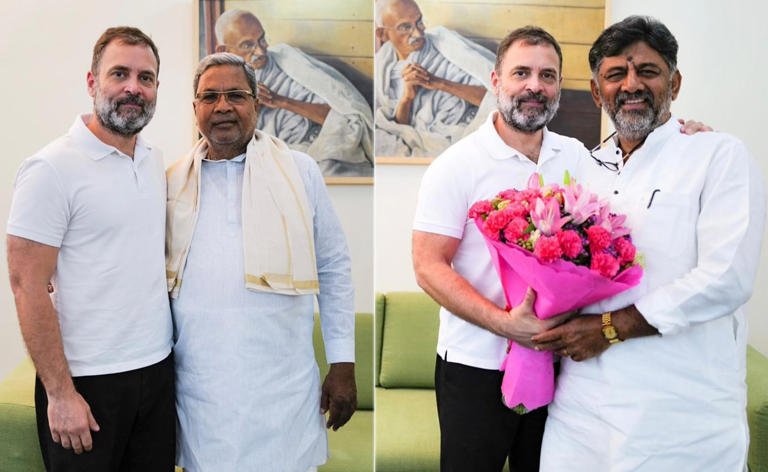
As discussions intensify within the Congress over the future leadership structure in Karnataka, attention has increasingly turned to what a potential government led by Deputy Chief Minister D.K. Shivakumar could look like. Party insiders indicate that Congress leader Rahul Gandhi is keen on shaping a governance model that combines administrative efficiency, social inclusion, youth representation, and strong delivery of welfare programmes.
While the Congress leadership has not officially announced any leadership transition, internal discussions have sparked speculation about the party’s long-term plans in Karnataka. Sources suggest that Rahul Gandhi views Karnataka as a crucial state for the Congress and wants any future government structure to reflect the party’s broader vision of inclusive governance and organizational renewal.
According to party leaders, Gandhi’s focus extends beyond personalities and revolves around building a government capable of delivering results while maintaining social balance and political stability.
Emphasis on Inclusive Representation
One of Rahul Gandhi’s key priorities is believed to be ensuring broad social representation within the government. Congress leaders say any future cabinet structure would likely reflect Karnataka’s diverse social composition.
The party leadership reportedly wants adequate representation for Scheduled Castes, Scheduled Tribes, Other Backward Classes, minorities, women, and various regional communities. Leaders believe such an approach would strengthen public trust and improve the government’s ability to address diverse concerns.
Congress insiders argue that representation is not merely a political consideration but also an important governance principle. A cabinet that mirrors the state’s demographic diversity can better understand local challenges and formulate responsive policies.
As a result, social balance is expected to remain a central factor in any future cabinet formation.
Greater Role for Young Leaders
Rahul Gandhi has consistently advocated greater opportunities for younger politicians within the Congress. Sources indicate that he wants the next generation of leaders to play a larger role in governance and decision-making.
A future DK Shivakumar-led administration could therefore see increased participation from younger legislators and emerging leaders. The objective would be to combine fresh perspectives with experienced leadership.
Party strategists believe younger ministers can contribute innovative ideas on issues such as technology, employment generation, urban development, climate resilience, and digital governance.
At the same time, senior leaders would continue to provide institutional experience and political guidance. Congress leaders emphasize that the goal is not to replace experience but to create a balanced leadership structure.
This approach aligns with Gandhi’s broader effort to promote generational renewal within the party.
Performance-Based Governance
Another important element reportedly favored by Rahul Gandhi is a stronger emphasis on performance and accountability. Party insiders suggest that any future government structure would prioritize measurable outcomes and efficient implementation of schemes.
Congress leaders believe governance should focus on delivering tangible benefits to citizens rather than merely announcing programmes. Therefore, ministers may be expected to meet clearly defined performance benchmarks.
The Karnataka government has already implemented several welfare initiatives. However, the leadership reportedly wants greater attention on execution and monitoring.
Officials may receive more responsibility for ensuring that schemes reach intended beneficiaries efficiently and transparently. Regular performance reviews could become a more prominent feature of governance.
Supporters argue that this approach would strengthen public confidence and improve administrative effectiveness.
Continued Focus on Welfare Programmes
The Congress leadership remains committed to welfare-driven governance in Karnataka. Rahul Gandhi reportedly views welfare programmes as an important component of the party’s political and governance strategy.
A future government under D.K. Shivakumar would likely continue focusing on schemes related to women, youth, education, healthcare, and social welfare.
Party leaders argue that welfare initiatives have helped strengthen the government’s connection with ordinary citizens. Consequently, there is little expectation of any major shift away from existing commitments.
Instead, the focus may be on improving implementation, expanding coverage, and ensuring long-term sustainability.
The Congress believes effective welfare programmes can contribute to social development while reinforcing public trust in governance.
Strengthening Party-Government Coordination
According to party sources, Rahul Gandhi wants stronger coordination between the Congress organization and the government in Karnataka.
Political observers note that effective communication between party structures and administrative institutions often helps governments respond more effectively to public concerns. Therefore, party leaders may seek mechanisms that facilitate regular interaction between elected representatives and organizational units.
The objective would be to ensure that governance decisions remain informed by grassroots feedback. Congress leaders believe such coordination can improve responsiveness and strengthen political outreach.
Party insiders suggest that a future administration may place greater emphasis on consultation and internal communication.
Balancing Regional Interests
Karnataka’s political landscape requires careful attention to regional dynamics. Different parts of the state often have distinct economic, social, and developmental priorities.
Rahul Gandhi reportedly wants any future government structure to maintain a balance between various regions, including Old Mysuru, Bengaluru, Hyderabad-Karnataka, Kittur Karnataka, and the coastal belt.
Ensuring regional representation can help prevent perceptions of imbalance and strengthen political stability. Therefore, regional considerations are expected to influence decisions related to cabinet composition and policy priorities.
Congress leaders believe balanced development remains essential for maintaining broad public support across the state.
D.K. Shivakumar’s Administrative Role
D.K. Shivakumar remains one of the Congress party’s most influential leaders in Karnataka. Known for his organizational skills and political management abilities, he has played a significant role in strengthening the party’s position in the state.
Supporters argue that his experience and grassroots connections could help drive development initiatives and strengthen governance. They also point to his ability to engage with diverse social groups and political stakeholders.
If entrusted with a larger leadership role in the future, observers believe Shivakumar would likely focus on infrastructure, investment, urban development, and welfare delivery.
However, party leaders continue to stress that any decisions regarding leadership transitions remain subject to discussions within the Congress high command.
Political Significance for Congress
Karnataka occupies a special place in the Congress party’s national strategy. It remains one of the few large states where the party currently governs independently.
As a result, the success of the Karnataka government carries implications beyond state politics. Rahul Gandhi reportedly views Karnataka as an example of how Congress governance can combine welfare, development, and social inclusion.
A strong and stable government in the state could strengthen the party’s national credibility and provide a model for future electoral campaigns.
Therefore, leadership discussions in Karnataka continue to attract considerable attention within the party.
Looking Ahead
Although no formal decisions have been announced regarding a future leadership transition, internal discussions provide insight into Rahul Gandhi’s vision for a potential D.K. Shivakumar-led government. The emphasis appears to be on inclusive representation, youth participation, administrative efficiency, and strong welfare delivery.
Party leaders believe such an approach can strengthen governance while maintaining political stability and social balance. By combining experienced leadership with emerging talent, the Congress hopes to create a government capable of addressing both present challenges and future opportunities.
As Karnataka’s political landscape continues to evolve, the direction chosen by the Congress leadership will likely play a significant role in shaping the state’s governance and the party’s broader political future.