

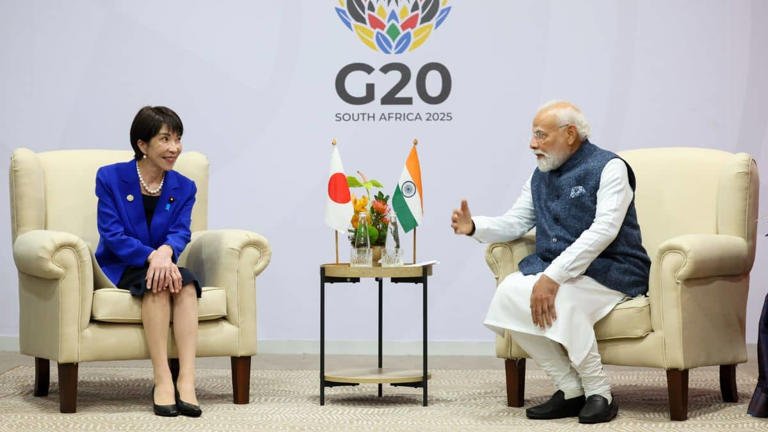
Japanese Prime Minister Sanae Takaichi is expected to visit India next month for a bilateral summit with Prime Minister Narendra Modi, according to media reports. The proposed visit is likely to further strengthen the long-standing strategic partnership between India and Japan, with discussions expected to focus on trade, investment, critical minerals, energy security, technology cooperation, and regional stability in the Indo-Pacific. Reports suggest that the summit may be held in Assam, although official confirmation from Indian authorities is still awaited.
The anticipated visit comes at a time when both countries are seeking to deepen cooperation across a range of sectors amid evolving geopolitical and economic dynamics in Asia. India and Japan have steadily expanded their partnership over the past two decades, transforming their relationship into one of the most significant strategic collaborations in the Indo-Pacific region.
Observers believe the upcoming summit could pave the way for new agreements and initiatives aimed at strengthening economic ties and enhancing cooperation in emerging technologies and supply chain resilience.
Strengthening a Special Strategic and Global Partnership
India and Japan share what both governments describe as a “Special Strategic and Global Partnership.” Over the years, the relationship has evolved beyond traditional diplomatic engagement to include extensive cooperation in infrastructure, defense, trade, technology, education, and people-to-people exchanges.
Prime Minister Modi and Prime Minister Takaichi have already expressed their commitment to strengthening bilateral ties. During previous interactions, both leaders emphasized cooperation in security, economic development, innovation, semiconductors, artificial intelligence, and economic security.
The proposed summit is expected to build upon the momentum generated by earlier meetings and reaffirm the commitment of both nations to a free, open, and inclusive Indo-Pacific region.
Officials from both countries have consistently highlighted the importance of maintaining close cooperation in an increasingly complex global environment.
Focus on Trade and Investment
Economic cooperation is likely to emerge as one of the central themes of the upcoming summit. Japan remains one of India’s most important economic partners and a major source of foreign investment.
Japanese companies have invested significantly in sectors such as automobiles, manufacturing, infrastructure, logistics, electronics, and industrial development. Several flagship projects, including industrial corridors and transportation initiatives, have benefited from Japanese investment and technical expertise.
The summit is expected to explore ways to further improve trade relations and encourage greater investment flows between the two countries. Policymakers are likely to discuss measures aimed at reducing barriers to business, enhancing supply chain integration, and promoting industrial collaboration.
Economic experts believe that stronger trade ties can support growth, create employment opportunities, and contribute to long-term economic resilience in both countries.
Energy Security and Critical Minerals on the Agenda
Reports indicate that energy security and critical minerals may feature prominently during discussions between the two leaders. Japan has been actively seeking to diversify its access to critical resources, while India is pursuing strategies to strengthen its role in global supply chains.
Critical minerals have become increasingly important because of their role in technologies such as electric vehicles, renewable energy systems, semiconductors, and advanced manufacturing. Cooperation in this sector could help both countries reduce vulnerabilities and strengthen industrial competitiveness.
Energy collaboration is also expected to receive attention, particularly in areas such as clean energy, hydrogen technology, renewable energy development, and sustainable infrastructure.
Officials from both nations have repeatedly emphasized the importance of secure and reliable supply chains in supporting economic growth and technological advancement.
Expanding Cooperation in Technology
Technology and innovation are expected to be major areas of discussion during the summit. India and Japan have identified emerging technologies as key pillars of future cooperation.
Both countries have expressed interest in strengthening collaboration in fields such as artificial intelligence, semiconductors, digital infrastructure, cybersecurity, telecommunications, and advanced manufacturing. Prime Minister Takaichi has previously highlighted the importance of leveraging the strengths of both nations to foster innovation and technological growth.
India’s growing digital economy and Japan’s technological capabilities create significant opportunities for mutually beneficial partnerships. Experts believe that collaboration in technology can enhance competitiveness while supporting broader economic and strategic objectives.
The summit could potentially result in new initiatives aimed at encouraging research partnerships, innovation exchanges, and industry collaboration.
Importance of the Indo-Pacific Region
The Indo-Pacific is expected to remain a major focus of bilateral discussions. India and Japan have consistently supported the vision of a free, open, and rules-based Indo-Pacific and have worked closely on regional issues.
The two countries cooperate through various regional and multilateral platforms and share concerns regarding maritime security, economic stability, and regional connectivity. Both governments view the Indo-Pacific as critical to global trade and economic prosperity.
Prime Minister Modi and Prime Minister Takaichi are likely to discuss regional developments and explore opportunities for deeper strategic coordination. Previous interactions between the two leaders reaffirmed their commitment to advancing cooperation in support of a Free and Open Indo-Pacific.
Observers believe that strengthening India-Japan cooperation contributes to broader regional stability and economic integration.
Northeast India May Gain Special Attention
Reports suggesting that the summit could be held in Assam have generated considerable interest in Northeast India. While official confirmation remains pending, such a venue would highlight the growing strategic and economic importance of the region.
Japan has been actively involved in several development initiatives in Northeast India, including infrastructure projects, connectivity improvements, and sustainable development programs. The region plays an important role in India’s Act East Policy and serves as a gateway to Southeast Asia.
Holding the summit in Assam would symbolize the importance of regional development and international cooperation in promoting connectivity and economic growth.
Officials have often described the Northeast as an important component of India’s engagement with the broader Indo-Pacific region.
Growing Defense and Security Cooperation
Defense and security cooperation between India and Japan has expanded considerably in recent years. Regular dialogues, joint exercises, defense exchanges, and strategic consultations have strengthened mutual trust and understanding.
The two countries share common interests in maintaining peace, stability, and security in the Indo-Pacific. Cooperation has extended to areas such as maritime security, disaster response, and defense technology exchanges.
The summit is expected to provide an opportunity to review ongoing security cooperation and identify new areas for collaboration. Strategic partnerships are increasingly viewed as essential for addressing evolving regional and global challenges.
Analysts believe that stronger defense ties contribute to broader strategic stability while enhancing the capabilities of both nations.
Building on a History of Strong Relations
India and Japan have enjoyed cordial relations for decades, with bilateral ties steadily expanding across multiple sectors. Annual summit meetings have played an important role in guiding the relationship and setting priorities for future cooperation.
The 15th India-Japan Annual Summit held during Prime Minister Modi’s visit to Japan in 2025 reinforced commitments to economic, technological, and strategic collaboration.
The proposed visit by Prime Minister Takaichi would continue this tradition of high-level engagement and provide an opportunity to assess progress on existing initiatives while identifying new avenues for partnership.
Both governments have repeatedly emphasized the value of long-term cooperation based on shared democratic values, economic interests, and strategic objectives.
Looking Ahead
The reported visit of Japanese Prime Minister Sanae Takaichi to India next month is expected to mark another important milestone in the evolving India-Japan relationship. Although official details are yet to be announced, the summit is likely to focus on strengthening cooperation in trade, investment, energy security, critical minerals, technology, and regional stability.
As both nations navigate a rapidly changing global environment, their partnership continues to gain strategic significance. Shared interests in economic growth, technological innovation, supply chain resilience, and Indo-Pacific security provide a strong foundation for deeper collaboration.
The anticipated summit is expected to reinforce mutual trust and strengthen one of Asia’s most important bilateral relationships. Whether through infrastructure development, technological cooperation, or strategic coordination, India and Japan appear poised to expand their partnership further, contributing to regional stability and economic prosperity in the years ahead.