

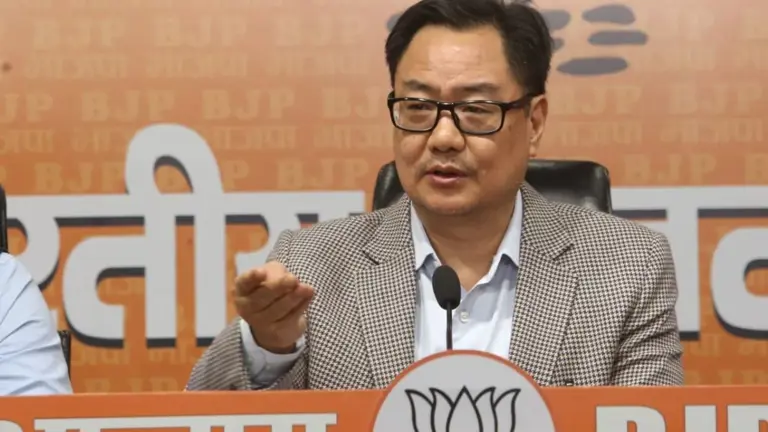
Union Minister Kiren Rijiju has strongly criticised opposition parties following the Bharatiya Janata Party’s recent electoral gains, stating that “abusing Prime Minister Narendra Modi does not win votes.” His remarks were directed at leaders from the Trinamool Congress and the Congress, whom he accused of relying on negative campaigning.
Rijiju’s statement came in the wake of election results that have reinforced the BJP’s position in several regions. He argued that the outcome reflects the electorate’s preference for development-oriented politics over personal attacks.
Moreover, his comments have sparked a broader debate about the effectiveness of political messaging in contemporary elections. The statement highlights the ongoing clash between competing narratives in Indian politics.
Read More: Rahul Gandhi Alleges BJP ‘Stole’ Assam, Bengal Polls With EC Help
Criticism of opposition’s campaign strategy
Kiren Rijiju took aim at what he described as the opposition’s overreliance on criticism of the Prime Minister. He suggested that focusing on personal attacks rather than policy issues weakens a party’s connection with voters.
According to him, voters are more interested in governance, development, and tangible results. He argued that negative rhetoric fails to address these priorities, thereby limiting its impact.
Furthermore, Rijiju stated that political parties need to present constructive alternatives instead of targeting individuals. He emphasized that meaningful debate should centre on policies and solutions.
This critique reflects the BJP’s broader strategy of positioning itself as a party focused on development and delivery.
BJP credits governance for electoral gains
The BJP leadership has attributed its recent electoral success to its governance record. Rijiju echoed this view, highlighting achievements in infrastructure, welfare schemes, and economic initiatives.
He noted that voters have responded positively to policies that directly impact their lives. According to him, the party’s focus on delivering results has strengthened public trust.
Additionally, Rijiju pointed out that consistency in governance has been a key factor. He argued that maintaining a clear vision and executing it effectively has helped the BJP expand its support base.
This emphasis on governance underscores the party’s narrative of performance-driven politics.
Opposition responds to Rijiju’s remarks
Leaders from the Trinamool Congress and the Congress have responded to Rijiju’s comments, offering a different perspective. They argued that criticism of the government is a legitimate part of democratic discourse.
Opposition figures stated that holding the Prime Minister and the government accountable is essential for transparency. They emphasized that raising questions about policies and decisions should not be dismissed as mere “abuse.”
At the same time, some leaders acknowledged the need to balance criticism with constructive proposals. They suggested that effective opposition requires both accountability and alternative visions.
This exchange of views highlights the ongoing debate over political communication strategies.
Debate on negative versus positive campaigning
Rijiju’s statement has reignited discussions about the role of negative campaigning in elections. Political analysts note that while criticism is an integral part of democracy, excessive focus on personal attacks can backfire.
They argue that voters tend to respond more positively to messages that highlight solutions and achievements. As a result, parties that focus on constructive narratives may have an advantage.
However, analysts also point out that criticism can be effective when it is issue-based and supported by evidence. The challenge lies in striking the right balance between critique and constructive engagement.
This debate reflects broader trends in political communication.
Impact on future election strategies
The remarks by Kiren Rijiju are likely to influence how parties approach future elections. For the BJP, the focus is expected to remain on governance and development as key themes.
On the other hand, opposition parties may reassess their strategies in light of electoral outcomes. They could place greater emphasis on presenting policy alternatives while continuing to hold the government accountable.
Moreover, the evolving nature of voter expectations will play a crucial role in shaping campaign approaches. Parties that adapt to these changes are more likely to succeed.
This dynamic environment underscores the importance of strategic communication in politics.
Public reaction and political discourse
Public response to Rijiju’s statement has been mixed. Supporters of the BJP have agreed with his view, arguing that development-focused politics resonates more with voters.
Meanwhile, critics have defended the role of opposition voices in questioning the government. They believe that robust debate is essential for a healthy democracy.
The discussion has gained traction on social media, where users are actively engaging with the issue. This level of engagement reflects the importance of political discourse in shaping public opinion.
At the same time, experts caution against oversimplifying complex electoral dynamics. They stress that multiple factors influence voting behaviour.
Broader implications for Indian politics
The exchange between Kiren Rijiju and opposition leaders highlights broader trends in Indian politics. It underscores the increasing emphasis on governance and performance as key determinants of electoral success.
At the same time, it reflects the continuing importance of political messaging. How parties communicate their ideas and respond to criticism can significantly impact voter perception.
Moreover, the debate illustrates the evolving nature of democracy, where both governance and accountability play crucial roles. Balancing these elements remains a central challenge for political actors.
Conclusion
Kiren Rijiju’s assertion that “abusing PM Modi does not win votes” has added a new dimension to the political conversation following the BJP’s electoral gains. His remarks highlight the importance of focusing on governance and constructive messaging.
While the BJP credits its success to development and delivery, opposition parties continue to emphasise accountability and critique. This interplay of narratives is likely to shape future political strategies.
As elections continue to influence the national landscape, the balance between criticism and constructive engagement will remain a key factor. Ultimately, voter expectations will determine which approach proves most effective.
Read More: Bengal Has Got Freedom: Tripura CM Hails BJP Victory in West Bengal