

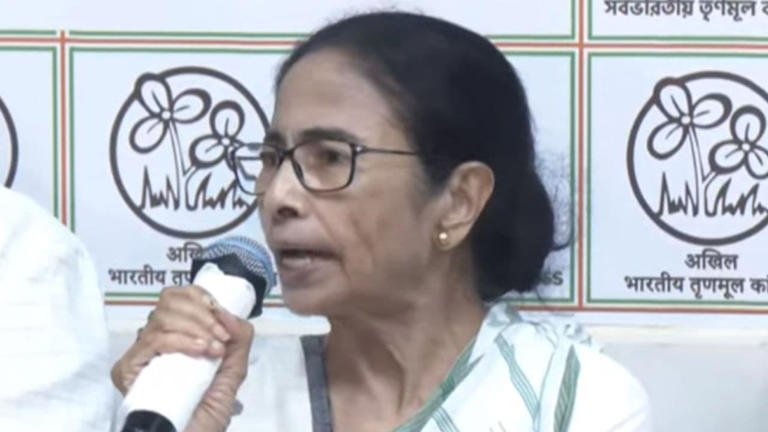
Mamata Banerjee has signalled that she is not ready to step away from politics even after the dissolution of the West Bengal assembly and the formal end of her government’s tenure.
The veteran Trinamool Congress leader struck a defiant tone following the political transition, indicating that her party would continue fighting both politically and organisationally in the coming months.
The dissolution of the assembly marked a major turning point in West Bengal politics after years of Trinamool Congress dominance under Mamata Banerjee’s leadership. However, political observers believe the latest developments may only mark the beginning of a new and intense political phase in the state.
Leaders from the All India Trinamool Congress (TMC) said the party remains united and prepared to continue its political battle despite the administrative transition.
Read More: Tripura CM Manik Saha Reviews Public Services And Law And Order
Mamata Banerjee signals political fightback
Soon after the assembly dissolution, Mamata Banerjee reportedly held discussions with senior party leaders and organisational members regarding the future political roadmap of the Trinamool Congress.
Party insiders said Banerjee remains determined to rebuild momentum and strengthen the organisation at the grassroots level. According to TMC leaders, the former Chief Minister believes the party still maintains strong public support across several districts in West Bengal.
Political analysts noted that Mamata Banerjee has built her political image around resistance and confrontation throughout her career. Therefore, many observers expected her to adopt an aggressive political strategy after the end of her government’s tenure.
TMC workers and supporters also organised meetings and gatherings in different parts of the state to express solidarity with the party leadership.
Several party leaders stated that the assembly dissolution does not mark the end of the Trinamool Congress as a major political force in West Bengal.
What happens after assembly dissolution?
The dissolution of the assembly formally ended the functioning of the outgoing government and initiated the constitutional process linked to political transition in the state.
Political experts explained that the next stage will involve administrative arrangements, leadership decisions, and future government formation procedures depending on the evolving political situation.
Observers believe political parties will now focus heavily on organisational strengthening and electoral preparation because local body and municipal-level political contests may become crucial in shaping future political momentum.
The BJP, Congress, and Left parties are also expected to intensify their political activities across West Bengal following the dissolution.
Political analysts noted that the coming months may witness heightened political campaigning, alliance discussions, and leadership restructuring among major parties.
The transition period could also influence administrative priorities and governance-related decisions in the state.
TMC focuses on organisational restructuring
Sources within the Trinamool Congress indicated that Mamata Banerjee may focus strongly on rebuilding and restructuring the party organisation.
Senior leaders reportedly discussed strengthening district-level units, expanding youth participation, and improving coordination between grassroots workers and senior leadership.
Political observers believe organisational unity will remain critical for the TMC as it faces increasing political competition from opposition parties.
The party leadership may also review electoral performance in different regions to identify areas where support weakened.
Several TMC leaders argued that maintaining close engagement with local communities will remain essential for the party’s future political strategy.
Observers also expect the Trinamool Congress to increase outreach programmes and public campaigns in rural and urban areas over the coming months.
BJP eyes political expansion in Bengal
The BJP is likely to view the assembly dissolution and political transition as an opportunity to further strengthen its influence in West Bengal.
Over the past few years, the BJP has significantly expanded its organisational presence in the state and emerged as one of the strongest challengers to the Trinamool Congress.
Political analysts believe the BJP may now intensify efforts to attract dissatisfied leaders, strengthen booth-level structures, and increase political mobilisation across districts.
Opposition leaders argued that West Bengal requires a new political direction focused on governance, transparency, and development.
At the same time, TMC leaders accused the BJP of trying to exploit the political transition for electoral gains.
Observers believe political rivalry between the BJP and TMC will continue dominating West Bengal politics in the near future.
Mamata Banerjee remains key opposition face
Despite the end of her tenure as Chief Minister, Mamata Banerjee continues to remain one of India’s most influential opposition leaders.
Political experts noted that her role extends beyond West Bengal because she has frequently positioned herself as a strong critic of the BJP at the national level.
Several opposition leaders from different states continue maintaining political communication with the TMC leadership regarding broader anti-BJP strategies.
Observers believe Mamata Banerjee may now focus more aggressively on national politics while simultaneously rebuilding the Trinamool Congress organisation in West Bengal.
The political transition may therefore reshape both state-level and national opposition dynamics in the coming months.
Analysts also noted that Banerjee’s political experience and mass appeal continue giving her significant influence among sections of voters and opposition groups.
Public reaction remains divided
Public reactions to the assembly dissolution and Mamata Banerjee’s political stance have remained sharply divided across West Bengal.
TMC supporters praised her leadership and described her as a leader who continues fighting for regional interests and welfare politics.
Meanwhile, opposition supporters argued that the political transition offers an opportunity for administrative change and governance reforms in the state.
Political discussions intensified on social media and public platforms regarding the future direction of West Bengal politics after the dissolution.
Observers said the transition period has created both uncertainty and political excitement among party workers and voters.
Several citizens also expressed curiosity regarding future alliance equations and leadership strategies among major political parties.
Bengal politics enters uncertain phase
Political experts believe West Bengal has now entered a highly uncertain and competitive political phase following the assembly dissolution.
The future direction of the state’s politics will likely depend on organisational strategies, leadership decisions, and public response over the coming months.
Mamata Banerjee’s refusal to step back from active politics suggests that the Trinamool Congress will continue mounting strong political resistance despite losing administrative control.
At the same time, opposition parties appear determined to capitalise on the transition and expand their support base across the state.
Observers believe future municipal polls, local body elections, and political campaigns may become important indicators of shifting political momentum in West Bengal.
As the political landscape continues evolving, all major parties are now preparing for an intense battle over leadership, governance, and public support in the next chapter of Bengal politics.