

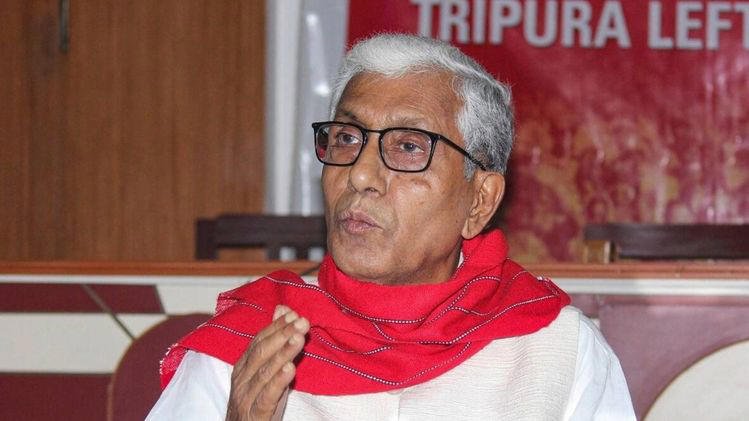
Senior CPI(M) leader and former Tripura chief minister Manik Sarkar has challenged the claims made by the BJP and Tipra Motha of having swept the Tripura council elections, questioning the narrative of a one-sided mandate. Sarkar said premature victory claims misrepresent ground realities and undermine the democratic process, urging parties to respect facts and official results.
Reacting to statements from the BJP and Tipra Motha Party, Sarkar argued that electoral outcomes in council areas remain complex and cannot be reduced to sweeping assertions. He maintained that voter behaviour reflects local issues, candidate credibility, and grassroots engagement rather than blanket endorsement of any single political force.
The Tripura council elections claims have sparked a fresh round of political debate in the state, with opposition parties accusing the ruling dispensation of manufacturing a narrative to influence public perception.
Read More: Cancer Awareness and Screening Camp Held in Digboi
Tripura council elections claims face sharp rebuttal
Manik Sarkar said the Tripura council elections claims made by the BJP and Tipra Motha ignore several constituencies where contests remained close or where opposition parties retained influence. According to him, portraying the results as a landslide distorts democratic nuance.
He stressed that council elections often reflect local governance concerns such as development delivery, land issues, and administrative efficiency. Therefore, Sarkar said, extrapolating these results into sweeping political conclusions lacks credibility.
The CPI(M) leader also cautioned against politicising autonomous council outcomes for broader electoral messaging. He said each tier of governance serves a distinct purpose and deserves objective assessment.
Criticism of BJP’s victory narrative
Sarkar took aim at the ruling Bharatiya Janata Party, accusing it of using aggressive messaging to project dominance beyond electoral facts. He said such narratives attempt to overshadow genuine public grievances.
According to Sarkar, governance performance, employment, and price rise remain key voter concerns. He argued that celebrating victory claims without addressing these issues reflects political complacency.
He added that democracy thrives on accountability. Therefore, ruling parties must engage with criticism rather than rely on triumphalist rhetoric.
Tipra Motha’s role under scrutiny
The former chief minister also questioned Tipra Motha’s assertions of decisive success in the council elections. While acknowledging the party’s influence in certain areas, Sarkar said its claims must align with verified data.
He noted that Tipra Motha draws support from specific regions and issues related to autonomy and identity. However, he cautioned against overstating reach across all council areas.
Political observers say Sarkar’s remarks reflect broader opposition efforts to counter narratives that may consolidate power narratives ahead of future elections.
Importance of factual interpretation of results
Sarkar emphasised the need for factual interpretation of the Tripura council elections claims. He urged parties to wait for complete, official tallies and constituency-wise breakdowns before making sweeping declarations.
According to him, selective presentation of results risks misleading the public and eroding trust in institutions. Transparent communication, he said, strengthens democratic legitimacy.
Election analysts echoed this view, noting that council elections often involve multi-cornered contests and local dynamics that resist simple narratives.
Council elections and local governance
The Tripura council elections play a crucial role in shaping local governance, especially in areas with unique administrative and social contexts. Sarkar said voters in these regions focus on service delivery, representation, and local leadership.
He argued that treating council polls as proxies for state-level dominance oversimplifies voter intent. Therefore, parties should respect the autonomy and purpose of these institutions.
Sarkar also said effective councils require cooperation across political lines. Excessive politicisation, he warned, could hinder development outcomes.
Opposition unity and response
Sarkar’s challenge to the Tripura council elections claims aligns with broader opposition efforts to present a united front against dominant narratives. CPI(M) leaders said the party continues to engage with voters on issues affecting daily life.
They emphasised grassroots mobilisation and accountability as priorities. According to them, inflated victory claims do not resolve challenges such as unemployment, inflation, and access to services.
Opposition leaders also called for responsible political discourse that avoids polarisation.
Public reaction and political debate
Public reaction to the competing claims has remained mixed. Some voters welcomed Sarkar’s call for restraint and factual clarity. Others viewed the debate as part of routine political contestation.
Civil society voices urged parties to focus on governance rather than symbolic victories. They stressed that council representatives must deliver tangible benefits regardless of party affiliation.
The debate over Tripura council elections claims has thus extended beyond numbers to questions of democratic conduct.
Broader implications for Tripura politics
Analysts say the controversy highlights shifting political equations in Tripura. While new parties and alliances reshape the landscape, traditional forces continue to assert relevance through critique and mobilisation.
Sarkar’s intervention underscores the CPI(M)’s attempt to reclaim political space by challenging dominant narratives. It also reflects ongoing competition between regional and national parties for influence.
The outcome of this debate may shape strategies ahead of future elections, including messaging, alliances, and voter outreach.
Call for responsible politics
Manik Sarkar concluded by calling for responsible politics rooted in truth and accountability. He said democratic strength lies in respecting voter diversity and institutional processes.
According to him, Tripura council elections claims should reflect verified outcomes, not political ambition. He urged all parties to prioritise governance and public welfare over rhetorical victories.
As Tripura’s political discourse evolves, the challenge to sweeping claims serves as a reminder that democracy depends not only on winning elections but also on honest interpretation and responsible leadership.
Read More: Tripura CM Lays Foundation Stone of Manu River Bridge