

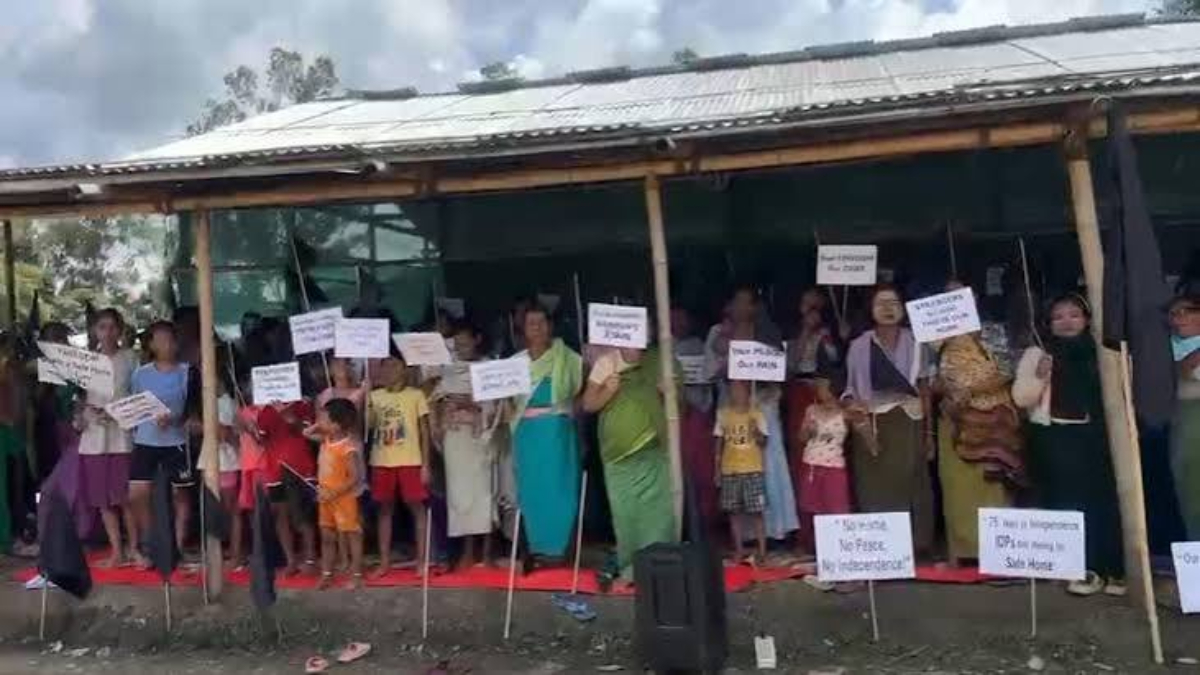
Manipur IDPs hoisted black flags at relief camps across the state on August 15, marking Independence Day with a protest over their prolonged displacement and continued inability to return home. The demonstrations came as the state joined the country in celebrating the 80th Independence Day, highlighting the sharp contrast between national celebrations and the uncertainty faced by thousands of displaced families.
Black flags mark continuing displacement
Displaced people staying at relief camps in several parts of Manipur carried black flags and staged peaceful demonstrations. The protests were aimed at drawing attention to their demand for a safe, secure and dignified return to their homes.
At camps in places including Sajiwa, Sawombung and Akampat, displaced families reportedly raised slogans calling for a permanent solution to the crisis. Some protesters also questioned the relevance of the “Har Ghar Tiranga” campaign while they remain unable to live in their own houses.
The protesters stressed that their action was not intended to be anti-national. Instead, they described it as a reminder that thousands of families remain displaced even as the rest of the country celebrates freedom and national unity.
For many families, the meaning of Independence Day was therefore tied to the ability to return home. They said they want to celebrate the national festival from their own homes rather than from temporary shelters.
Manipur IDPs seek safe return home
The displacement crisis began after ethnic violence erupted in Manipur in May 2023. More than three years later, a large number of people continue to live away from their original homes.
According to recent Manipur Home Department figures cited by local reports, more than 43,000 displaced people are currently staying in relief camps across nine districts. The overall number of displaced people in the state has crossed 58,000. Churachandpur alone accounts for around 33,000 displaced people, including approximately 15,000 in relief camps and another 18,000 living outside formal camps.
The continuing displacement has also raised concerns about livelihoods, security and rehabilitation. Chief Minister Yumnam Khemchand Singh recently acknowledged the difficulties faced by displaced residents during an interaction with IDPs.
He said he was particularly moved by accounts from people living near the Churachandpur border who said they could visit their homes during the day but did not feel safe enough to stay there overnight. The issue underscores the gap between physical access to some areas and the conditions required for a permanent return.
Relief camps remain a temporary reality
The black flag demonstrations also brought renewed attention to life inside relief camps. For families who have spent years away from their villages, temporary accommodation has become a prolonged reality rather than a short-term arrangement.
The Centre and the Manipur government have implemented several relief and rehabilitation measures since the violence began. Government data presented in Parliament in 2025 said thousands of displaced people had received support for housing, education, livelihoods and other needs. The Centre had also released funds for relief camp operations and rehabilitation programmes.
However, financial assistance and temporary shelter have not resolved the central demand of displaced families: a safe and sustainable return to their homes.
Independence Day celebrations highlight the divide
At the state-level Independence Day function in Imphal, Chief Minister Yumnam Khemchand Singh hoisted the national flag at the 1st Manipur Rifles Parade Ground and received the general salute during the ceremonial march past. It was his first Independence Day flag-hoisting ceremony as chief minister.
The official celebrations stood in stark contrast to the scenes at relief camps, where displaced families used black flags to express their frustration. Their message was not simply about the symbolism of August 15 but about what freedom means for people who cannot safely return to their homes.
For the Manipur IDPs, the protest reflected a demand for dignity, security and a lasting solution to displacement. Their appeal also places rehabilitation at the centre of the state’s broader peace process.
The government has made efforts to facilitate returns in some areas. In December 2025, for example, around 257 displaced people from 64 households returned to Waroiching village in Bishnupur district, with redevelopment assistance promised for abandoned homes.
Yet the latest protests show that large-scale displacement remains unresolved. Until families can return safely, rebuild their homes and restore their livelihoods, Independence Day will continue to carry a painful contradiction for many displaced residents.
The black flags raised across Manipur’s relief camps on August 15 served as a visible reminder that national freedom has a different meaning for families still waiting to go home. Their demand remains straightforward: security, rehabilitation and the chance to celebrate future Independence Days from their own rooftops.