

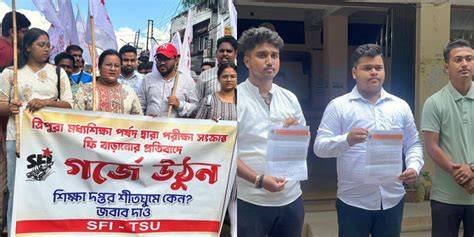
The Tripura Board of Secondary Education (TBSE) recently announced a revised fee structure for the Madhyamik (Class 10) and Higher Secondary (Class 12) examinations, effective from October 10, 2025. This revision, which represents the first comprehensive fee overhaul in over a decade, has not been met with quiet compliance. Instead, it has triggered an immediate and vigorous wave of protests, uniting student organisations across the political spectrum in opposition. The central point of contention is the sheer scale of the increase, which critics argue is an undue financial burden on the state’s economically weaker families.
The controversy surrounding the Tripura Exam Fee Hike has placed the state’s education department and the ruling government under intense public and political scrutiny.
Read More: CM Manik Saha seeks J P Nadda’s support for Tripura medical college
Decoding the Massive Tripura Exam Fee Hike
The new TBSE policy involves a multi-pronged increase, with the most significant jumps seen in the core examination and practical fees.
1. Staggering Increase in Core Fees: The most publicized change is the dramatic rise in the main examination fees, which had remained largely unchanged since 2013:
- Madhyamik (Class 10) Exam Fee: Increased from the existing ₹120 to ₹300. This is an effective jump of 150%.
- Higher Secondary (Class 12) Exam Fee: Increased from ₹150 to ₹400. This hike is approximately 167%.
2. Practical Fees and the Science Burden: Perhaps the most contentious revision is the shift in practical examination charges. Previously, a flat fee of ₹75 covered all practical subjects. Under the new policy, this charge is now ₹75 per subject. For a typical science student, this triples the practical component fee from ₹75 to ₹225, adding a significant extra cost to their education.
3. Hikes Across Associated Charges: The revision extends to nearly all associated fees, compounding the final cost for students:
- Registration Fee: Increased from ₹110 to ₹210.
- Centre Fee: Revised from ₹50 to between ₹80 and ₹100.
- Review of Answer Scripts (Per Paper): Raised from around ₹130 to ₹200.
- Self-Inspection Fee (Per Paper): Doubled from ₹250 to ₹500.
Cumulatively, for many students, the total cost for board examinations has more than doubled, triggering a massive backlash.
The Rationale: Why the TBSE Implemented the Tripura Exam Fee Hike
In a press conference, TBSE officials, including President Dr. Dhananjay Gan Chowdhury, defended the Tripura Exam Fee Hike by citing unavoidable financial realities. Their main arguments include:
- Inflation and Operational Costs: The board stated that a fee structure established in 2013 was no longer viable given the rising costs of paper, printing, logistics, and the need to increase the remuneration of teachers involved in the answer script evaluation process.
- Comparative Analysis: The TBSE was quick to point out that even with the revised rates, the fees remain substantially lower than those of the Central Board of Secondary Education (CBSE) (where Class 10 fees are around ₹1,500) and other North-Eastern state boards. This comparison attempts to frame the hike as a necessary adjustment rather than an exorbitant increase.
Student Organisations Up In Arms
Despite the board’s justification, the reaction from students, parents, and political opposition has been one of outrage. Protests, spearheaded by the left-affiliated Students’ Federation of India (SFI) and the Tribal Students Union (TSU), and notably joined by the ruling party’s student wing, the Akhil Bharatiya Vidyarthi Parishad (ABVP), erupted in Agartala.
The core arguments for demanding a rollback are rooted in the state’s economic structure:
- Burden on Rural Poor: Tripura’s economy, with a significant rural population and a relatively lower per capita income, means that even a moderate fee increase can be a substantial burden. Opponents argue that the new policy will effectively exclude thousands of students from economically disadvantaged backgrounds from taking their board exams, thereby jeopardizing their futures.
- Questionable Priorities: Student leaders have criticized the government for allegedly spending heavily on publicity and other campaigns while claiming a financial crunch in the education sector. They demand that the state government take on the financial responsibility to maintain affordable education instead of shifting the burden onto the students.
- Exclusionary Policy: The opposition views the dramatic rise, especially the ‘per-subject’ practical fee, as an “anti-student” move that may force a reduction in subject choices or even push vulnerable students toward dropping out.
The unified nature of the student protests, spanning the political spectrum, underscores the depth of public dissatisfaction with the TBSE’s decision. As the academic year progresses, the political heat generated by the Tripura Exam Fee Hike is unlikely to dissipate until the government or the board offers a significant concession or a rollback of the most contentious elements of the new fee policy.
Read More: Special Committee to Develop Zubeen Garg’s Samadhi Khetra