

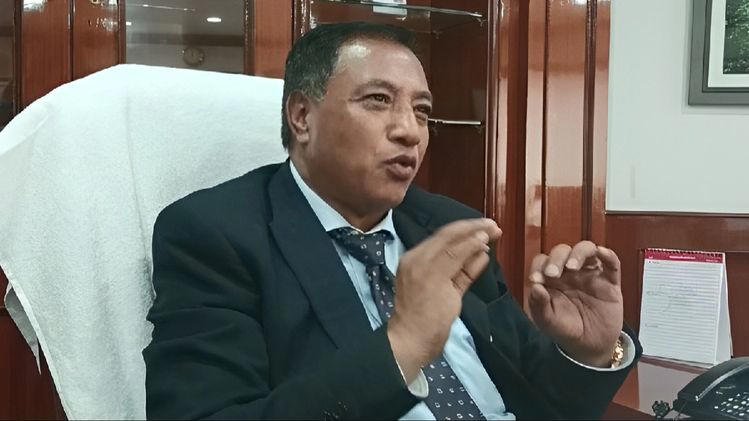
Senior Bharatiya Janata Party (BJP) leader and Meghalaya MLA Alexander Laloo Hek has expressed confidence that the party could win between 25 and 30 seats in the 2028 Meghalaya Assembly elections, provided it fields strong and capable candidates.
Hek said the BJP has already begun identifying constituencies where it sees significant electoral potential and is conducting surveys to assess suitable candidates ahead of the Assembly polls. The senior leader said the party’s objective is to strengthen its organisation across Meghalaya and work towards forming a BJP-led government in the state after the 2028 election.
BJP Identifies Potential Seats Across Meghalaya
According to Hek, the BJP has identified between 25 and 30 constituencies where it believes the party has a strong chance of performing well in the upcoming Assembly elections.
The party’s assessment covers different regions of the state, including Khasi Hills, Jaintia Hills and Garo Hills. However, Hek emphasised that the final electoral outcome would depend significantly on the selection of candidates.
“We have already identified the potential seats. Twenty-five to 30 seats are very potential for BJP in the upcoming 2028 election,” Hek said.
The BJP is currently focusing on surveys and organisational assessments to identify candidates capable of strengthening the party’s prospects in the targeted constituencies.
Candidate Selection to Play a Key Role
Hek stressed that selecting the right candidates would be crucial to the BJP’s electoral ambitions.
While the party sees potential in several constituencies, he said the ability to translate that potential into electoral success would depend on fielding candidates with strong public support and the ability to connect with voters.
The party is therefore expected to continue its surveys and grassroots assessments before taking decisions on candidates for the 2028 Meghalaya Assembly elections.
Hek’s remarks indicate that the BJP is looking to significantly expand its political presence in the state by focusing on constituencies where organisational growth and candidate strength could improve its electoral performance.
Focus on Strengthening BJP Organisation
The Meghalaya BJP leader said strengthening the party organisation remains a major priority ahead of the 2028 polls.
According to Hek, the BJP has developed an organisational structure extending from the booth level to constituencies and districts. The party plans to further strengthen this network over the coming months and years as part of its preparations for the Assembly election.
A strong grassroots organisation is expected to be central to the BJP’s strategy as it seeks to increase its presence across different regions of Meghalaya.
The party’s focus on organisational expansion also reflects its longer-term approach towards the 2028 election, with political activities and constituency-level assessments already underway well ahead of the polls.
BJP Open to New Entrants, Says Hek
Commenting on the possibility of leaders from other political parties joining the BJP, Hek said the party remained open to anyone willing to become part of the organisation.
He said the BJP’s doors were open to individuals who wanted to join the party and contribute to its political growth in Meghalaya.
Possible political realignments and the entry of influential leaders could become an important factor in the state’s political landscape as parties begin preparing for the 2028 Assembly elections.
However, Hek maintained that the BJP’s immediate focus remains strengthening its organisation and identifying capable candidates across the state.
No Leadership Dispute Within Meghalaya BJP
Hek also dismissed suggestions of any leadership dispute within the Meghalaya BJP.
He said decisions regarding the leadership of a future BJP government would ultimately be taken by the party’s central leadership.
According to Hek, seniority alone would not determine who would lead the government if the BJP succeeds in forming one. Instead, the party would look for a leader capable of bringing different sections together and providing effective governance.
He also said the party was open to the possibility of a new entrant eventually emerging as its chief ministerial face, depending on the decision of the central leadership and the suitability of the individual concerned.
Hek Rules Out Toppling MDA Government
Despite the BJP’s ambitious electoral target, Hek ruled out any attempt to topple the current National People’s Party-led Meghalaya Democratic Alliance (MDA) government.
“There is no question of toppling the government,” he said, making it clear that the BJP’s focus remains on strengthening itself for the next Assembly election rather than attempting to change the present political arrangement.
Hek added that the BJP was willing to work with political parties interested in cooperating with it.
The remarks underline the party’s strategy of focusing on the 2028 election while continuing its political and organisational activities within the existing political framework of the state.
BJP Sets Ambitious Target for 2028
Hek’s statement reflects the BJP’s ambitious plan to significantly improve its electoral position in Meghalaya during the 2028 Assembly elections.
Winning 25 to 30 seats would place the party in a strong position in the 60-member Meghalaya Legislative Assembly and could potentially bring it close to forming or leading the next government.
The BJP is expected to continue expanding its grassroots network, identifying electorally promising constituencies and conducting surveys to select candidates as the election approaches.
With more than a year still remaining before the expected 2028 Assembly polls, political parties in Meghalaya are likely to intensify their organisational activities and electoral preparations.
For the BJP, Hek’s confidence in securing 25 to 30 seats sets an ambitious benchmark and signals the party’s intention to emerge as a much stronger force in Meghalaya politics. The success of the Meghalaya BJP 2028 Assembly polls strategy will ultimately depend on candidate selection, organisational strength, political alliances and voter response across the Khasi Hills, Jaintia Hills and Garo Hills.