

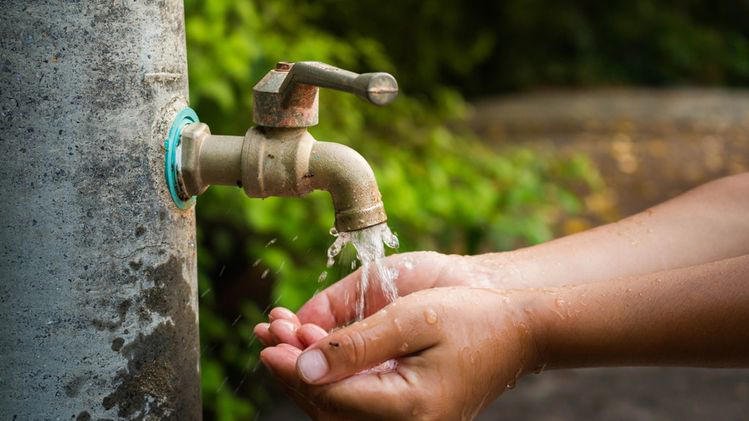
Meghalaya is shifting its focus under the Jal Jeevan Mission from expanding tap connections to ensuring reliable water supply.
The change comes as the state prepares to implement Jal Jeevan Mission 2.0. The new phase places greater emphasis on service delivery, sustainability and the long-term functioning of rural water systems.
The Meghalaya government reviewed the performance of household tap connections in August. Officials assessed whether existing connections actually delivered water regularly and in adequate quantities.
The review identified 322 villages that require focused attention. The state will now work on repairs, retrofitting, operation and maintenance and water-source sustainability in these areas.
Tap Connections Alone Do Not Guarantee Water
Meghalaya has made major progress in expanding household tap coverage since the launch of the Jal Jeevan Mission in 2019.
State government data shows that rural tap water coverage increased from just 4,550 households, or 0.70 per cent, to more than 5.47 lakh households. This represents about 84 per cent of rural households.
The state has also reported that 3,616 villages have achieved Har Ghar Jal status. These figures show the scale of infrastructure expansion under the mission.
However, the latest assessment highlights a different challenge. A household may have a tap connection without receiving water every day.
The government is therefore shifting attention from physical connectivity to actual service delivery.
87.32 Per Cent Villages Receive Regular Supply
The August assessment provided a clearer picture of water availability across Meghalaya.
According to the review, 87.32 per cent of villages receive regular water supply. However, only 79.23 per cent receive water daily.
The assessment also found that 71.74 per cent of villages meet the prescribed adequacy requirements.
These figures show gaps between having infrastructure and receiving a dependable water service.
The government has identified 322 villages for focused intervention based on these findings. Officials will examine the reasons behind supply failures and take corrective measures.
Conrad Sangma Reviews JJM Progress
Chief Minister Conrad K. Sangma reviewed the Jal Jeevan Mission with the Public Health Engineering Department and the JJM Meghalaya team.
The review focused on the functionality of household tap connections across districts and blocks.
Officials examined whether connections were delivering water consistently. They also looked at the reasons behind non-functional systems.
The government discussed a State Improvement Plan during the meeting. The plan covers repairs, retrofitting and operation and maintenance costs.
It also includes measures to improve the long-term sustainability of water supply schemes.
Sangma said the priority is to ensure that every household connection provides reliable, adequate and regular water.
Meghalaya Joined JJM 2.0 Reform Framework
Meghalaya formally joined the reform-linked framework of Jal Jeevan Mission 2.0 in March 2026.
The state became the 12th state to sign a reform-linked MoU with the Union government under the second phase of the mission.
The agreement marked Meghalaya’s move towards an outcome-oriented and service-driven rural water supply system.
JJM 2.0 received Union Cabinet approval in March. The second phase places greater emphasis on sustainability, decentralisation and reliable service delivery.
The reform framework therefore fits with Meghalaya’s latest effort to improve the performance of existing water infrastructure.
Focus Shifts to Maintenance and Sustainability
Building new infrastructure represents only one part of a rural water supply system.
Pipelines, pumps, storage tanks and treatment facilities need regular maintenance. Water sources also need protection to ensure long-term availability.
Meghalaya’s latest plan recognises these challenges.
The State Improvement Plan will focus on repairing damaged systems and upgrading infrastructure where required. Officials will also assess operation and maintenance requirements.
Source sustainability will remain another important area.
Meghalaya’s geography creates additional challenges for water infrastructure. Many villages lie across hilly and geographically dispersed areas.
Maintaining supply systems across such terrain requires regular monitoring and local participation.
Community Participation Remains Important
The Jal Jeevan Mission places strong emphasis on community participation.
Village Water and Sanitation Committees play an important role in planning and managing local water systems. Meghalaya has used these community structures to strengthen local ownership of water infrastructure.
The state’s experience also includes training local residents to operate and maintain water systems.
Such participation can help authorities identify problems earlier. Local communities can report damaged pipelines, pump failures or changes in water availability.
Community ownership can also support conservation of local water sources.
Digital Monitoring to Track Water Supply
Meghalaya is also using digital tools to improve monitoring under JJM.
The state has highlighted Sujalam Bharat, a digital platform designed to monitor rural water systems.
Another initiative, Jal Seva Aankalan, focuses on assessing the actual quality and delivery of water services.
These tools can help authorities move beyond counting connections. They can provide information about whether households receive water and whether systems continue to function.
District-level reviews are also examining data on household connections, schools, Anganwadi centres and water quality testing.
Water Quality Also Part of the New Approach
Reliable supply must also include safe drinking water.
The state is therefore continuing water-quality testing as part of JJM implementation.
District Water Missions have been reviewing water-quality testing, source sustainability and the functioning of rural water schemes.
The government also plans to strengthen monitoring of existing infrastructure.
Regular testing can help identify contamination and allow authorities to respond before problems affect larger communities.
JJM 2.0 Extends Mission Timeline
The Centre has extended Jal Jeevan Mission 2.0 until December 2028.
Meghalaya’s Public Health Engineering Minister Marcuise N. Marak said the state would use the second phase to strengthen reliable service delivery.
He also highlighted source sustainability and stronger community ownership as important priorities.
The state launched Jal Utsav 2026 earlier this year to encourage people to protect and conserve water. The programme forms part of Meghalaya’s broader effort to promote community participation in water management.
322 Villages Become Immediate Priority
The identification of 322 villages gives Meghalaya a specific target for corrective action.
Officials will need to determine why water systems fail in these locations. The causes may include damaged infrastructure, maintenance gaps, inadequate sources or other local challenges.
The proposed improvement plan will address these issues through repairs and retrofitting.
Authorities will also need to track whether the interventions produce regular and adequate supply.
This approach could help the state measure success through actual water delivery rather than connection numbers alone.
From Connections to Reliable Service
Meghalaya’s Jal Jeevan Mission strategy is entering a new phase.
The state has significantly increased household tap coverage since 2019. The latest review, however, shows that connectivity does not always guarantee regular water.
The government’s new focus therefore places greater weight on functionality, adequacy and sustainability.
With 322 villages identified for focused attention, the state now has a clear list of areas requiring improvement.
The success of JJM 2.0 in Meghalaya will depend on effective repairs, regular maintenance, sustainable water sources and strong community participation.
The larger goal remains the same: ensuring that every rural household has access to safe water. But Meghalaya’s approach is now moving beyond installing taps to making sure those taps deliver water reliably.