

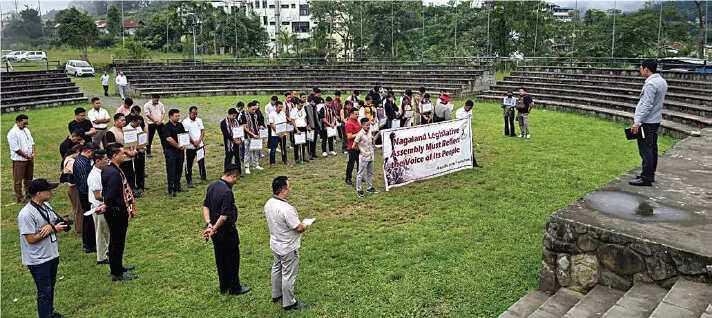
The Naga Students’ Federation (NSF) staged a peaceful protest in Kohima against what it described as the compulsory imposition of the revised version of Vande Mataram during government programmes and official functions in Nagaland.
The demonstration coincided with the commencement of the ninth session of the 14th Nagaland Legislative Assembly on September 1. NSF members and students gathered at Naga Solidarity Park before marching towards the Nagaland Legislative Assembly, demanding that the state Assembly adopt a strong resolution against the compulsory singing or playing of Vande Mataram in the state.
The Naga Students’ Federation protests against Vande Mataram have centred on concerns relating to religious freedom, freedom of conscience and the constitutional rights of the Naga people. The federation has maintained that its protest is not directed against the nation or recognised national symbols, but against what it considers compulsory participation in an activity that could conflict with religious beliefs.
NSF Holds Peaceful Demonstration in Kohima
The protest began at Naga Solidarity Park in Kohima, where NSF leaders addressed students and supporters before the group marched towards the Nagaland Legislative Assembly.
Protesters carried placards with messages including “No Compulsion,” “Respect Faith,” “Respect our rights” and “Freedom of conscience is our rights.” The demonstration remained focused on the federation’s demand for the government and legislators to address the issue during the ongoing Assembly session.
The march took place on the opening day of the Assembly’s Monsoon session in the Christian-majority state. NSF members raised slogans against what they described as the imposition of Vande Mataram and called upon legislators to safeguard the religious beliefs and constitutional rights of the Naga people.
The federation said it wanted the Assembly to formally take up the matter and adopt a resolution opposing compulsory singing, recital or playing of the song during official programmes and functions in Nagaland.
Demand for Nagaland Assembly Resolution
A central demand of the NSF was for the Nagaland Legislative Assembly to pass a resolution or take legislative action against the compulsory use of Vande Mataram in official and other programmes in the state.
NSF president Mteisuding appealed to legislators to take up the issue during the Assembly session. The federation had earlier submitted representations to Nagaland Chief Minister Neiphiu Rio and Assembly Speaker Sharingain Longkumer, seeking their intervention and requesting that the matter be discussed in the House.
The NSF has also sought the tabling of the report of an Assembly Select Committee constituted to examine the Vande Mataram issue. The federation urged the government to ensure that the report is formally placed before the Assembly and followed by a substantive discussion.
According to the federation, a clear resolution would provide assurance that citizens, students, employees and public servants would not face adverse consequences for exercising their freedom of conscience.
NSF Cites Religious Freedom and Freedom of Conscience
The NSF has described the issue as one involving religious freedom and constitutional rights rather than national allegiance.
The federation has maintained that the Naga people have no objection to respecting the National Flag, National Anthem and other duly recognised national symbols. Its concern, it said, relates specifically to the compulsory singing, recital or imposition of Vande Mataram, particularly where its devotional or religious imagery may conflict with the conscience and faith of citizens belonging to non-Hindu communities.
The NSF pointed to constitutional provisions guaranteeing freedom of conscience and the right to freely profess, practise and propagate religion.
The federation argued that national unity and patriotism should be promoted in a manner that respects the religious freedom, dignity and individual conscience of citizens.
It maintained that no individual should be compelled to participate in an activity that conflicts with sincerely held religious beliefs.
Article 371A Also Raised by Protesters
The protesters also drew attention to Article 371A of the Constitution, which provides special constitutional safeguards relating to Nagaland.
The NSF argued that policies or directives affecting the religious practices, beliefs and conscience of the Naga people should be examined while taking these constitutional protections into consideration.
The federation has called on the state government and legislators to protect what it describes as the religious identity, dignity and constitutional rights of the Naga people.
Placards carried during the demonstration also referred to Article 371A, reflecting the importance the protesters attached to the state’s special constitutional position.
Protesters Say Movement Is Not Against the Nation
NSF president Mteisuding clarified during the protest that the federation’s opposition should not be interpreted as an attempt to insult the nation or denounce a national song.
He said the organisation’s objection was based on concerns that the compulsory imposition of Vande Mataram conflicted with the religious faith of the Naga people.
The NSF maintained that its movement was aimed at protecting religious rights and preserving the secular character of Naga society.
The federation also urged members of the Naga community to remain united on the issue and support efforts to protect religious freedom and individual conscience.
The protest leaders stressed that their opposition was directed at compulsion rather than respect for recognised national symbols.
Earlier Opposition to Revised Vande Mataram Directive
The latest protest is part of the NSF’s continuing opposition to directives relating to the singing and playing of the revised version of Vande Mataram.
The federation had earlier expressed concern over a January 28, 2026 notification of the Ministry of Home Affairs concerning the playing, singing and popularisation of the song.
According to the NSF, the directive generated concern among Naga students and communities, particularly over the possibility of compulsory participation in official programmes and educational institutions.
The federation noted that Naga students had previously demonstrated their opposition through peaceful non-participation in certain official events.
It cited instances where students declined to participate in the rendition of the song during programmes, maintaining that their position was based on concerns relating to faith and conscience.
NSF Vows to Continue Its Protest
The NSF indicated that it would continue pursuing its demand until the Nagaland Legislative Assembly addressed the issue.
Mteisuding said the federation would maintain pressure on the government and legislators to adopt a resolution or take other appropriate action concerning the compulsory singing or playing of Vande Mataram.
The federation’s demand has placed the issue before the state Assembly at a time when legislators are meeting for the Monsoon session.
With the NSF calling for a formal discussion and a clear resolution, attention is now likely to remain on the response of the Nagaland government and the Legislative Assembly.
Naga Students’ Federation Protests Highlight Debate Over Compulsion
The Naga Students’ Federation protests against Vande Mataram have brought the debate over compulsory participation, religious freedom and freedom of conscience back into focus in Nagaland.
The NSF has made it clear that it is seeking protection against compulsory singing or playing of the song and has urged the Assembly to adopt a strong and unequivocal resolution on the matter.
For the federation, the issue goes beyond a disagreement over a government programme and concerns what it considers the constitutional and religious rights of the Naga people.
As the Nagaland Legislative Assembly session continues, the response of the state government to the NSF’s demands will be closely watched. The student body’s protest has ensured that the issue of Vande Mataram, religious conscience and constitutional protections remains firmly on the political and public agenda in Nagaland.