

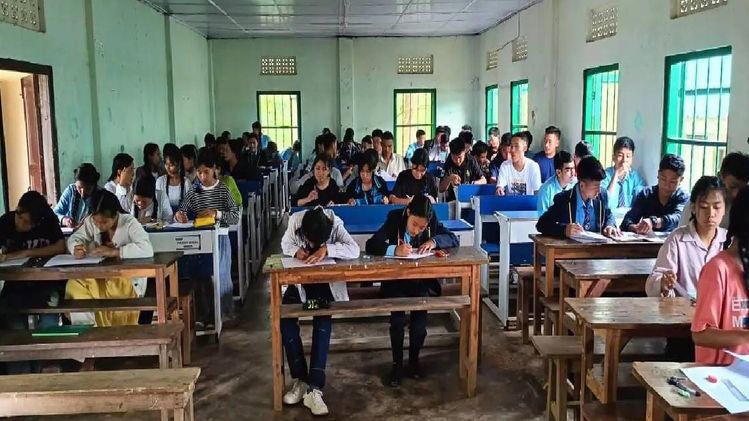
The Nagaland government is set to restructure its school education system by amalgamating schools with low student enrolment and developing larger composite institutions. The move is aimed at improving the quality of education, making better use of available resources and ensuring that students have access to stronger academic infrastructure and teaching facilities.
The decision reflects a growing concern over the large number of schools operating with very few students in several parts of the state. Maintaining separate institutions with low enrolment can place pressure on government resources while also making it difficult to provide adequate teachers, infrastructure and a wider range of educational opportunities.
Under the proposed restructuring, low-enrolment schools are expected to be merged or reorganised into composite institutions that can accommodate students across different classes and educational levels. The larger schools are expected to have better access to teachers, learning facilities and other resources.
The initiative is part of the Nagaland government’s broader effort to strengthen the education sector and address challenges associated with declining or uneven student enrolment.
Why Nagaland Is Amalgamating Low-Enrolment Schools
One of the major reasons behind the proposed move is the need to address schools functioning with a very small number of students.
In some areas, demographic changes, migration and the presence of multiple schools within a limited geographical region have contributed to uneven enrolment. As a result, some schools may have only a handful of students while still requiring separate teachers, administrative staff and infrastructure.
The government believes that consolidating such schools could allow resources to be used more effectively.
Instead of spreading teachers and facilities across several under-enrolled institutions, the education department can concentrate resources in larger composite schools. This could help improve student-teacher interaction, provide access to more specialised teachers and create a stronger academic environment.
The move could also allow schools to offer better facilities, including libraries, laboratories, sports infrastructure and digital learning resources.
What Are Composite Institutions?
Composite institutions generally bring different stages or levels of schooling under a larger and more integrated educational structure.
Rather than operating multiple small and separate schools, the government can develop institutions that serve students from different classes within the same campus or educational network.
This model can help create continuity in a student’s education. Children may be able to continue their studies at the same composite institution instead of having to move to another school after completing a particular level.
Larger institutions can also make it easier to deploy teachers according to their subjects and areas of expertise.
For example, instead of a small school struggling to provide teachers for multiple subjects, a composite institution can have a broader teaching staff and distribute responsibilities more effectively.
Better Use of Teachers and Resources
The proposed school amalgamation is also expected to address the issue of resource utilisation.
Teachers are one of the most important components of the education system. In schools with very low enrolment, a small number of students may be taught by several teachers. While every child deserves access to quality education, such an arrangement can create an imbalance in the distribution of teaching resources.
By reorganising low-enrolment schools, the government aims to ensure that teachers are deployed where they are needed the most.
The same principle applies to infrastructure and government spending.
Maintaining several buildings, administrative systems and facilities can be costly. A composite institution can potentially serve a larger number of students through shared infrastructure and coordinated management.
The government hopes that better resource allocation will ultimately lead to improved educational outcomes.
Focus on Improving the Quality of Education
The key objective of the restructuring is expected to be improving the overall quality of education.
A school with a larger student population and stronger infrastructure can provide students with greater exposure to academic activities, sports, cultural programmes and collaborative learning.
Students may also benefit from interaction with peers from different backgrounds and communities.
Larger composite schools could have the capacity to provide specialised facilities that may not be practical for every small institution.
These could include science laboratories, computer rooms, libraries and other learning resources.
However, the success of the initiative will depend heavily on implementation.
The government will need to ensure that students from amalgamated schools are able to reach their new institutions safely and conveniently. Transportation and accessibility will be particularly important in remote and hilly parts of Nagaland.
Concerns Over Access and Travel Distance
While school amalgamation can improve resource efficiency, it may also create concerns for students and parents.
For families living in remote villages, the closure or merger of a nearby school could mean that children have to travel longer distances to attend classes.
This could particularly affect younger children and students from economically weaker families.
The government will therefore need to consider transportation support, hostel facilities and other measures to ensure that the restructuring does not reduce access to education.
A carefully planned amalgamation process will be essential. Schools located in remote and geographically difficult areas may require a different approach compared with schools situated close to one another in urban or semi-urban regions.
The state government is expected to take local conditions into account while implementing the policy.
Education Reforms and Changing Demographics
The move to amalgamate low-enrolment schools is part of a wider trend in education planning across India.
Several states have faced challenges related to changing population patterns and declining student enrolment in government schools. Migration to cities, falling birth rates in some regions and the growing popularity of private schools have all contributed to changes in the number of students attending government institutions.
Governments are increasingly looking at ways to consolidate resources while improving educational standards.
For Nagaland, the challenge is particularly complex because of the state’s geography and the scattered nature of many communities.
The government will need to balance the benefits of larger institutions with the need to ensure that children in remote areas continue to have access to schools.
Role of Teachers and Local Communities
Teachers, parents and local communities are likely to play an important role in the implementation of the new system.
The success of school amalgamation will depend not only on administrative decisions but also on whether communities understand and support the changes.
Teachers may need to be redeployed, while students could be shifted to new institutions.
This process will require careful coordination to ensure that the transition does not disrupt the academic progress of children.
The government may also need to engage with village authorities, parents and school management bodies before making major changes.
Local feedback could help authorities identify potential challenges related to transportation, infrastructure and student safety.
A New Approach to School Education in Nagaland
The decision to amalgamate low-enrolment schools and create composite institutions signals a major shift in Nagaland’s approach to school education.
Rather than maintaining a large number of small institutions with limited resources, the government is looking towards a model that focuses on stronger, better-equipped and more integrated schools.
If implemented effectively, the initiative could improve teacher deployment, strengthen infrastructure and provide students with a broader learning environment.
At the same time, the government will need to address concerns related to accessibility, transportation and the needs of children living in remote areas.
The ultimate success of the Nagaland school amalgamation plan will depend on how effectively the state balances efficiency with inclusion. While composite institutions could create stronger educational facilities, ensuring that no child is left behind due to distance or geographical challenges will remain the most important part of the reform.