


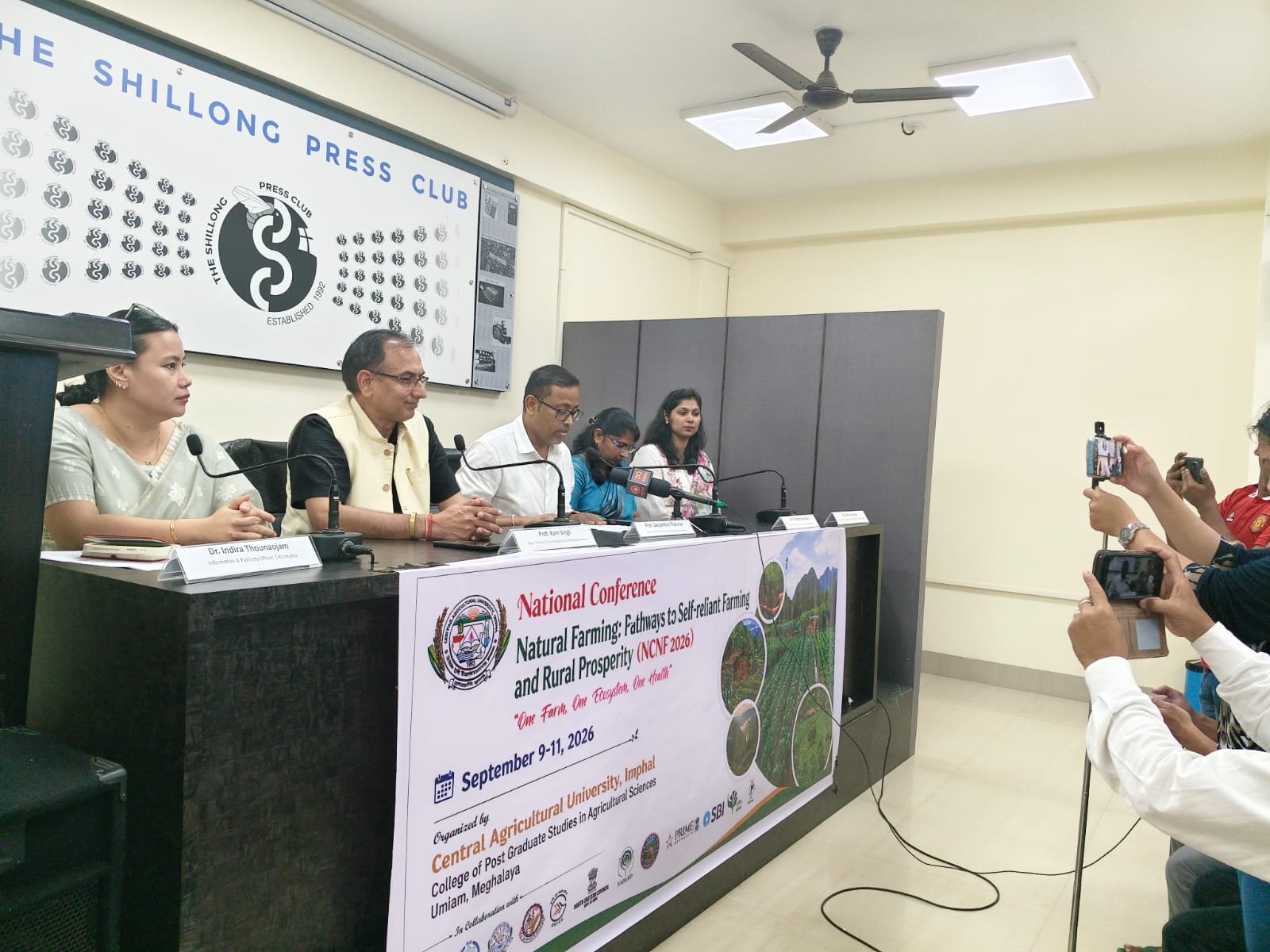
Natural Farming National Conference discussions have brought agricultural experts, researchers and practitioners together at the Post-Graduate Agricultural College in Umami to examine sustainable farming practices and the future of chemical-free agriculture. The participation of representatives from 21 states highlights the growing national interest in approaches that reduce dependence on external agricultural inputs.
The conference provides a platform for sharing experiences from different agricultural regions and discussing practical approaches to sustainable cultivation. Moreover, the event connects academic research with field-level farming practices. Therefore, its discussions could contribute to wider awareness of natural farming methods among students, researchers, farmers and policymakers.
Loktak Lake Fishermen Schemes: Manipur Expands Support for Sustainable Floating Livelihoods
Natural Farming National Conference Brings States Together
The national conference at the Post-Graduate Agricultural College has created an opportunity for agricultural experts from 21 states to exchange knowledge about natural farming and sustainable agriculture. Participants from different regions can bring diverse experiences because farming conditions, soil characteristics, rainfall patterns and crop choices vary considerably across India.
Furthermore, national-level agricultural conferences help institutions compare approaches that farmers use in different parts of the country. Such exchanges can highlight both successful practices and challenges that require further research.
Natural farming has gained attention because it seeks to reduce reliance on synthetic agricultural inputs and emphasise ecological processes. However, different organisations and experts may use different approaches under the broader natural-farming umbrella. Consequently, discussions at academic forums remain important for examining which practices work effectively under particular local conditions.
The participation of 21 states also gives the event a wider national character. Rather than focusing exclusively on one region, the conference allows participants to discuss sustainability from multiple agricultural perspectives.
For an agricultural college, hosting such an event can also provide students with direct exposure to experts working beyond their regular academic curriculum. Therefore, the conference can complement classroom education with discussions about emerging agricultural practices and field experiences.
Sustainable Agriculture Takes Centre Stage
Sustainability has become an important issue for Indian agriculture as farmers face challenges involving soil health, water availability, input costs and changing climatic conditions. Natural farming discussions often focus on maintaining soil ecosystems, recycling farm resources and reducing dependence on purchased inputs.
Moreover, sustainable farming requires more than simply changing individual cultivation practices. Farmers need access to appropriate knowledge, locally suitable techniques, markets and reliable agricultural extension services. Consequently, academic institutions can play an important role by evaluating farming methods and communicating evidence-based information.
Natural farming also encourages greater attention to biological processes within agricultural systems. Farmers may use locally available organic materials and biological preparations as part of different natural-farming approaches. However, the suitability and effectiveness of any particular practice can vary according to crop, climate, soil and farm conditions.
Therefore, conferences involving researchers and practitioners provide an important setting for discussing these differences. Participants can examine field experiences alongside scientific research rather than relying on a single farming model for every region.
The event’s emphasis on sustainability also aligns with India’s broader agricultural priorities. Government programmes increasingly discuss soil health, resource efficiency, climate resilience and sustainable agricultural production. Thus, the conference contributes to a wider national conversation about how agriculture can remain productive while protecting natural resources.
Agricultural Education Connects Research With Farmers
The involvement of a Post-Graduate Agricultural College gives the conference an important academic dimension. Agricultural universities and colleges train future scientists, extension officers and professionals who can influence farming practices through research and field-level engagement.
Furthermore, postgraduate institutions provide opportunities for students to investigate agricultural questions through experiments and research projects. Discussions on natural farming can therefore encourage students to examine topics such as soil biology, crop productivity, input efficiency and ecological sustainability.
Research remains especially important because farmers need practical evidence before adopting new techniques on a large scale. A farming method that performs well in one region may produce different results elsewhere. Consequently, researchers must consider local conditions when evaluating sustainable agricultural practices.
The participation of experts from 21 states can strengthen this exchange of knowledge. Different regions may have developed distinct approaches to managing soil fertility, pests, water and crop residues. Sharing those experiences can help researchers identify questions that deserve further investigation.
Meanwhile, students attending the conference can gain a broader understanding of agriculture beyond their immediate geographical area. They can learn how farming communities in different states respond to environmental and economic challenges.
This interaction between academia and practitioners can ultimately strengthen agricultural extension. When research findings reach farmers through understandable and locally relevant guidance, academic knowledge can have a more direct impact on agricultural decision-making.
Natural Farming Could Shape Future Agricultural Strategies
The growing interest in natural farming reflects a larger debate about the future direction of Indian agriculture. Farmers need systems that maintain productivity while addressing rising concerns about soil degradation, water use, production costs and environmental sustainability.
However, the transition toward any alternative farming system requires careful assessment. Farmers depend on agriculture for their livelihoods, so changes in cultivation practices must consider productivity, income stability, labour requirements and market demand.
Therefore, national conferences can help move the discussion beyond broad slogans. Researchers and agricultural professionals can examine evidence, compare regional experiences and identify practical challenges associated with sustainable farming.
The involvement of 21 states is particularly significant because India has highly diverse agricultural conditions. Crop systems in the Northeast, northern plains, central India, western drylands and southern regions differ substantially. Consequently, sustainable farming strategies may need to remain flexible rather than follow one uniform model.
Moreover, natural farming discussions can encourage greater attention to locally available resources. Efficient resource use can potentially reduce certain external-input requirements, although farmers need reliable information before changing established practices.
Agricultural colleges can contribute by conducting trials, documenting outcomes and training students in both conventional and emerging farming systems. In this way, institutions can support evidence-based agricultural innovation while maintaining a strong connection with farming communities.
The conference at Umami therefore represents more than a gathering of experts. It provides a platform for examining how agricultural education, research and practical farming experience can work together to address sustainability challenges.
Conclusion
Natural Farming National Conference discussions at the Post-Graduate Agricultural College in Umami have brought experts from 21 states together around the growing national conversation on sustainable agriculture. The event creates an important platform for exchanging regional experiences, examining farming practices and connecting agricultural research with practical challenges.
Moreover, the participation of experts from across India highlights the diversity of approaches required for sustainable farming. Soil conditions, crops, climate and farmer needs differ from state to state. Therefore, future natural-farming strategies will need strong research, local adaptation and effective agricultural extension.
The conference can also give students and researchers valuable exposure to national agricultural debates. If such academic and practitioner exchanges continue, they could help strengthen evidence-based approaches to sustainable farming and support farmers seeking viable long-term cultivation systems.
FAQs
What is the Natural Farming National Conference?
The Natural Farming National Conference is an academic and agricultural platform focused on natural farming, sustainability and the exchange of knowledge among agricultural experts and practitioners.
How many states are represented at the conference?
Experts and participants from 21 states are taking part in the conference, giving the event a broad national character.
Why is natural farming receiving greater attention?
Natural farming has gained attention because of growing concerns about soil health, input dependence, water resources, environmental sustainability and the long-term resilience of agricultural systems.
What role can agricultural colleges play in natural farming?
Agricultural colleges can conduct research, evaluate farming techniques, train students and help transfer reliable agricultural knowledge to farmers through extension activities.
Can natural farming methods work across all Indian regions?
Not necessarily. India’s agricultural conditions vary widely, so natural-farming practices need appropriate local testing and adaptation based on crops, soil, climate and farm conditions.