

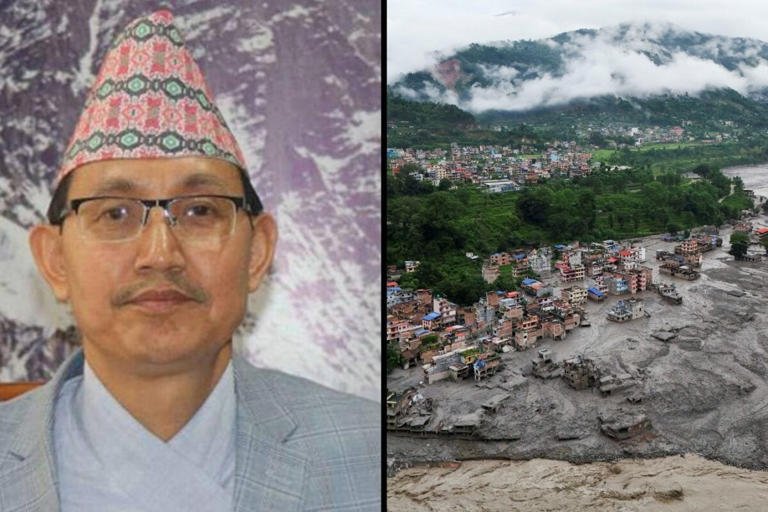
Nepal has appealed to India for financial and technical assistance as the Himalayan nation struggles to respond to the aftermath of devastating flash floods that have caused widespread destruction, killed more than 160 people and left hundreds missing.
In an exclusive interaction, Nepal’s Chief Secretary stressed the need for stronger support from India during the rescue, relief and reconstruction phases. The appeal comes as authorities assess extensive damage to roads, bridges, power infrastructure and settlements in the flood-hit region.
The disaster struck Nepal’s mountainous border region after a massive collapse of ice, rock and debris triggered catastrophic flooding. Rescue teams continue to search for survivors, while authorities work to restore access and essential services in severely affected areas.
India has already extended humanitarian assistance to Nepal. However, the scale of the destruction has highlighted the need for sustained financial and technical cooperation as Nepal moves from emergency relief towards long-term recovery.
Nepal seeks greater support from India
Nepal’s Chief Secretary has called for financial and technical assistance from India as the country confronts the enormous task of rebuilding after the floods.
The immediate priority remains search and rescue operations.
Authorities also need to provide shelter, food, medical care and other essential supplies to affected communities.
However, the challenge will continue long after the emergency phase ends.
The floods have damaged critical infrastructure in difficult Himalayan terrain. Rebuilding roads, bridges and power networks will require significant resources and specialised expertise.
Nepal therefore sees India’s support as important not only for immediate relief but also for reconstruction.
India and Nepal share close geographical, economic and social ties. Their proximity could allow technical teams, equipment and humanitarian supplies to reach affected areas more quickly.
The appeal also underlines Nepal’s need for support in restoring connectivity and rebuilding essential public infrastructure.
Devastating floods leave trail of destruction
The flash floods caused extensive devastation in Nepal’s mountainous border areas.
Homes and settlements were swept away, while roads, bridges and power infrastructure suffered severe damage.
The disaster also affected tourists and pilgrims from several countries.
Authorities have reported a large number of missing people, including foreign nationals. Rescue teams have deployed personnel and equipment as the search continues in challenging terrain.
The destruction has complicated rescue operations.
Damaged roads have restricted access to several affected locations. Communication and electricity networks have also suffered disruption.
Helicopters and emergency teams have played a crucial role in reaching isolated communities.
Officials face the difficult task of locating survivors while also assessing the full scale of the damage.
The situation could continue to evolve as rescue teams reach areas that remain difficult to access.
Financial assistance crucial for Nepal’s recovery
Reconstruction after a major natural disaster requires substantial financial resources.
Nepal will need funds to rebuild damaged public infrastructure and support affected families.
Roads and bridges will require repairs or complete reconstruction in several areas.
Authorities must also restore electricity and communication networks.
The rebuilding effort could place significant pressure on government resources.
Financial assistance from neighbouring countries and international institutions can help Nepal accelerate recovery.
The World Bank, India, China and other international partners have already announced or mobilised support in response to the disaster.
However, Nepal’s appeal highlights the need for continued assistance as the country assesses its longer-term requirements.
Emergency aid can address immediate humanitarian needs.
Reconstruction, however, requires sustained investment over a longer period.
Technical expertise can support reconstruction
Nepal’s request also focuses on technical assistance.
Rebuilding infrastructure in the Himalayan region presents unique engineering challenges.
The affected areas feature steep terrain and remain vulnerable to landslides, flooding and other natural hazards.
Roads and bridges must therefore be rebuilt with future risks in mind.
Technical cooperation could help Nepal assess damaged infrastructure and identify safer reconstruction methods.
India has extensive experience in building and maintaining infrastructure in Himalayan and other geographically challenging regions.
Nepal could seek assistance in areas such as road engineering, bridge construction, power restoration and disaster management.
Technical experts could also help assess geological risks before reconstruction begins.
This approach could reduce the possibility of rebuilding vulnerable infrastructure in areas exposed to future disasters.
India already sends emergency humanitarian aid
India has moved quickly to provide assistance following the disaster.
According to official and international reports, India dispatched emergency relief supplies to Nepal, including temporary shelters, blankets, hygiene kits, solar lamps and medicines.
The Indian government has also said it stands with Nepal during the crisis.
Prime Minister Narendra Modi spoke with Nepal’s leadership and conveyed India’s solidarity with the people affected by the floods.
Indian authorities have also remained alert because flooding and changes in Himalayan river systems can create risks downstream.
The central government has placed disaster-response agencies on alert in vulnerable areas of Bihar and Uttar Pradesh.
The latest appeal from Nepal suggests that cooperation may need to expand beyond immediate humanitarian supplies.
The focus could increasingly shift towards restoring infrastructure and supporting long-term recovery.
Roads, bridges and power infrastructure need restoration
The floods caused major damage to critical infrastructure.
Roads and bridges are particularly important because they connect remote Himalayan communities with markets, hospitals and emergency services.
Their destruction can isolate entire settlements.
Restoring transport links will therefore remain a priority.
Power infrastructure has also suffered serious damage in affected areas.
The loss of electricity can disrupt hospitals, communication systems and relief operations.
Technical support could help authorities restore these essential services more quickly.
Nepal may also need to review the resilience of infrastructure located in vulnerable river valleys.
Future construction could require stronger safety standards and better disaster-risk planning.
The recovery process may therefore involve both rebuilding and redesigning damaged systems.
Rescue operations continue amid difficult conditions
Search and rescue operations remain a major priority.
Thousands of personnel have been involved in efforts to locate survivors and provide assistance.
However, difficult terrain and damaged infrastructure have created significant challenges.
Floodwaters, debris and unstable slopes have complicated access to several locations.
Rescuers have also faced concerns about further landslides and changing conditions in the affected Himalayan region.
Authorities continue to assess the number of people missing.
The disaster has affected local residents as well as foreign tourists and pilgrims.
As rescue efforts continue, Nepal will require sustained logistical support and specialised equipment.
Helicopters, communication systems and emergency medical supplies could remain crucial in the coming days.
India-Nepal cooperation important for disaster response
The latest disaster has once again highlighted the importance of regional cooperation.
Natural disasters in the Himalayas can affect more than one country.
Rivers and weather systems cross national borders. Flooding and landslides can therefore create risks for communities across the wider region.
India and Nepal have a long history of cooperation in infrastructure and disaster management.
Greater coordination could help improve early-warning systems and emergency preparedness.
The current crisis may also renew discussions about monitoring vulnerable Himalayan regions.
Scientists and disaster-management authorities increasingly recognise the risks associated with changing glaciers and unstable mountain slopes.
Sharing technical knowledge could help countries identify threats earlier.
Better coordination may also improve evacuation planning and emergency response.
Long-term recovery will require sustained partnership
The immediate humanitarian response represents only the first stage of Nepal’s recovery.
The country will face a much longer process of reconstruction.
Affected families will need homes, livelihoods and access to essential services.
Local economies may also require support after infrastructure and tourism activities suffered major disruption.
Financial assistance could help Nepal rebuild public infrastructure.
Technical cooperation could help ensure that new projects are more resilient.
The country’s appeal to India reflects the importance of combining these two forms of support.
Reconstruction will require money, expertise, equipment and long-term planning.
International assistance can support these efforts.
However, Nepal’s close relationship and geographical proximity with India could make bilateral cooperation particularly important.
Nepal’s appeal highlights scale of reconstruction challenge
Nepal’s request for financial and technical support from India reflects the enormous challenge created by the devastating floods.
The immediate focus remains on rescuing survivors and helping displaced communities.
Yet the scale of infrastructure damage means that recovery will continue for months and possibly years.
India has already extended humanitarian support and expressed solidarity with Nepal.
The next phase could involve deeper cooperation on reconstruction, engineering and disaster resilience.
For Nepal, the challenge is not simply to rebuild what the floods destroyed.
The country must also prepare for future risks in an increasingly vulnerable Himalayan environment.
Financial assistance can help fund recovery.
Technical expertise can help Nepal rebuild stronger and safer infrastructure.
As rescue operations continue and the full extent of the destruction becomes clearer, Nepal’s appeal for support from India is likely to remain an important part of the wider recovery effort.