

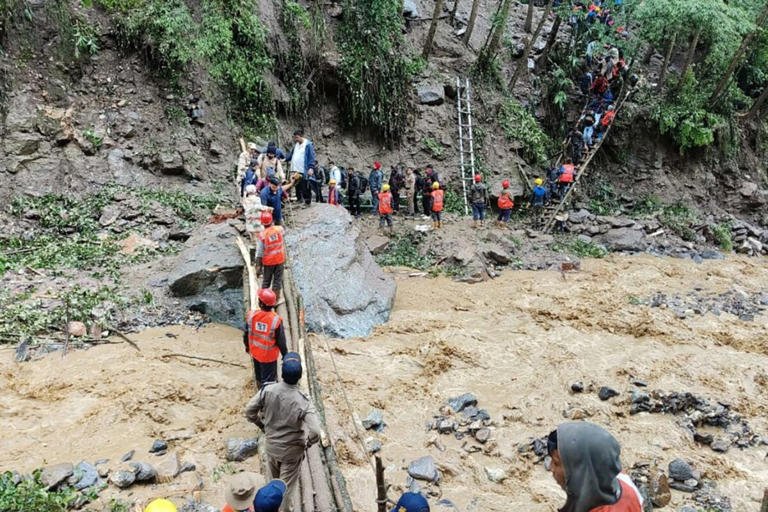
The devastating glacier-related disaster in Nepal has renewed concerns across the Himalayan region, including in Sikkim, where 16 glacial lakes have been identified as high-risk and are under close monitoring.
However, experts and officials have stressed that the circumstances behind Nepal’s recent catastrophe and the risks associated with Sikkim’s vulnerable glacial lakes are not identical. While the Nepal disaster was triggered by a massive glacier and rock collapse that unleashed a destructive flood, Sikkim’s identified lakes are primarily being monitored for the potential threat of Glacial Lake Outburst Floods (GLOFs).
The distinction is important, but the disaster has nevertheless served as a stark reminder that rapidly changing Himalayan landscapes require constant scientific monitoring, stronger early-warning systems and improved preparedness.
Nepal Disaster Triggered by Glacier Collapse
The recent disaster in Nepal was not a conventional monsoon flood. A collapse involving glacier ice and rock in the high Himalayas triggered a catastrophic chain of events, sending a torrent of water, mud, rocks and debris downstream.
The sudden nature of the event demonstrated the dangers posed by unstable mountain slopes, melting glaciers and rapidly changing high-altitude environments. Scientists have warned that warming temperatures can weaken ice and permafrost, increasing the likelihood of such ice-rock avalanches and other cascading disasters.
The Nepal tragedy has therefore highlighted a broader challenge for Himalayan states: not every glacier-related disaster begins with a glacial lake bursting. Some events can originate from collapsing ice masses, unstable rock slopes or avalanches, which may subsequently block rivers and trigger sudden floods.
Sikkim’s 16 High-Risk Lakes Face a Different Threat
Sikkim, meanwhile, has identified 16 glacial lakes under its high-vulnerability assessment. Of these, 13 are located in North Sikkim and three in West Sikkim.
The primary concern surrounding these lakes is the possibility of a GLOF, which occurs when water suddenly escapes from a glacial lake after the failure or breach of a natural barrier, such as a moraine or ice dam.
Such an event can send enormous volumes of water and debris through narrow mountain valleys within a short period, posing serious risks to downstream settlements, roads, bridges and hydropower infrastructure.
While Nepal’s recent disaster involved a glacier and rock collapse, the high-risk classification of Sikkim’s lakes relates to the potential instability of the lakes and their natural barriers. This means the hazards are different in their immediate mechanisms, even though both are connected to the growing vulnerability of the Himalayas.
Sikkim Already Experienced a Major GLOF Disaster
Sikkim’s concern over glacial lake risks is not merely theoretical.
The state witnessed a devastating glacial lake outburst flood in October 2023 after the South Lhonak Lake burst, triggering catastrophic flooding along the Teesta river system. The disaster caused widespread destruction to infrastructure and communities downstream.
That experience has made glacial lake monitoring and disaster preparedness a major priority for the state. The recent Nepal tragedy has further intensified discussions about whether existing systems are capable of detecting rapidly developing hazards in time to protect vulnerable communities.
The Nepal disaster is therefore being viewed as an important warning, not because Sikkim’s 16 lakes are expected to produce the same type of disaster, but because the Himalayas are capable of producing multiple forms of interconnected and rapidly escalating hazards.
Sensors and Early-Warning Systems Strengthened
Sikkim has stepped up monitoring efforts at its vulnerable glacial lakes, installing sensors and strengthening early-warning mechanisms.
The monitoring systems are designed to track changes that could indicate growing risks and provide authorities with information needed to issue alerts to downstream communities. However, experts have also warned that technology cannot completely eliminate the threat posed by sudden high-altitude disasters.
The Nepal catastrophe demonstrated how rapidly glacier-related events can unfold, leaving authorities with limited time to respond. The effectiveness of an early-warning system therefore depends not only on sensors but also on reliable communication networks, real-time data analysis and well-prepared evacuation plans.
Climate Change Raises Risks Across the Himalayas
Despite the differences between Nepal’s glacier collapse and the risks posed by Sikkim’s glacial lakes, both situations are linked to wider concerns over climate change.
Rising temperatures are contributing to glacier retreat, the growth of glacial lakes and the weakening of frozen mountain slopes. Scientists have warned that the Hindu Kush Himalaya is becoming increasingly vulnerable to floods, avalanches, landslides and other cascading disasters as the climate continues to warm.
The challenge for Himalayan states is that risks can evolve quickly. A lake considered stable today may change as glaciers retreat, rainfall patterns shift and surrounding slopes become unstable.
Preparedness Remains the Biggest Lesson
The Nepal disaster has reinforced the need for Sikkim and other Himalayan states to prepare for multiple types of mountain hazards rather than focusing on a single disaster scenario.
The state’s 16 high-risk glacial lakes may face a different immediate threat from the event that devastated Nepal, but the underlying message remains the same: Himalayan hazards require continuous monitoring and faster warning systems.
With climate change transforming glaciers and mountain landscapes, experts believe preparedness, scientific research and timely communication will be crucial to reducing future losses.
Nepal’s tragedy is therefore a warning for Sikkim—not because the state’s vulnerable glacial lakes are identical to the disaster site in Nepal, but because the fragile Himalayas are increasingly producing complex and unpredictable risks that demand constant vigilance.