

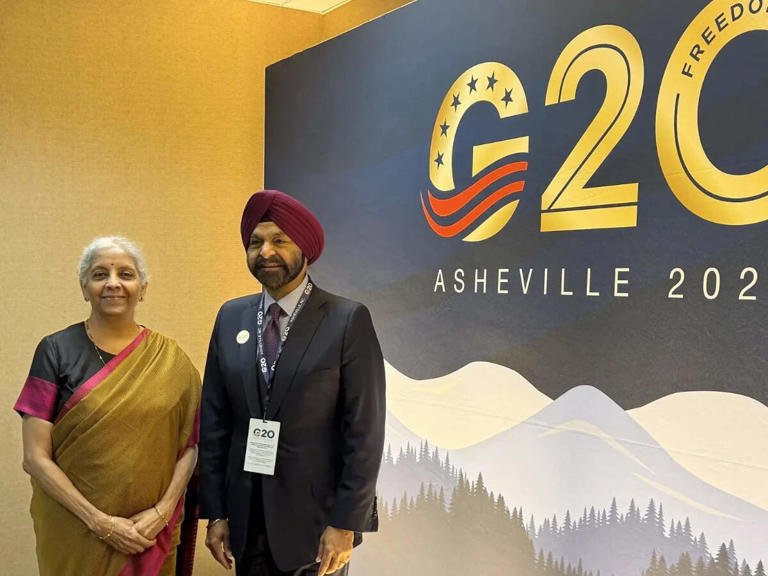
Union Finance and Corporate Affairs Minister Nirmala Sitharaman held a meeting with World Bank Group President Ajay Banga to discuss ways to further deepen cooperation between India and the global financial institution, with a focus on infrastructure financing, private capital mobilisation, bond markets, digital innovation and tourism development.
The Nirmala Sitharaman Ajay Banga meeting took place on the sidelines of the G20 Finance Ministers and Central Bank Governors Meeting in Asheville, United States. The discussions reflected India’s growing engagement with the World Bank Group and explored ways to move the partnership beyond the traditional lender-borrower relationship towards a broader platform for knowledge, innovation and investment.
Focus on Strengthening India-World Bank Partnership
During the meeting, Sitharaman appreciated the World Bank Group’s continued engagement with India and acknowledged the speedy processing of $1.5 billion in Development Policy Financing.
The Finance Minister also welcomed the International Finance Corporation’s support for micro, small and medium enterprises through the Small Industries Development Bank of India. The IFC-supported initiative was processed in record time and has already had a positive impact on the MSME sector, according to the Finance Ministry.
The discussions focused on strengthening the India-World Bank Group partnership to support the country’s development priorities while also expanding opportunities for private investment and innovative financing mechanisms.
Larger Role for MIGA in Infrastructure Finance
One of the major areas discussed during the meeting was the possibility of expanding the role of the Multilateral Investment Guarantee Agency, or MIGA, in India.
The two leaders explored ways in which MIGA’s guarantees could help deepen India’s corporate, infrastructure and municipal bond markets. The systematic use of guarantees could help mobilise greater private capital for large development projects and infrastructure initiatives.
The discussions also covered a sector-based and programmatic approach to credit enhancement for infrastructure. Such mechanisms could help improve the ability of infrastructure projects to attract investment by reducing certain financial and political risks associated with long-term investments.
The proposed approach is expected to strengthen the use of innovative financing tools as India continues to expand its infrastructure and development programmes.
Ajay Banga Appreciates India’s Infrastructure Transformation
World Bank Group President Ajay Banga acknowledged the significant transformation that has taken place in India’s infrastructure sector.
According to the Finance Ministry, Banga noted that there are further opportunities to use World Bank Group instruments to support India’s development ambitions.
The discussions included the possibility of greater MIGA engagement and the use of political risk insurance to support Indian companies making investments overseas.
Political risk insurance and other guarantee mechanisms can help companies manage risks while expanding their international operations. This could become increasingly relevant as Indian businesses explore investment opportunities in global markets and seek to expand their international presence.
The meeting therefore examined not only domestic infrastructure financing but also ways in which international financial instruments could support India’s broader economic ambitions.
Digital Public Infrastructure Knowledge Hub Discussed
Another important area of discussion was India’s engagement with the World Bank Group on establishing a Global Digital Public Infrastructure Knowledge Hub in India.
Sitharaman highlighted the progress of discussions around the proposed initiative and expressed hope for early movement towards its launch.
India’s experience in building and implementing Digital Public Infrastructure has increasingly drawn international attention. The proposed knowledge hub could create a platform for sharing experiences, expertise and best practices with other countries and development partners.
The Finance Minister and the World Bank chief also discussed opportunities to leverage technology in sectors such as agriculture.
The use of digital technologies in agriculture has the potential to support better access to information, improve planning and strengthen links between farmers, markets and government services. The discussion reflected the broader effort to combine India’s technological capabilities with global development expertise.
Tourism Development Under New Partnership Framework
Sitharaman and Banga also discussed developing globally competitive tourism destinations in India under the new India-World Bank Group Country Partnership Framework.
The proposed approach would involve coordinated support from different institutions within the World Bank Group.
The International Bank for Reconstruction and Development could provide policy and infrastructure support, while the International Finance Corporation could contribute through investment opportunities. MIGA could provide guarantees to help mobilise additional private capital.
The coordinated approach could support the development of tourism destinations by bringing together infrastructure development, policy support, private investment and risk mitigation.
Tourism has emerged as an important sector for employment generation and local economic development, and the discussions highlighted opportunities to develop destinations capable of attracting both domestic and international visitors.
Moving Beyond the Traditional Lender-Borrower Relationship
A key theme of the Nirmala Sitharaman Ajay Banga meeting was the effort to evolve the India-World Bank relationship beyond the traditional model of a lender and borrower.
The two leaders discussed developing the partnership into a strategic platform focused on global knowledge, innovation and private capital mobilisation.
The approach would combine India’s scale and capacity for implementing large development programmes with the World Bank Group’s global experience, technical expertise and financing instruments.
This represents a broader vision for international development partnerships, where cooperation is not limited to providing financial assistance but also includes knowledge-sharing, technology, institutional expertise and the mobilisation of investment.
Such a partnership could help India access a wider range of global experiences while also allowing Indian development models and innovations to contribute to international discussions.
Greater Focus on Private Capital Mobilisation
Private capital mobilisation emerged as a central component of the discussions.
India’s infrastructure and development ambitions require substantial investment, and greater participation from private investors can complement public expenditure and traditional development financing.
Guarantees, credit enhancement and risk mitigation tools were discussed as possible ways to encourage greater private sector participation.
The World Bank Group’s different institutions can potentially play complementary roles by providing policy support, investment, guarantees and risk insurance.
The discussions between Sitharaman and Banga therefore focused on building financial structures capable of attracting more private capital into sectors that are important for India’s long-term growth.
Infrastructure, corporate finance and municipal financing were among the areas identified for deeper engagement.
Meeting Signals Expanding Strategic Cooperation
The meeting between Sitharaman and Banga came as India continues to expand its engagement with global financial institutions and international partners to support its economic and development priorities.
The discussions covered a wide range of sectors, from infrastructure and capital markets to digital technology, agriculture and tourism.
The emphasis on guarantees, private investment and knowledge-sharing indicates an effort to create a more diversified and strategic framework for cooperation between India and the World Bank Group.
As India pursues ambitious infrastructure, technology and development goals, the World Bank Group’s global expertise and range of financial instruments could play an increasingly important role.
The Nirmala Sitharaman Ajay Banga meeting underlined the shared interest in building a deeper partnership that combines India’s implementation capacity with global knowledge, innovative financing and greater private capital mobilisation. The discussions are expected to contribute to the evolution of India-World Bank cooperation into a broader strategic partnership focused on supporting India’s future development ambitions.