


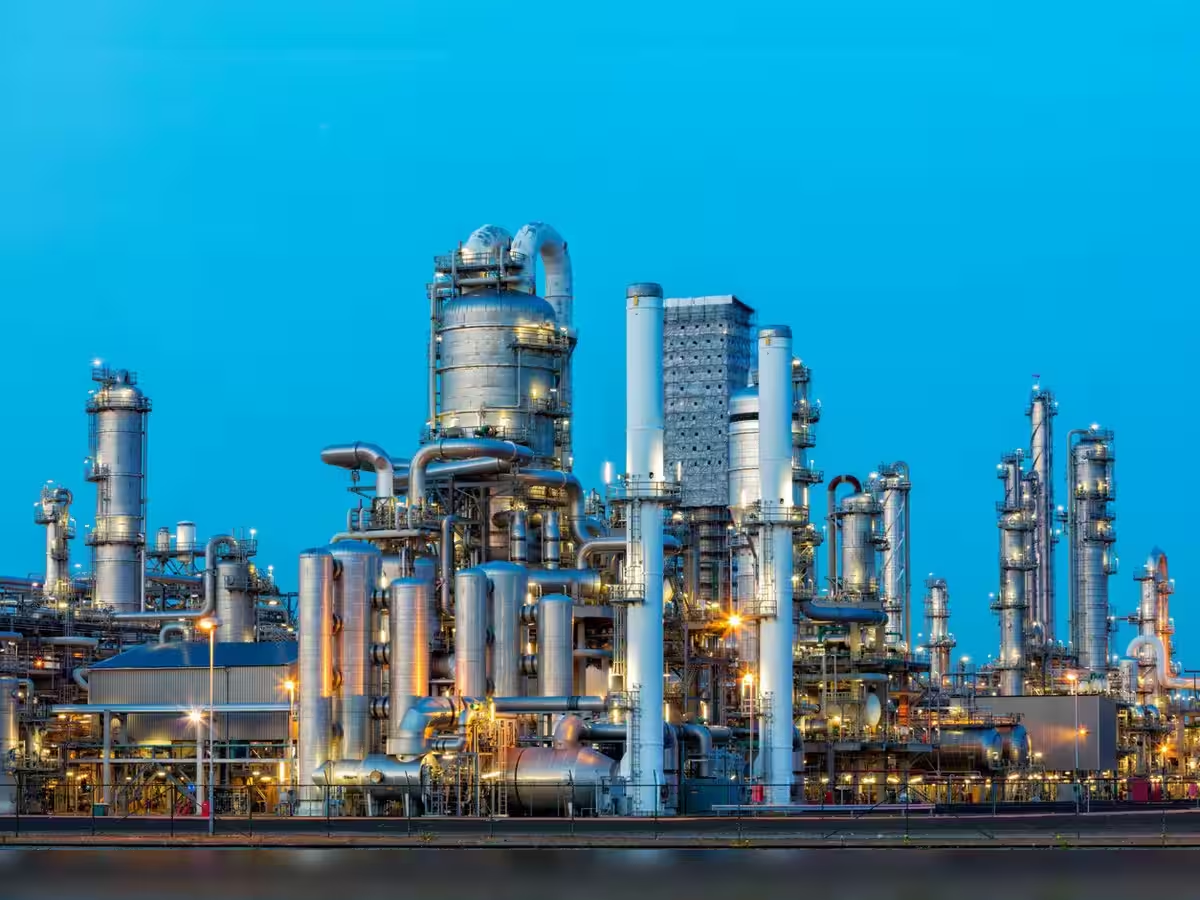
The NRL massive refiner expansion has reached 87.1% physical progress as Numaligarh Refinery Limited advances its flagship project to triple refining capacity from 3 million tonnes per annum to 9 MMTPA. The update was reported after the company’s 33rd Annual General Meeting in Guwahati.
The expansion involves a new 6 MMTPA refinery at Numaligarh, Golaghat, alongside associated infrastructure. NRL expects the expanded refinery to be commissioned by March 2027, strengthening its ability to serve Assam, the wider Northeast and eastern India.
Pakyong Light Vehicle Access Allowed as Routes Remain Under Strict Surveillance
NRL Massive Refiner Expansion Reaches 87.1% Milestone
The NRL massive refiner expansion represents one of the company’s largest ongoing infrastructure projects. NRL’s existing refinery has a crude-processing capacity of 3 MMTPA, while the expansion will add another 6 MMTPA through a new refinery unit.
As a result, the company’s total refining capacity will rise to 9 MMTPA. The project therefore represents a threefold increase in NRL’s crude-processing capability once the new facilities become operational.
NRL Chairman Ranjit Rath said after the company’s 33rd AGM that the Numaligarh Refinery Expansion Project had achieved 87.1% physical progress. The company continues to treat the expansion as its immediate priority before taking forward its proposed polypropylene unit.
The 87.1% figure refers to physical progress rather than completion or commercial operation. Therefore, the project still requires further construction, commissioning and integration work before the expanded capacity becomes fully available.
NRL’s own corporate information describes the project as a major capacity-augmentation programme designed to increase the refinery from 3.0 MMTPA to 9.0 MMTPA.
New Refinery Will Add 6 MMTPA Capacity
The expansion involves establishing a new 6 MMTPA refinery alongside the existing facilities at Numaligarh in Assam’s Golaghat district. The additional capacity will allow NRL to process significantly larger quantities of crude once the project reaches full operation.
The project was approved by the Cabinet Committee on Economic Affairs in January 2019. NRL’s official information identifies the expansion as part of the Government of India’s broader Hydrocarbon Vision 2030 for the Northeast.
Moreover, the expansion is designed around imported crude because domestic crude production in the Northeast cannot provide all the additional feedstock required for the larger refinery. NRL has therefore developed associated infrastructure to bring additional crude to Numaligarh.
A key component is the Paradip-Numaligarh Crude Oil Pipeline. NRL’s project plan envisages a roughly 1,635-kilometre pipeline connecting Paradip in Odisha with Numaligarh to transport imported crude.
Consequently, the refinery expansion and crude pipeline form interconnected parts of the broader capacity-augmentation programme. The additional refinery capacity will require reliable crude supplies as well as infrastructure for transporting and distributing finished petroleum products.
Project Timeline Extends to March 2027
The latest progress update also provides greater clarity about the project’s expected commissioning schedule. NRL is targeting March 2027 for commissioning of the expanded refinery.
The timeline represents a revision from earlier targets. CRISIL Ratings reported in August 2026 that the refinery and pipeline project had achieved around 88% physical progress as of May 31, 2026 and that commissioning had shifted to March 2027 from the earlier September 2026 target.
The difference between the 87.1% figure reported for March 31 and the approximately 88% figure reported for May 31 reflects different reporting dates and should not be treated as contradictory completion figures.
Furthermore, NRL Managing Director Bhaskar Jyoti Phukan said commissioning would follow the normal sequence for a refinery, with utilities and primary units coming before secondary units. He said plant-by-plant commissioning would continue and expressed confidence in completing the project by March 2027.
Therefore, reaching the physical-progress milestone does not mean that the entire expanded refinery can immediately operate at its final capacity. Commissioning and testing of individual systems remain important stages before commercial production.
Investment and Infrastructure Scale
The scale of the expansion has also changed considerably since the original project approval. CRISIL Ratings reported that the refinery project’s estimated cost had increased from the original ₹28,026 crore to ₹37,720 crore.
The integrated refinery and petrochemical complex has also seen an increase in its overall estimated cost. According to CRISIL, the combined refinery and petrochemical project cost reached ₹44,951 crore, including the refinery expansion and a 360 KTPA petrochemical project.
The petrochemical component is being treated separately from the immediate refinery expansion priority. NRL Chairman Ranjit Rath said the company would focus first on completing the refinery expansion before moving ahead with the proposed polypropylene unit.
This sequencing reflects the importance of bringing the core refining capacity online. Additionally, the larger refinery will provide increased feedstock availability for future downstream projects.
NRL has also received Navratna status, giving the public-sector company greater financial and operational autonomy. The company’s official information identifies it as a Navratna public-sector undertaking under the Ministry of Petroleum and Natural Gas.
Expansion Targets Northeast and Eastern India
The capacity increase is expected to strengthen NRL’s ability to serve fuel markets across the Northeast and eastern India. The company’s leadership has highlighted rising petroleum-product demand in the region as a major reason for expanding the refinery.
With capacity rising from 3 MMTPA to 9 MMTPA, NRL will have substantially greater processing capability. Consequently, the company expects to strengthen supplies to the eight northeastern states while also serving markets such as West Bengal.
The expansion could also improve NRL’s ability to pursue markets outside the Northeast. The company’s leadership has discussed opportunities in neighbouring countries after the refinery expansion stabilises.
NRL already has cross-border petroleum links. Its Siliguri facilities support product distribution, while the India-Bangladesh Friendship Pipeline has enabled petroleum-product movement between India and Bangladesh. NRL has also been identified as the Indian refinery supplying high-altitude diesel to Bhutan.
However, international expansion will depend on market conditions and the successful stabilisation of the expanded refinery. Therefore, the immediate priority remains commissioning the additional domestic refining capacity.
Product Evacuation Infrastructure Also Being Expanded
Increasing refinery capacity also requires sufficient infrastructure to move finished petroleum products to consumers. NRL has therefore been expanding its Siliguri Marketing Terminal alongside the refinery project.
The company reported that the Siliguri Marketing Terminal expansion and augmentation had reached 86.3% physical progress at the end of the financial year. The terminal is intended to support product evacuation after the expanded refinery becomes operational.
This supporting infrastructure is important because the additional products generated at Numaligarh will need to reach markets efficiently. Moreover, NRL operates in a region where transportation logistics can be challenging because of geographic distances and connectivity constraints.
The company’s broader expansion strategy therefore involves more than simply constructing a larger refinery. It includes crude transportation, product evacuation and marketing infrastructure designed to support higher throughput.
Consequently, the successful commissioning of the 9 MMTPA refinery will depend on the coordinated operation of these interconnected facilities.
NRL Expansion Could Reshape Regional Energy Supply
The NRL massive refiner expansion could significantly increase the company’s role in India’s eastern and northeastern petroleum market once the project becomes operational.
The existing 3 MMTPA refinery has already played an important role in supplying petroleum products to the region. Tripling capacity will give NRL a substantially larger production base and could reduce the need to source additional products from refineries located farther away.
Moreover, higher local refining capacity could support industrial development around the refinery and associated infrastructure. The project also requires a large network of engineering, construction, transportation and operational activities.
However, the final economic impact will depend on the project’s commissioning, utilisation rates and market conditions after the expansion becomes operational. Therefore, the 87.1% progress figure should be viewed as an important construction milestone rather than evidence that the projected benefits have already materialised.
NRL’s leadership has nevertheless positioned the project as the company’s immediate strategic priority. The next major milestone will be the completion and commissioning of the expanded refinery by the targeted March 2027 timeline.
Conclusion
The NRL massive refiner expansion has reached 87.1% physical progress, marking a major milestone in Numaligarh Refinery Limited’s plan to triple its refining capacity from 3 MMTPA to 9 MMTPA. The project includes a new 6 MMTPA refinery and associated crude and product transportation infrastructure.
NRL is targeting March 2027 for commissioning of the expanded refinery. The company has also prioritised completing the refinery expansion before advancing its proposed polypropylene project.
The larger refinery is expected to strengthen petroleum-product availability across the Northeast and eastern India while providing NRL with greater capacity to pursue regional and international markets. However, further construction, commissioning and integration work remain before the expanded 9 MMTPA facility becomes fully operational.
FAQs
What is the NRL massive refiner expansion?
The NRL massive refiner expansion is Numaligarh Refinery Limited’s project to increase crude-processing capacity from 3 MMTPA to 9 MMTPA by adding a new 6 MMTPA refinery.
What is the current physical progress of the NRL expansion?
NRL reported 87.1% physical progress for the Numaligarh Refinery Expansion Project as of March 31, 2026.
When is the expanded refinery expected to be commissioned?
NRL is targeting March 2027 for commissioning of the expanded refinery.
Where is the expanded refinery located?
The expansion is being developed at Numaligarh in Golaghat district, Assam, alongside NRL’s existing refinery.
Why is NRL expanding from 3 to 9 MMTPA?
The expansion is intended to meet rising petroleum-product demand in the Northeast and eastern India while giving NRL greater refining capacity and opportunities to serve wider regional markets.