

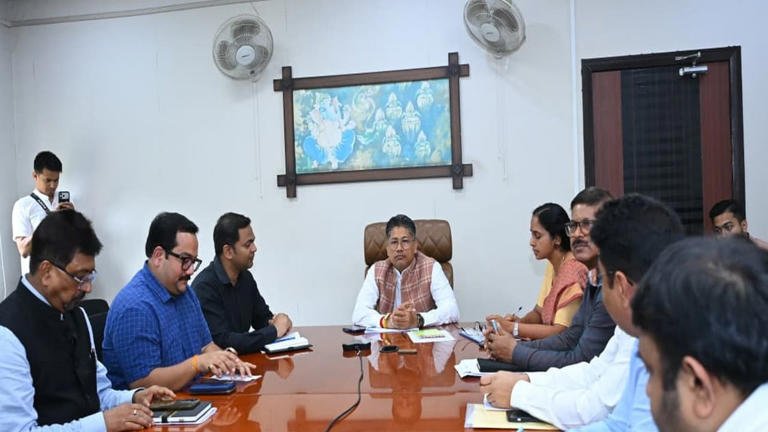
Assam Water Resources and Information & Public Relations Minister Pijush Hazarika reviewed the progress of a pilot irrigation project in Guwahati, reaffirming the state government’s commitment to improving water management and strengthening agricultural infrastructure. The review visit formed part of ongoing efforts to assess the effectiveness of innovative irrigation initiatives aimed at enhancing water availability, boosting farm productivity, and supporting sustainable agricultural development across Assam.
During the inspection, the minister interacted with officials, engineers, and project personnel to evaluate the implementation status, operational efficiency, and future potential of the pilot initiative. The project is expected to serve as a model for similar interventions in other parts of the state, particularly in areas facing irrigation challenges.
The review reflects the government’s broader focus on modernizing water resource management and ensuring that farmers have access to reliable irrigation facilities to support year-round agricultural activities.
Minister Assesses Progress of Pilot Initiative
Pijush Hazarika closely examined various components of the pilot irrigation project and sought updates from officials regarding its implementation and performance. The minister reviewed technical aspects of the scheme, including water distribution systems, infrastructure development, and operational mechanisms designed to improve irrigation efficiency.
Officials briefed the minister on the project’s objectives and progress achieved so far. Discussions focused on the effectiveness of the infrastructure in delivering water to agricultural areas and the potential benefits for farming communities.
Hazarika emphasized the importance of ensuring that public infrastructure projects deliver tangible outcomes and contribute meaningfully to development goals. He directed officials to maintain quality standards and ensure that the project functions efficiently.
The review also provided an opportunity to identify challenges and explore measures for further strengthening the initiative.
Focus on Strengthening Agricultural Infrastructure
Agriculture remains a key sector of Assam’s economy, supporting the livelihoods of a large section of the population. Reliable irrigation facilities are essential for improving agricultural productivity and reducing dependence on unpredictable rainfall patterns.
During the review, the minister highlighted the government’s commitment to strengthening agricultural infrastructure through strategic investments in irrigation systems and water management projects. He noted that expanding irrigation coverage can significantly enhance crop production and improve income opportunities for farmers.
The pilot project is designed to demonstrate how modern irrigation techniques can be effectively implemented to maximize water utilization and support agricultural growth.
Officials believe that successful implementation could pave the way for wider adoption of similar systems across various districts of the state.
Importance of Efficient Water Management
One of the key objectives of the pilot project is to promote efficient use of water resources. Water management has become increasingly important due to changing climatic conditions, population growth, and rising demand for agricultural production.
Pijush Hazarika stressed that sustainable water management is essential for ensuring long-term agricultural resilience and food security. He noted that modern irrigation systems can help reduce water wastage while improving productivity.
The minister observed that effective management of water resources can contribute to environmental sustainability and support the state’s broader development objectives. By optimizing water usage, irrigation projects can help farmers cultivate crops more efficiently and improve overall agricultural outcomes.
Officials explained that the pilot initiative incorporates innovative approaches aimed at maximizing the benefits of available water resources.
Enhancing Support for Farmers
A major focus of the project is to improve support for farmers by ensuring access to reliable irrigation facilities. Agriculture in many parts of Assam remains dependent on seasonal rainfall, making farming activities vulnerable to weather variations.
The minister emphasized that irrigation infrastructure can provide farmers with greater flexibility and stability, enabling them to plan cultivation activities more effectively. Access to water throughout the year can support multiple cropping cycles and increase agricultural productivity.
Officials noted that improved irrigation systems can also encourage diversification into higher-value crops, thereby enhancing income opportunities for rural households.
The government views investments in irrigation as an important tool for empowering farmers and strengthening the agricultural economy.
Potential for Replication Across Assam
The pilot project is being closely monitored because of its potential to serve as a model for future irrigation initiatives. If successful, the project could provide valuable insights into effective water management practices and infrastructure solutions that can be replicated elsewhere.
Pijush Hazarika stated that pilot initiatives play an important role in testing innovative approaches before larger-scale implementation. Lessons learned from the project can help inform future policy decisions and investment strategies.
Officials are expected to evaluate various aspects of the project, including cost-effectiveness, operational performance, and impact on agricultural productivity. The findings will guide future efforts aimed at expanding irrigation coverage across the state.
The minister expressed optimism that successful outcomes could contribute to broader improvements in Assam’s irrigation network.
Role of Technology in Modern Irrigation
The review also highlighted the growing role of technology in water resource management and irrigation planning. Modern irrigation systems increasingly rely on advanced technologies to improve efficiency, monitor performance, and optimize resource utilization.
Officials explained that technological innovations can support better decision-making and enable more precise management of water distribution. Such approaches help ensure that water reaches intended beneficiaries while minimizing losses.
Pijush Hazarika noted that integrating technology into infrastructure projects can improve service delivery and enhance overall effectiveness. The adoption of innovative solutions aligns with the government’s efforts to modernize key sectors and improve public service outcomes.
Technology-driven irrigation systems are expected to play an increasingly important role in future agricultural development strategies.
Government’s Commitment to Rural Development
The pilot irrigation project also reflects the government’s broader commitment to rural development and infrastructure expansion. Investments in water management, agriculture, roads, and public services are intended to improve living standards and create economic opportunities in rural areas.
The minister emphasized that infrastructure development remains a cornerstone of the state’s growth strategy. Projects aimed at supporting agriculture are particularly important because of their direct impact on livelihoods and food production.
Officials stated that strengthening rural infrastructure contributes to inclusive growth and helps address disparities between different regions. Improved irrigation facilities can support economic activity while enhancing resilience to climatic and environmental challenges.
The review underscored the importance of integrated development approaches that combine infrastructure, technology, and community participation.
Coordination Among Departments
Effective implementation of irrigation projects requires close coordination among various government departments and agencies. During the review, officials discussed the importance of collaboration in planning, execution, and monitoring activities.
Pijush Hazarika emphasized that coordinated efforts can improve project outcomes and ensure efficient utilization of resources. He encouraged departments to work together in addressing challenges and identifying opportunities for improvement.
Officials noted that inter-departmental cooperation is essential for achieving long-term water management objectives and ensuring the sustainability of irrigation infrastructure.
The review meeting provided a platform for stakeholders to share updates and align their efforts toward common development goals.
Looking Ahead
The review of Assam’s pilot irrigation project in Guwahati highlights the state’s determination to strengthen agricultural infrastructure and improve water management systems. By focusing on innovative approaches and efficient resource utilization, the initiative aims to support farmers, enhance productivity, and contribute to sustainable development.
Pijush Hazarika’s assessment of the project reflects the government’s emphasis on ensuring that infrastructure investments deliver meaningful benefits to communities. The pilot initiative is expected to generate valuable insights that can guide future irrigation projects across the state.
As Assam continues to modernize its agricultural sector, irrigation development will remain a key priority. Reliable access to water can help farmers increase production, diversify crops, and improve economic resilience. Through strategic planning, technological innovation, and sustained investment, the state aims to create a stronger and more productive agricultural ecosystem capable of meeting future challenges.
The successful implementation of the pilot project could mark an important step toward achieving these objectives and strengthening Assam’s long-term agricultural growth prospects.