

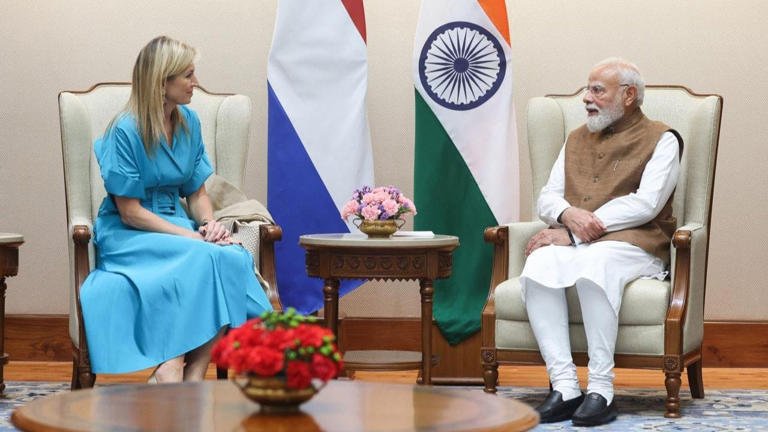
Prime Minister Narendra Modi held a high-level meeting with Queen Máxima of the Netherlands, the United Nations Secretary-General’s Special Advocate (UNSGSA) for Financial Health, to discuss digital finance, financial inclusion, and India’s transformative Digital Public Infrastructure (DPI). The meeting underscored India’s growing role as a global leader in leveraging technology to expand financial access and empower millions through inclusive digital ecosystems.
The discussions centred on India’s remarkable progress in digital financial services, the expansion of financial inclusion initiatives, and the country’s efforts to build secure, accessible, and affordable digital payment systems. Both leaders exchanged views on how digital innovation can strengthen economic participation while ensuring that financial services reach every section of society.
The interaction reflected the shared commitment to promoting inclusive economic growth through technology-driven financial solutions.
India Showcases Its Financial Inclusion Journey
During the meeting, Prime Minister Modi highlighted India’s significant achievements in financial inclusion over the past decade. He outlined how government initiatives have successfully connected millions of previously unbanked citizens to the formal financial system through a combination of digital identity, banking access, and mobile technology.
The Prime Minister emphasised that India’s financial inclusion strategy has focused on making banking services accessible, affordable, and convenient for citizens across both urban and rural regions.
He explained that digital platforms have played a transformative role in enabling direct benefit transfers, expanding access to government welfare schemes, encouraging digital payments, and promoting greater financial literacy.
India’s experience has increasingly attracted global attention as an example of how technology can accelerate inclusive economic development.
Digital Public Infrastructure Takes Centre Stage
A major focus of the discussions was India’s Digital Public Infrastructure (DPI), which has emerged as one of the country’s most significant technological achievements. Prime Minister Modi explained how integrated digital platforms have enabled seamless delivery of financial services while improving transparency, efficiency, and accessibility.
The Digital Public Infrastructure framework combines digital identity, payment systems, and secure data-sharing mechanisms to facilitate a wide range of public and private sector services.
The Prime Minister noted that these digital innovations have significantly reduced transaction costs, increased financial participation, and simplified service delivery for millions of citizens.
India’s DPI model has increasingly become an area of international interest, with several countries exploring opportunities to learn from its implementation.
Queen Máxima Appreciates India’s Progress
Queen Máxima appreciated India’s substantial progress in expanding financial inclusion through technology-driven solutions. As the United Nations Secretary-General’s Special Advocate for Financial Health, she has consistently advocated for responsible financial systems that improve people’s economic well-being.
During the discussions, she acknowledged India’s achievements in creating scalable digital infrastructure capable of serving a vast and diverse population.
She also recognised the importance of designing financial systems that remain inclusive while addressing the needs of vulnerable communities, women, small entrepreneurs, and rural populations.
The meeting highlighted the growing international recognition of India’s digital transformation in the financial sector.
Expanding Access Through Digital Payments
Prime Minister Modi highlighted the rapid growth of digital payments across the country and their contribution to strengthening financial inclusion. The widespread adoption of digital payment platforms has enabled individuals, businesses, and government agencies to conduct transactions efficiently and securely.
Digital payment systems have become an important driver of economic activity by supporting small businesses, enhancing transparency, and reducing dependence on cash transactions.
The Prime Minister explained that improved digital connectivity has made financial services more accessible, particularly in remote and underserved regions where traditional banking infrastructure had previously been limited.
These advancements have contributed to greater economic participation among citizens across diverse socio-economic backgrounds.
Financial Inclusion Supports Economic Empowerment
The meeting also explored the broader relationship between financial inclusion and sustainable development. Prime Minister Modi observed that expanding access to formal financial services empowers individuals by providing opportunities for savings, credit, insurance, entrepreneurship, and investment.
He noted that inclusive financial systems strengthen household resilience while contributing to poverty reduction and economic stability.
Government initiatives aimed at promoting financial literacy, digital awareness, and access to banking services have played a significant role in enabling individuals to participate more actively in the country’s economic growth.
Both leaders agreed that inclusive financial ecosystems are essential for achieving long-term sustainable development goals.
Technology and Innovation Driving Transformation
The discussions highlighted the growing importance of technology and innovation in modern financial systems. Artificial intelligence, secure digital platforms, mobile applications, and advanced payment technologies are increasingly reshaping how financial services are delivered worldwide.
Prime Minister Modi reaffirmed India’s commitment to leveraging innovation while maintaining robust cybersecurity standards and protecting user privacy.
He stressed that technological advancement should always remain people-centric, ensuring that digital solutions improve accessibility without excluding vulnerable populations.
India continues to invest in expanding digital infrastructure while promoting innovation across fintech, banking, and public service delivery.
Strengthening Global Cooperation
The meeting also reflected the importance of international cooperation in promoting responsible digital finance. Both sides discussed opportunities for knowledge sharing and collaboration in areas such as financial inclusion, digital innovation, regulatory best practices, and capacity building.
Prime Minister Modi reiterated India’s willingness to share its experiences and technological expertise with partner countries seeking to strengthen their own financial inclusion frameworks.
The exchange reinforced India’s role as an important contributor to global discussions on digital governance and inclusive economic development.
International collaboration, both leaders observed, will be increasingly important as countries continue adapting to rapidly evolving digital financial ecosystems.
India’s Global Leadership in Digital Finance
India’s achievements in digital finance have positioned the country among the world’s leading examples of technology-enabled financial inclusion. The integration of digital identity, banking access, mobile connectivity, and secure payment infrastructure has created a comprehensive ecosystem serving hundreds of millions of users.
The country’s experience demonstrates how carefully designed public digital infrastructure can improve governance, enhance transparency, reduce transaction costs, and expand access to essential services.
Prime Minister Modi emphasised that India’s approach remains focused on ensuring that technological progress benefits every citizen, particularly those who were previously excluded from formal financial systems.
Shared Vision for Inclusive Financial Future
The meeting between Prime Minister Narendra Modi and Queen Máxima reaffirmed the shared commitment to advancing inclusive, secure, and sustainable financial systems through innovation and international cooperation. Their discussions highlighted the growing significance of digital finance in improving economic opportunities, promoting social inclusion, and strengthening resilience across societies.
As India continues expanding its Digital Public Infrastructure and financial inclusion initiatives, its experience is increasingly serving as a valuable model for countries seeking to harness technology for inclusive development. The interaction also reinforced India’s position as a global leader in digital transformation, demonstrating how innovation, good governance, and people-centric policies can work together to create a more inclusive financial future for millions around the world.