

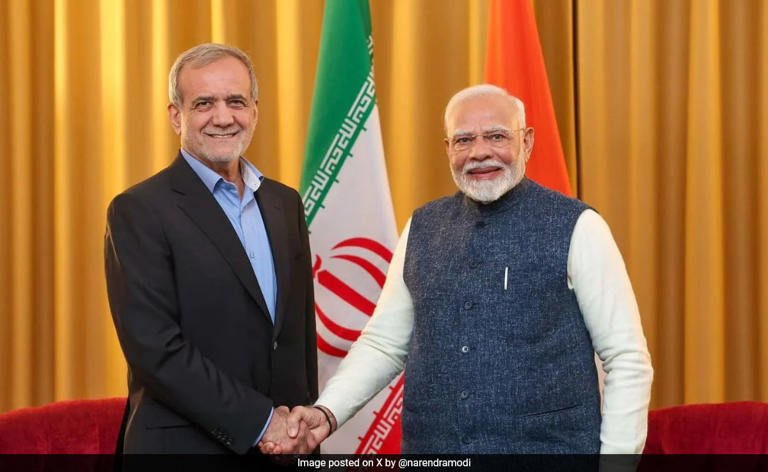
Prime Minister Narendra Modi held a telephonic conversation with Iranian President Dr. Masoud Pezeshkian to discuss the evolving situation in West Asia, reiterating India’s consistent support for dialogue, diplomacy, and the safeguarding of freedom of navigation in the strategically important Hormuz Strait. During the conversation, the Prime Minister underlined the need for sustained efforts to ensure lasting peace and stability in the region while emphasising that uninterrupted maritime commerce remains vital for India and the global economy.
The call comes at a crucial time as diplomatic efforts continue to ease tensions in West Asia. President Pezeshkian briefed Prime Minister Modi on recent regional developments and the progress made in ongoing negotiations, while both leaders exchanged views on maintaining stability and preventing further escalation.
India reiterates support for dialogue and diplomacy
During the conversation, Prime Minister Modi welcomed the progress made in diplomatic negotiations and reaffirmed India’s long-standing position that disputes should be resolved peacefully through dialogue and diplomatic engagement.
The Prime Minister expressed hope that continued negotiations would contribute to lasting peace in the region and create conditions for sustained stability. India has consistently advocated peaceful resolution of conflicts while encouraging all parties to exercise restraint and engage in constructive discussions.
Officials noted that India’s approach continues to prioritise diplomatic engagement, regional stability, and peaceful conflict resolution, particularly in areas that significantly influence global economic and security interests.
Freedom of navigation remains a key concern
A major focus of the discussion was the importance of safeguarding freedom of navigation in the Hormuz Strait, one of the world’s busiest maritime trade routes.
Prime Minister Modi stressed that ensuring uninterrupted navigation through the strategic waterway is essential not only for India but also for the international community, given its critical role in global trade and energy transportation.
The Hormuz Strait serves as a vital corridor for the movement of crude oil, liquefied natural gas, and commercial cargo between the Gulf region and international markets. Any disruption to maritime traffic through the passage has the potential to impact global supply chains, energy security, and international commerce.
India, which imports a substantial portion of its energy requirements from West Asia, has consistently highlighted the importance of secure shipping lanes and the uninterrupted movement of commercial vessels through the region.
Regional peace central to India’s foreign policy
Prime Minister Modi reiterated that lasting peace and stability in West Asia remain essential for regional prosperity and international security.
The discussion reflected India’s continued engagement with key regional partners while maintaining balanced diplomatic relations across West Asia. Officials stated that New Delhi remains committed to supporting initiatives that promote peace, dialogue, and cooperative solutions to regional challenges.
India has repeatedly emphasised that peaceful coexistence and diplomatic negotiations are fundamental to preventing prolonged instability and protecting the interests of countries dependent on the region for trade and energy supplies.
The Prime Minister also highlighted the need for sustained international efforts to preserve stability while ensuring that global commerce remains unaffected by regional tensions.
President Pezeshkian briefs PM on latest developments
During the telephonic conversation, President Masoud Pezeshkian updated Prime Minister Modi on recent developments in West Asia and shared his assessment of the evolving regional situation.
The briefing covered the progress achieved through ongoing diplomatic engagements and the possible way forward as efforts continue to reduce tensions in the region.
Officials stated that the exchange of views reflected the close communication maintained between India and Iran on matters of mutual interest, particularly issues affecting regional security, energy cooperation, and international trade.
The conversation also underscored the importance of maintaining regular diplomatic engagement during periods of geopolitical uncertainty.
Hormuz Strait remains strategically significant
The Hormuz Strait continues to be one of the most strategically important maritime passages in the world, connecting the Persian Gulf with international waters.
A significant share of global crude oil exports and liquefied natural gas shipments passes through the narrow waterway, making it a critical artery for international energy markets.
For India, uninterrupted navigation through the Hormuz Strait is particularly important because of the country’s substantial dependence on energy imports from Gulf nations.
Any disruption to maritime movement can affect shipping schedules, freight costs, insurance premiums, and overall energy security. Consequently, India has consistently advocated for maintaining open, secure, and stable sea lanes in accordance with international maritime principles.
The Prime Minister’s emphasis on freedom of navigation reflects these broader strategic and economic considerations.
India continues balanced engagement in West Asia
India has maintained a balanced diplomatic approach in its engagement with countries across West Asia, fostering strong bilateral relationships while supporting regional peace initiatives.
Officials noted that New Delhi continues to engage constructively with all stakeholders to encourage dialogue and reduce tensions that could affect regional stability.
The government’s foreign policy has consistently focused on protecting India’s strategic interests, ensuring energy security, safeguarding Indian nationals abroad, and maintaining uninterrupted trade routes.
The latest conversation between Prime Minister Modi and President Pezeshkian reflects this broader diplomatic engagement and India’s continued commitment to peaceful conflict resolution.
Maritime security and global commerce remain priorities
The Prime Minister also underlined the broader importance of protecting international commerce by ensuring secure maritime routes.
Open and secure shipping lanes are essential for the smooth functioning of global trade, particularly for countries heavily dependent on maritime transportation for imports and exports.
Officials observed that safeguarding freedom of navigation contributes to economic stability, protects global supply chains, and strengthens international confidence in maritime security.
India has consistently supported international efforts aimed at preserving the safety and openness of critical sea routes while encouraging adherence to international law governing maritime navigation.
India reiterates commitment to peace and stability
Prime Minister Narendra Modi’s conversation with Iranian President Masoud Pezeshkian reaffirmed India’s commitment to diplomacy, regional stability, and the peaceful resolution of disputes in West Asia. By emphasising the importance of freedom of navigation in the Hormuz Strait, the Prime Minister highlighted a key strategic concern that directly impacts India’s energy security and global commerce.
As diplomatic efforts continue to ease regional tensions, India remains committed to supporting initiatives that promote dialogue, safeguard international shipping routes, and contribute to lasting peace. The telephonic conversation also reflects the importance of sustained diplomatic engagement between New Delhi and Tehran in addressing regional developments while protecting shared economic and strategic interests.