

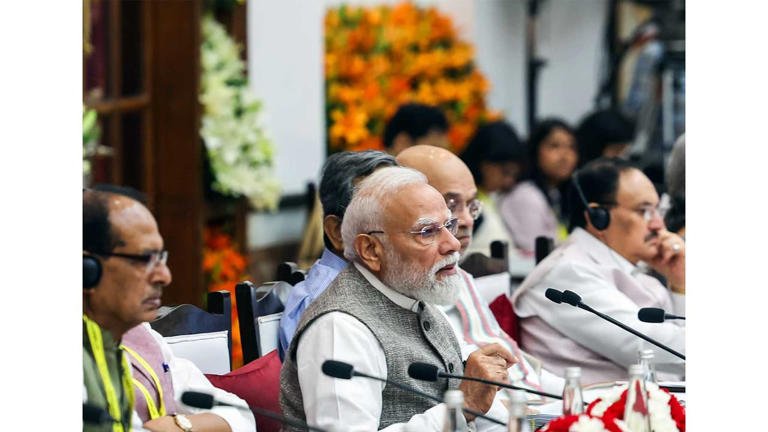
Prime Minister Narendra Modi is set to chair a high-level meeting focused on policy reforms and governance, bringing together senior government officials to review the implementation of key initiatives and discuss strategies aimed at enhancing administrative efficiency, public service delivery, and overall governance. The meeting is expected to provide an important platform for assessing the progress of ongoing reforms while identifying new measures to accelerate economic growth, improve institutional performance, and strengthen citizen-centric governance.
The review comes as the Central government continues to place significant emphasis on improving administrative systems, promoting transparency, leveraging technology for public service delivery, and ensuring effective implementation of flagship programmes. Senior officials from various ministries and departments are expected to participate in the discussions, which will cover multiple sectors critical to India’s development agenda.
The meeting reflects the government’s continued focus on policy coordination and efficient governance to support long-term economic and social development.
Focus on Policy Reforms
The high-level meeting is expected to review the progress of major policy reforms undertaken across different ministries and evaluate their implementation at both the national and state levels.
Officials are likely to present updates on ongoing reform initiatives, identify implementation challenges, and discuss measures to improve coordination among departments.
The review is expected to focus on enhancing administrative efficiency, simplifying procedures, reducing bureaucratic delays, and improving the overall effectiveness of government programmes.
Strengthening policy implementation remains a priority as the government seeks to ensure that reforms translate into tangible benefits for citizens and businesses alike.
The discussions may also explore opportunities for introducing additional reforms to address emerging governance challenges.
Strengthening Governance Framework
Governance is expected to remain a central theme of the meeting, with particular emphasis on improving service delivery, accountability, and institutional responsiveness.
Officials are likely to review mechanisms aimed at enhancing coordination among ministries, streamlining administrative processes, and ensuring timely execution of government initiatives.
The government has consistently emphasised the importance of responsive governance supported by efficient decision-making and transparent administrative practices.
The meeting is expected to reinforce these objectives by identifying areas where further improvements can strengthen public administration.
Efforts to improve governance are also expected to contribute to greater public confidence in government institutions.
Review of Flagship Government Initiatives
Senior officials are expected to provide updates on the implementation of various flagship programmes across sectors such as infrastructure, healthcare, education, agriculture, digital governance, urban development, rural development, and social welfare.
The review will likely assess the pace of implementation, achievements recorded so far, and challenges requiring policy intervention.
Monitoring flagship schemes remains an important aspect of governance to ensure that intended benefits reach citizens efficiently and within stipulated timelines.
The meeting is expected to facilitate inter-ministerial coordination in resolving implementation bottlenecks and improving programme outcomes.
Officials may also discuss best practices that can be replicated across different sectors.
Emphasis on Technology-Driven Governance
Technology is expected to play a significant role in discussions on governance reforms.
The government has increasingly adopted digital platforms to improve service delivery, enhance transparency, simplify citizen interactions, and strengthen administrative efficiency.
Officials are likely to review the progress of digital governance initiatives, including online public services, digital documentation, integrated databases, and technology-enabled monitoring systems.
The use of digital tools has contributed to faster delivery of government services while reducing paperwork and improving accessibility.
Further integration of technology into governance processes is expected to remain a key area of policy focus.
Improving Ease of Doing Business
Policy reforms aimed at improving the business environment are also expected to feature prominently during the meeting.
The government has undertaken multiple initiatives in recent years to simplify regulatory procedures, encourage investment, reduce compliance burdens, and promote entrepreneurship.
Officials may review the impact of these reforms while identifying additional measures to strengthen India’s investment climate and support economic growth.
Improving ease of doing business remains closely linked to governance reforms that promote efficiency, transparency, and faster decision-making.
The discussions are expected to consider ways to further enhance investor confidence through administrative improvements.
Citizen-Centric Service Delivery
A major objective of governance reforms is ensuring that government services become more accessible, efficient, and responsive to citizens’ needs.
The meeting is expected to review initiatives aimed at simplifying access to welfare schemes, improving grievance redressal systems, expanding digital services, and enhancing public satisfaction.
Officials may examine feedback mechanisms that help evaluate service quality and identify opportunities for continuous improvement.
The government has repeatedly emphasised that governance reforms should ultimately improve the everyday experiences of citizens while ensuring equitable access to public services.
Citizen welfare is expected to remain a guiding principle in future policy decisions.
Monitoring Implementation and Accountability
The high-level review is likely to place considerable emphasis on implementation monitoring and institutional accountability.
Officials are expected to discuss mechanisms for tracking project progress, evaluating performance, and ensuring timely completion of government initiatives.
Strengthening monitoring systems enables policymakers to identify delays, resolve operational challenges, and improve coordination among implementing agencies.
Performance-based governance has increasingly become an important component of administrative reforms aimed at delivering measurable outcomes.
The meeting is expected to encourage ministries to maintain high standards of accountability and efficiency.
Promoting Cooperative Governance
The Centre’s governance strategy also places importance on collaboration among ministries, departments, and state governments.
The meeting may include discussions on strengthening cooperative governance through improved communication, policy coordination, and joint implementation of development programmes.
Officials are expected to explore ways of sharing successful governance practices across sectors and regions.
Closer coordination among various levels of government contributes to more effective policy implementation and improved public service delivery.
Such collaborative approaches are considered essential for addressing complex developmental challenges.
Supporting India’s Long-Term Development Goals
Policy reforms and governance improvements remain closely linked to India’s broader development objectives.
Efficient governance supports economic growth by improving infrastructure development, strengthening public institutions, attracting investments, and enhancing service delivery across sectors.
The government has consistently maintained that administrative reforms are essential for achieving sustainable development while improving the quality of life for citizens.
The high-level meeting is expected to reinforce these priorities by aligning governance strategies with national development goals.
Officials believe continuous policy evaluation and institutional reforms will contribute significantly to India’s long-term progress.
Reinforcing the Commitment to Good Governance
Prime Minister Narendra Modi’s decision to chair the high-level meeting reflects the government’s continued emphasis on policy reforms, administrative efficiency, and citizen-focused governance. By reviewing the progress of ongoing initiatives and encouraging greater coordination among ministries, the meeting aims to strengthen implementation while ensuring that development programmes achieve their intended objectives.
As India continues to pursue economic growth and institutional modernisation, effective governance remains central to delivering public services, encouraging investment, and improving administrative performance. The discussions are expected to provide valuable direction for future reforms while reaffirming the government’s commitment to transparency, accountability, and efficient governance that supports inclusive and sustainable national development.