

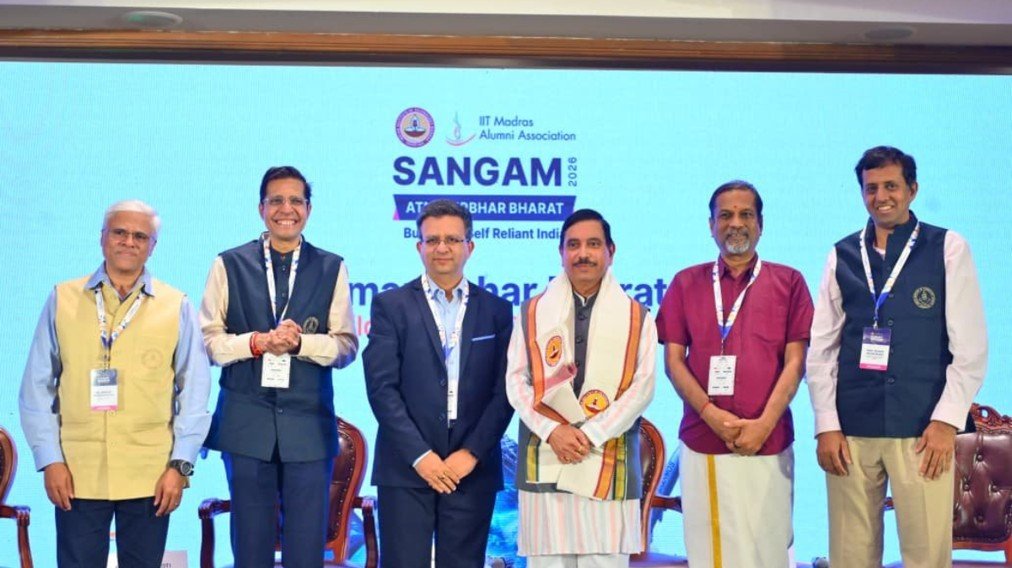
Union Education Minister Pralhad Joshi has urged IIT Madras alumni to take a more active role in mentoring young innovators and strengthening India’s technology ecosystem.
Joshi made the remarks while addressing the seventh edition of SANGAM, an initiative of the IIT Madras Alumni Association, in Bengaluru on September 26. The event focused on the theme “Atmanirbhar Bharat – Building a Self-Reliant India.”
The minister called on senior alumni to use their experience and professional networks to support the next generation of innovators. He highlighted mentoring, technology commercialisation, deep-tech entrepreneurship and international collaboration as key areas where alumni can contribute.
Joshi Calls for Greater Alumni Participation
Joshi said IIT Madras alumni can play a larger role in India’s innovation journey by helping young innovators turn ideas into practical solutions.
He specifically urged alumni to mentor young innovators, accelerate the commercialisation of technology and support entrepreneurs working in deep-tech fields. He also called for stronger connections between India’s innovation ecosystem and global markets.
The minister’s remarks placed experienced professionals at the centre of efforts to strengthen India’s research and entrepreneurship ecosystem. Alumni with expertise in technology, business and industry can provide guidance to young innovators as they develop and commercialise new ideas.
SANGAM 2026 Focuses on Self-Reliance
SANGAM 2026 brought together members of the IIT Madras alumni community around the theme of Atmanirbhar Bharat.
The event provided a platform for discussions involving technology, education, industry and entrepreneurship. Joshi said this combination represents an important part of India’s innovation ecosystem and can contribute to the country’s broader development goals.
According to the minister, IIT Madras has demonstrated how scientific research and knowledge can be converted into solutions for real-world challenges.
The focus on self-reliance also reflects the broader emphasis on developing domestic technological capabilities and encouraging Indian enterprises to create solutions for national and international markets.
Deep-Tech Entrepreneurship Gets Attention
Deep-tech entrepreneurship was another important area highlighted by Joshi.
Deep-tech companies generally build products and services around advanced scientific or engineering research. Such ventures can require significant research, specialised talent and long development cycles before reaching commercial markets.
The minister’s call for alumni support therefore includes helping young entrepreneurs navigate the gap between research and commercialisation.
Experienced alumni can contribute through mentorship, industry connections and guidance on taking technologies from laboratories and institutions into the marketplace.
Connecting Indian Innovation With Global Markets
Joshi also encouraged IIT Madras alumni to help connect India’s innovation ecosystem with international opportunities.
Global partnerships can provide Indian startups and technology companies with access to markets, investors, research collaborations and specialised expertise. Alumni working in different parts of the world can potentially contribute to these connections through their professional networks.
The minister linked this approach with India’s broader development vision, including the government’s Viksit Bharat 2047 goal.
Education and Innovation Ecosystem
The emphasis on alumni mentorship comes as educational institutions and government bodies continue to promote innovation among students.
On September 25, Joshi launched the website and registration portal for the Seva First Innovation Challenge at the Indian Institute of Science in Bengaluru. The initiative involves the Education Ministry, AICTE and UGC, with IISc Bengaluru serving as the nodal institution.
The challenge encourages students and young innovators to identify problems in their communities and develop solutions that can be tested and implemented.
Students from schools, ITIs, polytechnics, colleges and universities can participate in the initiative. The national finale is scheduled to take place in December in New Delhi.
Turning Ideas Into Practical Solutions
The minister’s message to IIT Madras alumni also underlines the importance of moving beyond ideas and research.
Mentorship can help young innovators understand the practical aspects of developing a product or service. It can also help them identify potential users, improve their technologies and explore opportunities for commercialisation.
For deep-tech ventures, access to experienced mentors can be particularly relevant because these businesses often operate at the intersection of scientific research and commercial enterprise.
Alumni Network as a National Resource
IIT Madras has a large alumni network spread across technology, academia, industry, entrepreneurship and other professional fields.
Joshi’s appeal seeks to encourage this network to contribute more actively to the country’s innovation ecosystem. Rather than limiting alumni involvement to institutional activities, the minister highlighted their potential role in supporting young innovators and emerging businesses.
The approach also creates a link between established professionals and students who are beginning their innovation journeys.
Focus on India’s Innovation Ambitions
The SANGAM 2026 discussions come at a time when India is placing greater emphasis on research, technology development, entrepreneurship and self-reliance.
Joshi’s call for IIT Madras alumni to mentor young innovators brings together these priorities. It places experienced professionals, educational institutions and emerging entrepreneurs within the same innovation ecosystem.
As India continues to develop its technology and deep-tech capabilities, the involvement of experienced alumni could provide young innovators with access to knowledge, networks and industry experience.
The minister’s remarks at SANGAM 2026 therefore highlighted a broader role for alumni communities: supporting young talent, helping commercialise technology and strengthening connections between Indian innovation and global opportunities.