

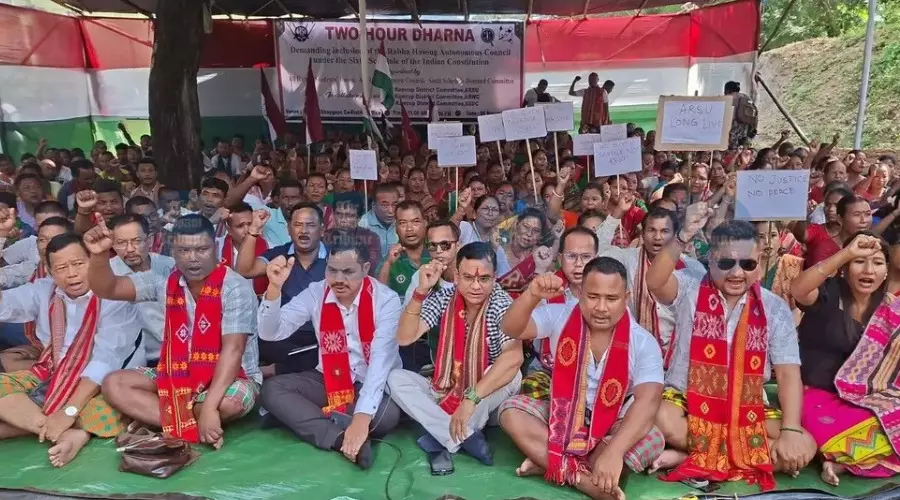
Rabha bodies protest in South Kamrup demanding the inclusion of the Rabha Hasong Autonomous Council (RHAC) under the Sixth Schedule of the Indian Constitution. Hundreds of members from various Rabha organizations gathered to voice their long-pending demand for constitutional recognition and greater autonomy in governance.
The protest, held in Chaygaon in South Kamrup district, witnessed the participation of several Rabha bodies, including the All Rabha Students’ Union (ARSU), the Sixth Schedule Demand Committee, and the Rabha Women Council. Protesters raised slogans calling for immediate steps by the Assam government and the Centre to address their long-standing demand for political and developmental empowerment.
The demonstrators said that Sixth Schedule status would ensure self-governance, protect cultural identity, and accelerate development in Rabha-inhabited areas.
Read More: Mizoram BJP Prepares for Dampa By-Election, MLA Beichhua Vows ‘Real Development’
Call for Political and Administrative Empowerment
Leaders from various organizations spoke at the rally, emphasizing that the Rabha people have been demanding inclusion under the Sixth Schedule for over two decades. Despite repeated assurances from political leaders, no concrete action has been taken.
Speaking at the event, ARSU President Juran Rabha said that Rabha bodies protest in South Kamrup because the community’s demand continues to be ignored. “We are not asking for special treatment. We are asking for our constitutional rights that were promised to us years ago,” he said.
He added that inclusion under the Sixth Schedule would empower the Rabha Hasong Autonomous Council (RHAC) to make decisions related to education, land, and resource management in Rabha-majority areas. “Without constitutional backing, our council remains powerless, and our people continue to suffer,” he added.
Historical Context of the Demand
The Rabha Hasong Autonomous Council was formed in 1995 to safeguard the rights and development interests of the Rabha community living in parts of Kamrup and Goalpara districts. However, since its creation, the RHAC has functioned without Sixth Schedule recognition, limiting its authority and resources.
Community leaders said that the lack of constitutional protection prevents the council from implementing effective policies. They claimed that the RHAC cannot function independently as it relies heavily on the state government for funds and administrative support.
According to the protesters, inclusion under the Sixth Schedule would grant the council legislative and executive powers similar to those enjoyed by autonomous councils in Karbi Anglong, Dima Hasao, and Bodoland.
Rabha Bodies Protest in South Kamrup for Equality and Justice
During the protest, speakers accused the state government of discriminating against the Rabha people. They said that while other tribal groups in Assam have been granted autonomy under the Sixth Schedule, the Rabhas continue to be sidelined.
One of the demonstrators said, “Our identity, land, and language are at stake. The government talks about inclusive development, but it has ignored the Rabha people for decades.”
The leaders warned that if their demand is not addressed soon, the movement will intensify. They said that Rabha bodies protest in South Kamrup not just for recognition but also for dignity, equality, and justice.
Several women’s groups and student organizations also participated in the rally, reflecting growing community unity. Placards carried messages such as “Implement Sixth Schedule Now” and “Justice for Rabha Hasong.”
Demand for Centre’s Intervention
The protesters called on the Union Government to take immediate steps to grant Sixth Schedule status to the RHAC. They urged Prime Minister Narendra Modi and Home Minister Amit Shah to intervene and fulfill the community’s constitutional aspirations.
They also criticized the state government for delaying the process despite repeated discussions with Rabha leaders. “Every election season, promises are made. Once the elections are over, we are forgotten,” said one ARSU member.
The leaders added that they would continue to mobilize support from neighboring districts and other indigenous communities. They said that the movement will remain peaceful but persistent until the government takes action.
Voices of the Youth and Women
Many young protesters expressed frustration over the lack of employment and development opportunities in RHAC areas. They said that the absence of Sixth Schedule protection prevents the region from accessing central funds meant for tribal development.
A young participant from Chaygaon said, “We have the talent and the will to grow, but our council lacks the authority to make real changes. Sixth Schedule status can change that.”
Women leaders highlighted that economic hardships have forced many Rabha families to migrate to urban areas. They said constitutional recognition would ensure better education, healthcare, and livelihood options for women and children in rural Rabha regions.
Government’s Response
While the state government has not issued a formal response to the latest protest, sources within the administration said that discussions on the matter are ongoing. However, no clear timeline has been announced regarding the implementation of Sixth Schedule status for RHAC.
Officials from the Revenue and Tribal Affairs departments have reportedly been studying the implications of extending Sixth Schedule provisions to new areas. Yet, community leaders remain skeptical, saying that similar assurances in the past have not yielded results.
Renewed Unity and Commitment
At the end of the rally, the leaders of the Sixth Schedule Demand Committee announced that the movement would continue with greater strength. They said that if the government fails to respond soon, they would organize statewide protests and sit-in demonstrations in Dispur and New Delhi.
They also appealed to other indigenous groups in Assam to show solidarity with their demand. “We are not against any community. We are fighting for our rightful place within the Constitution,” a speaker said.
The Road Ahead for the Rabha Hasong Region
As Rabha bodies protest in South Kamrup grows stronger, political observers believe that the demand for Sixth Schedule inclusion will gain more attention in the coming months. The movement highlights the larger issue of equitable autonomy for all indigenous communities in Assam.
For the Rabha people, the fight for inclusion is not just about political power—it is about preserving identity, culture, and future generations. As the protest concluded with chants of unity, one message echoed loud and clear: the Rabha community will continue its peaceful struggle until the promise of the Sixth Schedule becomes a reality.
Read More: Assam Unveils SMART AXOM App to Boost Flood Resilience and Disaster Communication