

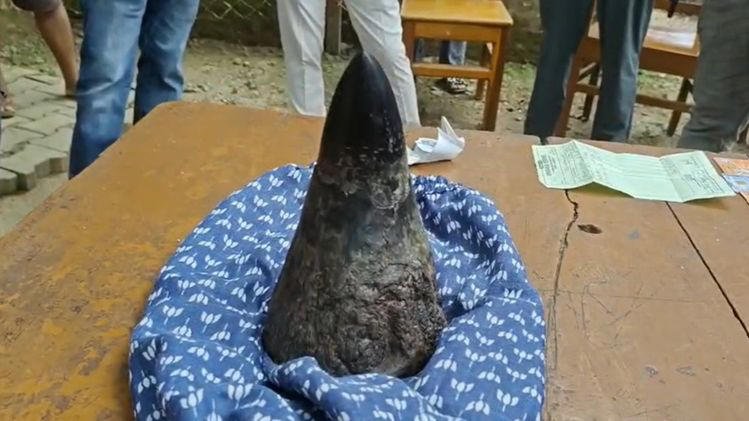
In a significant breakthrough against illegal wildlife trafficking, authorities seized a rhino horn during a raid at a resort in Sonapur, Assam, and arrested three individuals suspected of being involved in an organised wildlife trafficking network. The operation, carried out jointly by the Assam Forest Department and law enforcement agencies, marks another major success in the state’s ongoing efforts to combat wildlife crimes and protect its globally renowned biodiversity.
The raid was conducted based on specific intelligence inputs indicating that a group of suspected traffickers was attempting to negotiate the illegal sale of a rhino horn. Acting swiftly on the information, officials launched a coordinated operation that led to the recovery of the wildlife contraband and the apprehension of the suspects before the alleged transaction could be completed.
Authorities have launched a detailed investigation to determine the origin of the seized rhino horn, identify other individuals involved in the trafficking network, and uncover possible interstate or international links associated with the illegal trade.
Intelligence-Led Operation Leads to Successful Raid
According to officials, the raid was the result of sustained intelligence gathering and surveillance carried out over several days. Information suggested that suspected wildlife traffickers had assembled at a resort in Sonapur for the purpose of conducting an illegal transaction involving a rhino horn.
A joint team comprising forest officials and police personnel planned the operation carefully to ensure the suspects could be apprehended without allowing the contraband to be moved elsewhere.
As the team reached the location, authorities conducted a thorough search of the premises, resulting in the recovery of the rhino horn believed to have been kept for illegal sale.
Three individuals present at the location were taken into custody on suspicion of involvement in wildlife trafficking activities. Officials stated that further legal procedures are being carried out in accordance with the provisions of the Wildlife (Protection) Act.
Rhino Horn Recovered During Search
During the operation, officials recovered one rhino horn, considered one of the most valuable items in the illegal wildlife trade.
The seized horn has been secured as evidence and will undergo scientific examination and documentation as part of the ongoing investigation.
Authorities are also examining its origin to determine whether it was obtained through poaching within Assam or sourced from another location.
Wildlife investigators are expected to use forensic techniques, intelligence records, and other evidence to trace the movement of the horn and establish the complete chain of illegal possession.
The recovery represents another important step in preventing wildlife products from reaching illegal domestic or international markets.
Three Suspected Traffickers Arrested
The three individuals arrested during the raid are being questioned to ascertain their specific roles in the suspected trafficking operation.
Investigators are focusing on identifying the source of the rhino horn, intended buyers, financial transactions, and possible associates connected to the illegal trade.
Officials believe the arrests may provide valuable leads into larger trafficking networks operating across state and international borders.
Electronic devices, communication records, and other materials recovered during the investigation are also being examined to gather further evidence.
Authorities have indicated that additional arrests may follow if new information emerges during the course of the investigation.
Assam’s Continued Fight Against Wildlife Crime
Assam is home to the world’s largest population of the greater one-horned rhinoceros, making wildlife protection a top conservation priority for the state.
Over the years, the Assam government has intensified anti-poaching operations by strengthening surveillance, deploying advanced monitoring technologies, increasing forest patrols, and enhancing coordination among wildlife enforcement agencies.
The state has also invested in improving intelligence networks to detect and prevent illegal wildlife trade before protected animal parts can be smuggled out of the region.
Officials have repeatedly stressed that protecting endangered species requires constant vigilance and coordinated enforcement involving forest personnel, police, intelligence agencies, and local communities.
Rhino Horn Trafficking Remains a Serious Challenge
Despite significant conservation successes, illegal demand for rhino horns continues to drive wildlife trafficking across several parts of Asia.
Rhino horns are often targeted by organised criminal syndicates due to their high black-market value. This illegal trade poses a serious threat to rhino conservation efforts and contributes to transnational wildlife crime.
Law enforcement agencies have intensified efforts to dismantle trafficking networks by targeting not only poachers but also middlemen, transporters, financiers, and buyers involved in the illegal supply chain.
Officials believe disrupting the trade at every stage is essential to protecting vulnerable wildlife populations.
The latest seizure in Sonapur demonstrates the effectiveness of intelligence-based operations in intercepting illegal wildlife products before they reach criminal markets.
Coordinated Enforcement Strengthens Conservation Efforts
The successful operation reflects the growing coordination between the Assam Forest Department, Assam Police, and other enforcement agencies engaged in wildlife protection.
Joint operations have become increasingly effective due to improved intelligence sharing, specialised training, and enhanced investigative capabilities.
Authorities continue to conduct surveillance in sensitive locations while monitoring suspected wildlife trafficking routes across the state.
Officials noted that public cooperation also plays an important role in preventing wildlife crimes, with local residents encouraged to report suspicious activities involving protected species or wildlife products.
Such collaborative efforts have contributed significantly to reducing poaching incidents and improving enforcement outcomes in recent years.
Legal Action Under Wildlife Protection Laws
The accused are expected to face legal proceedings under relevant provisions of the Wildlife (Protection) Act, which prescribes stringent penalties for offences related to the possession, transportation, and trade of protected wildlife and their body parts.
The recovered rhino horn will remain in official custody as investigators continue to gather evidence and prepare the case.
Authorities emphasised that wildlife crimes are treated with utmost seriousness and that strict legal action will be taken against anyone found involved in poaching or illegal wildlife trade.
Officials also reiterated that investigations will continue until all individuals connected to the trafficking network are identified and brought to justice.
Protecting Assam’s Rich Wildlife Heritage
The seizure highlights the importance of sustained conservation efforts in safeguarding Assam’s globally significant wildlife heritage. National parks and protected forests across the state are home to several endangered species, including the iconic greater one-horned rhinoceros, whose conservation has become a symbol of Assam’s environmental success.
Continuous investment in habitat protection, anti-poaching infrastructure, community participation, and scientific wildlife management has contributed to the growth of rhino populations over the years.
However, authorities acknowledge that illegal trafficking remains an ongoing threat that requires constant vigilance and strong enforcement.
A Strong Message Against Wildlife Trafficking
The successful raid at the Sonapur resort sends a strong message that wildlife crimes will be met with swift and decisive action. By recovering the rhino horn and arresting three suspected traffickers, enforcement agencies have disrupted another alleged link in the illegal wildlife trade while reinforcing Assam’s commitment to protecting its endangered species.
Officials have reaffirmed that intelligence-driven operations, inter-agency cooperation, and strict enforcement of wildlife protection laws will continue across the state. As investigations progress, authorities remain focused on dismantling organised trafficking networks and ensuring that those involved in crimes against wildlife are held accountable.
The operation serves as another reminder of the importance of preserving Assam’s extraordinary biodiversity for future generations while maintaining zero tolerance towards illegal activities that threaten the state’s invaluable natural heritage.