

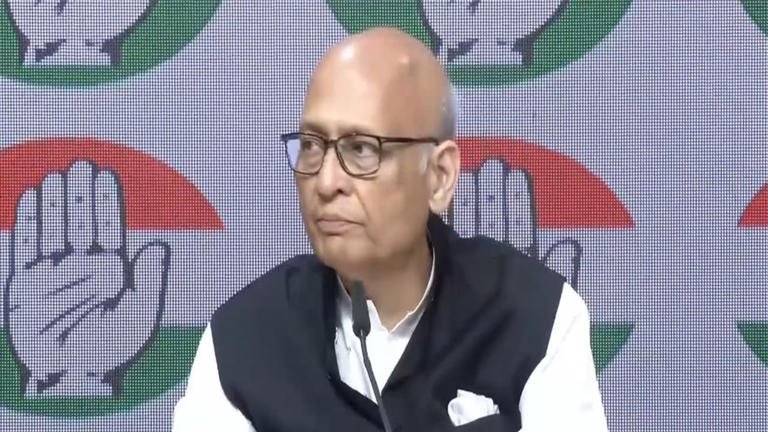
Senior Congress leader and Supreme Court advocate Abhishek Manu Singhvi on Thursday criticised the recent Supreme Court judgment related to the SIR matter, stating that the ruling has “raised more questions than it answers.”
Singhvi said the verdict has generated legal, constitutional, and administrative concerns that require greater clarity and wider public understanding.
Addressing reporters after the judgment, the Congress leader argued that several aspects of the ruling remain open to interpretation and could lead to future legal and political debates.
He also stressed the importance of judicial clarity in matters involving constitutional principles and public administration.
The remarks quickly triggered political reactions, with opposition leaders and legal experts discussing the broader implications of the judgment.
Singhvi Questions Interpretation of Verdict
During his interaction with the media, Singhvi said the judgment leaves significant unanswered questions regarding implementation, interpretation, and long-term legal consequences.
According to him, certain observations made in the ruling could create confusion about administrative procedures and constitutional safeguards.
The Congress leader argued that judgments involving sensitive legal matters should ideally provide greater operational clarity for institutions and the public.
Singhvi also stated that the verdict may generate additional litigation because of ambiguities surrounding certain legal provisions.
He maintained that while the judiciary deserves respect, public discussion and legal scrutiny remain important parts of democratic functioning.
Congress Expresses Concern Over Judgment
The Indian National Congress has expressed concern regarding the implications of the Supreme Court ruling.
Party leaders argued that the judgment could influence future administrative and legal decisions in ways that require closer examination.
Some Congress leaders also questioned whether the ruling sufficiently addressed concerns raised during legal proceedings.
Political observers noted that opposition parties have increasingly scrutinised major judicial and constitutional developments in recent years.
The Congress leadership reportedly plans to study the verdict further before deciding its future political and legal response.
Legal Experts Debate Implications
The Supreme Court judgment has sparked discussion among constitutional experts, lawyers, and political commentators.
Some legal experts believe the ruling clarifies important aspects of the matter, while others agree with Singhvi’s observation that several questions remain unresolved.
Analysts said judgments involving constitutional interpretation often generate debate because of their wider legal and political impact.
Experts also noted that differing interpretations frequently emerge after major Supreme Court rulings, especially in politically sensitive matters.
Several lawyers stated that future cases and judicial reviews may further define the scope and implications of the judgment.
Singhvi Highlights Need for Constitutional Clarity
Singhvi stressed that constitutional matters require precise legal interpretation because they directly affect governance and democratic institutions.
He said judicial pronouncements should minimise ambiguity to prevent confusion among administrative authorities and the public.
According to the Congress leader, institutional clarity remains essential for maintaining trust in constitutional processes.
He also emphasised the importance of transparent legal reasoning in judgments dealing with significant policy or governance questions.
Political observers noted that Singhvi often comments on constitutional and judicial issues because of his legal background and experience before the Supreme Court.
Political Reactions Continue
The judgment and Singhvi’s remarks triggered reactions from both ruling and opposition political circles.
Some leaders defended the Supreme Court ruling and accused the opposition of unnecessarily criticising judicial institutions.
Others argued that public discussion regarding legal judgments forms part of democratic accountability and constitutional discourse.
Political analysts believe the controversy surrounding the judgment could continue in political and legal debates over the coming weeks.
The issue has also generated strong discussions on social media platforms, where supporters and critics of different political parties expressed varying opinions regarding the ruling.
Supreme Court Judgments Often Trigger Debate
Major Supreme Court decisions frequently become subjects of national debate because of their constitutional and political significance.
Judgments involving governance, administrative powers, or institutional functioning often attract close scrutiny from political parties, legal experts, and civil society groups.
Analysts said such debates reflect the important role played by the judiciary in India’s democratic framework.
However, experts also stressed that criticism and discussion should remain respectful and focused on legal interpretation rather than personal attacks.
Singhvi maintained that questioning legal reasoning and seeking clarity should not be viewed as disrespect toward judicial institutions.
Opposition Calls for Wider Discussion
Some opposition leaders supported Singhvi’s remarks and demanded broader discussion regarding the implications of the ruling.
They argued that constitutional judgments with long-term governance impact should receive careful public and legal examination.
Leaders from opposition parties also stressed the need for transparency and institutional accountability in matters affecting democratic processes.
Political observers believe the issue may continue featuring in parliamentary and political discussions in the coming days.
Government Yet to Respond Officially
The central government has not issued any detailed official response regarding Singhvi’s criticism of the judgment.
However, sources within ruling party circles defended the verdict and described the Supreme Court’s decision as legally sound.
Officials indicated that the government would continue following constitutional and judicial processes regarding the matter.
Legal experts expect further analysis and commentary on the judgment from lawyers, academics, and political leaders in the coming days.
Debate Around Judgment Likely to Continue
Political and legal observers believe discussions surrounding the SIR judgment are unlikely to end soon.
The ruling has already sparked debate regarding constitutional interpretation, administrative implications, and judicial clarity.
Singhvi’s comments have added another dimension to the ongoing conversation, especially among opposition leaders and legal circles.
Experts noted that major constitutional judgments often evolve through future legal challenges, clarifications, and judicial interpretation.
Meanwhile, the Supreme Court’s SIR judgment continues to remain at the centre of legal and political discussions, with opposition leaders like Abhishek Manu Singhvi insisting that the ruling leaves several important questions unanswered.