

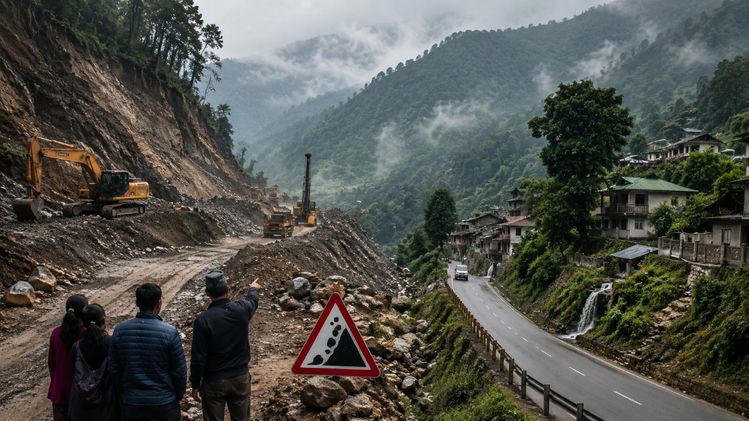
The proposed Pakyong–Barapathing National Highway project has sparked fresh political and public debate in Sikkim, with the Bharatiya Janata Party (BJP) state unit opposing the current alignment and calling for its realignment. The party has urged the National Highways & Infrastructure Development Corporation Limited (NHIDCL) and the Union Ministry of Road Transport and Highways to reconsider the proposed route, arguing that it could adversely affect local communities, natural water sources, and environmentally sensitive areas.
While expressing support for the construction of the strategically important highway, the BJP clarified that its opposition is limited to the present alignment and not to the project itself. Party leaders have stressed that infrastructure development should proceed in a manner that balances connectivity with environmental conservation and public welfare. They have called for an alternative alignment that minimises damage to vulnerable areas while still achieving the project’s objective of improving road connectivity in eastern Sikkim.
The controversy has gained momentum following concerns raised by local residents, who fear that the existing proposal could lead to environmental degradation, increase landslide risks, and threaten the water security of several villages.
BJP Calls for Alternative Highway Alignment
The Sikkim BJP has urged authorities to review the proposed highway alignment before any final decision is taken. According to party leaders, several local communities have expressed serious concerns over the current route, prompting the need for a detailed reassessment.
The party believes that the alignment should be modified in consultation with technical experts, local residents, and environmental specialists to ensure that the highway serves its developmental purpose without causing unnecessary ecological or social disruption.
BJP leaders have also emphasised that major infrastructure projects should incorporate public feedback during the planning stage, especially in environmentally fragile Himalayan regions where construction activities require careful assessment.
According to the party, a revised alignment could reduce environmental risks while ensuring that the highway delivers long-term benefits to the people of Sikkim.
Concerns Over Water Sources and Landslide Risks
One of the primary reasons behind the demand for realignment is the potential impact of the proposed highway on natural spring water sources that supply drinking water to hundreds of households.
Residents from villages including Tankilakha, Ganchung, Linkey, Parkha, and Thekabung have submitted a memorandum to Union Road Transport and Highways Minister Nitin Gadkari requesting a review of the alignment. They argue that the present route could affect important natural springs relied upon by nearly 350 households and increase the risk of landslides in already vulnerable areas.
The memorandum also highlights concerns regarding environmental sustainability, soil stability, and the long-term safety of nearby settlements. Local residents have proposed that instead of constructing a completely new alignment, the government should consider upgrading the existing Pakyong–Linkey road to National Highway standards.
Supporters of this proposal believe it would provide better connectivity while reducing environmental disturbance and minimising the need for extensive land acquisition.
Highway Holds Strategic Importance
Despite the objections over the alignment, there is broad agreement that the proposed Pakyong–Barapathing National Highway is an important infrastructure project for Sikkim.
The highway is expected to improve connectivity between Pakyong and Barapathing, strengthen access to the strategically significant Nathu La region, provide better connectivity from Pakyong Greenfield Airport, and contribute to tourism and economic development across eastern Sikkim.
Improved road infrastructure is also expected to facilitate faster transportation of goods and services, reduce travel time, and improve accessibility for residents living in remote areas.
Government officials have repeatedly highlighted the project’s importance in supporting regional development and enhancing connectivity in the Himalayan state.
NHIDCL Yet to Finalise Alignment
Amid the growing controversy, Rajya Sabha MP D.T. Lepcha has clarified that the final alignment of the proposed highway has not yet been approved.
According to him, NHIDCL is still conducting engineering surveys and technical evaluations before finalising the route. He explained that although public representatives and the state government may offer suggestions, the final decision regarding the alignment will be based on technical feasibility and engineering standards established by NHIDCL.
Lepcha also assured residents that statutory public hearings will be conducted before the alignment is finalised, providing affected communities with an opportunity to present their concerns.
This clarification has offered some reassurance to residents who had feared that the alignment had already been permanently approved.
Demand for Comprehensive Environmental Assessment
Environmental concerns remain central to the debate surrounding the proposed highway.
Residents and political leaders have called for detailed geological, hydrological, and environmental assessments before construction begins. They argue that the fragile Himalayan ecosystem requires careful scientific evaluation to avoid long-term ecological damage.
The memorandum submitted by local residents seeks an independent technical study, a comprehensive Social Impact Assessment, protection of natural water sources, and transparent public consultations before the project moves forward.
Environmental experts have often pointed out that road construction in mountainous terrain requires extensive planning due to the risks of landslides, erosion, and disruption of underground water channels.
The demand for additional studies reflects growing public awareness about balancing infrastructure development with environmental sustainability.
Public Participation Becomes Key Issue
The ongoing debate has also highlighted the importance of public participation in major infrastructure projects.
Local residents have welcomed the government’s assurance that consultations will be held before the final alignment is approved. Many believe that involving affected communities early in the planning process can help identify practical alternatives and reduce future disputes.
The BJP has similarly stressed that development projects should be implemented with the consent and cooperation of local people, especially when issues such as land acquisition, water security, and environmental protection are involved.
Public hearings are expected to provide a platform for residents, technical experts, and government agencies to discuss possible modifications to the proposed route.
Balancing Development with Environmental Protection
The Pakyong–Barapathing highway debate reflects a broader challenge faced by many Himalayan states—how to expand infrastructure while preserving fragile ecosystems.
Road connectivity is essential for improving economic growth, tourism, healthcare access, and disaster response. At the same time, construction activities in ecologically sensitive areas require careful planning to prevent irreversible environmental damage.
Political observers note that both supporters and critics of the project broadly agree on the need for better connectivity. The primary difference lies in identifying the most suitable alignment that minimises environmental impact while meeting engineering and strategic requirements.
This balanced approach is likely to guide future discussions as the project moves through its planning stages.
Looking Ahead
The Sikkim BJP’s opposition to the proposed Pakyong–Barapathing highway alignment has added momentum to an ongoing public debate over one of the state’s key infrastructure projects. While supporting the highway’s strategic and developmental importance, the party has urged authorities to reconsider the present route to safeguard natural water sources, minimise landslide risks, and protect environmentally sensitive areas.
With NHIDCL yet to finalise the alignment and statutory public consultations still to be held, the project remains at an important planning stage. The outcome of technical studies, environmental assessments, and public feedback will play a crucial role in determining the final route. As Sikkim continues to pursue infrastructure development, the challenge will be to ensure that improved connectivity goes hand in hand with environmental sustainability and the long-term interests of local communities.