

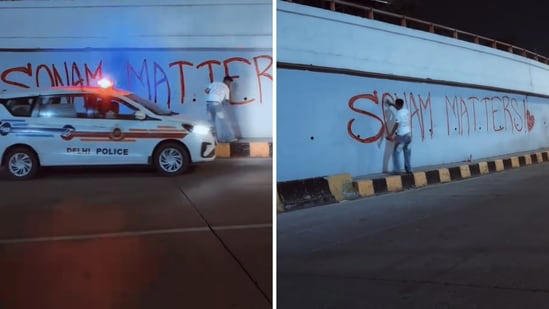
A striking piece of graffiti inspired by education reformer and environmental activist Sonam Wangchuk has appeared on a flyover wall in Delhi, attracting the attention of commuters, residents, and social media users alike. The large-scale artwork, created by a street artist, highlights Wangchuk’s growing prominence in public discourse and reflects the role of public art in expressing contemporary social and environmental concerns.
Videos and photographs of the mural have been widely shared online, with many praising the artist’s creativity and the powerful message conveyed through the artwork. The graffiti has quickly become a talking point, drawing visitors who stopped to photograph and record the mural.
The artwork demonstrates how street art continues to serve as a medium for engaging the public on issues of national importance.
Artwork Captures Public Attention
The mural, painted across a prominent flyover wall, features an eye-catching visual representation associated with Sonam Wangchuk and his advocacy for environmental conservation and sustainable development in the Himalayan region.
Its large size and strategic location have made it highly visible to thousands of commuters travelling through the area each day. Passers-by gathered to view the artwork, while several videos circulating on social media captured people admiring the mural and discussing its significance.
The artwork has generated considerable online engagement, with many users describing it as an impressive example of socially conscious public art.
Street Art as a Platform for Public Expression
Graffiti and murals have increasingly become powerful forms of public expression, allowing artists to communicate ideas beyond the confines of galleries and exhibition spaces.
By using public walls as artistic canvases, street artists often encourage conversations around environmental protection, education, social justice, cultural identity, and civic responsibility. The latest mural inspired by Sonam Wangchuk reflects this tradition by bringing attention to issues that have gained widespread public interest.
Observers note that such artworks not only beautify urban spaces but also stimulate dialogue among citizens about current social and environmental challenges.
Sonam Wangchuk’s Public Advocacy
Sonam Wangchuk is widely recognised for his work in education, innovation, sustainable development, and environmental conservation, particularly in the Himalayan region.
Over the years, his initiatives have focused on promoting sustainable technologies, climate awareness, and education reforms. His public advocacy has earned attention from students, environmentalists, educators, and citizens across the country.
The mural reflects the influence that Wangchuk’s work has had on artists and members of the public who view creative expression as a means of highlighting important issues affecting society.
Social Media Amplifies the Artwork
Soon after the graffiti appeared, videos and photographs of the mural began circulating widely across social media platforms, attracting thousands of views, comments, and shares.
Many users appreciated the artistic execution, while others discussed the themes represented through the painting. Several viewers described the mural as an effective way of encouraging public engagement with contemporary issues through visual storytelling.
The widespread online circulation has extended the artwork’s reach far beyond its physical location, allowing audiences across the country to view and discuss it.
The viral response also highlights the growing influence of digital platforms in amplifying public art.
Public Art Shapes Urban Spaces
Urban murals have become increasingly common in Indian cities, transforming public spaces into platforms for creativity and civic engagement.
Government agencies, municipal bodies, and independent artists have often collaborated to create murals celebrating cultural heritage, environmental awareness, public health campaigns, and national achievements. Such artworks contribute to urban beautification while encouraging citizens to engage with meaningful themes.
The latest graffiti adds to Delhi’s evolving landscape of public art, where walls and flyovers have increasingly been transformed into vibrant spaces showcasing artistic talent and public messages.
Creative Expression and Civic Dialogue
Art experts believe that large-scale public artworks encourage constructive civic dialogue by making important subjects more accessible to ordinary citizens.
Unlike traditional exhibitions, murals placed in busy public locations reach diverse audiences, including people who may not ordinarily engage with formal art spaces. This accessibility allows artists to communicate messages in ways that resonate with everyday life.
The Sonam Wangchuk-inspired graffiti demonstrates how visual art can serve as a bridge between creativity and public conversation, prompting viewers to reflect on issues beyond the artwork itself.
It also highlights the growing role of artists in contributing to discussions on environmental sustainability and social awareness.
Mural Sparks Conversation Across the Capital
The giant graffiti has become one of the latest examples of how public art can capture attention and generate widespread discussion. Positioned on a busy Delhi flyover wall, the artwork has transformed an ordinary urban structure into a landmark attracting public interest both offline and online.
As videos of the mural continue to circulate, the artwork stands as a reminder of the power of creative expression to engage communities, encourage dialogue, and inspire reflection on issues that resonate with people across the country. The striking tribute to Sonam Wangchuk underscores the growing influence of street art in shaping public conversations while enriching the cultural landscape of India’s capital.