

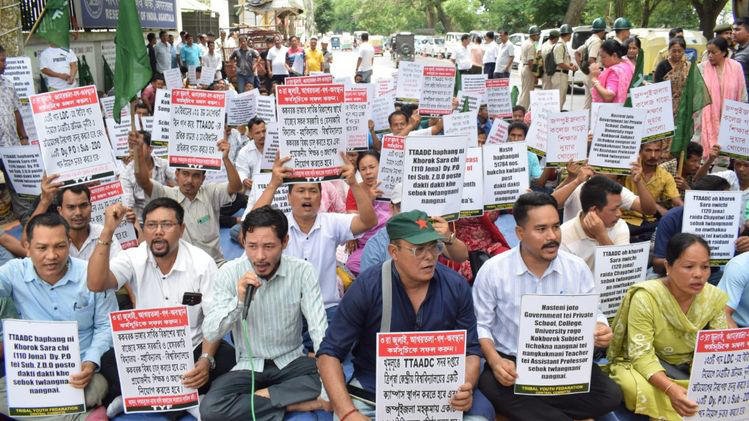
Leader of the Opposition (LoP) in the Tripura Legislative Assembly, Jitendra Chaudhury, has criticised the state and Central governments over employment issues while expressing support for demands related to the Kokborok language. Addressing party workers and supporters during a public programme, Chaudhury alleged that unemployment remains one of the most pressing challenges facing the state and urged the government to take concrete steps to generate sustainable employment opportunities for the youth.
The senior Opposition leader also reiterated his support for long-standing demands concerning Kokborok, one of Tripura’s principal indigenous languages. He stressed that preserving linguistic identity and ensuring equal opportunities for indigenous communities are important aspects of inclusive development. His remarks have once again brought employment, language policy, and tribal welfare into the centre of political discourse in the state.
The statements come at a time when employment generation and issues concerning indigenous communities continue to feature prominently in Tripura’s political landscape.
LoP Raises Concerns Over Employment
Jitendra Chaudhury strongly criticised the government’s handling of employment, claiming that many educated young people in Tripura continue to face difficulties in securing stable jobs despite completing their education and professional training.
He argued that unemployment has emerged as a major socio-economic concern affecting thousands of families across the state. According to the Opposition leader, creating quality employment opportunities should remain one of the government’s highest priorities, particularly for educated youth entering the workforce.
Chaudhury called for greater investment in industries, agriculture, small enterprises, and skill development programmes that can generate long-term employment while strengthening the state’s economy.
He also stressed the importance of transparent recruitment processes and timely filling of vacancies in various government departments.
Calls for Sustainable Economic Development
Beyond raising concerns over government jobs, the Opposition leader emphasised the need for broader economic policies that encourage private investment, entrepreneurship, and industrial growth. He observed that sustainable employment requires the expansion of multiple sectors rather than reliance on government recruitment alone.
According to Chaudhury, strengthening agriculture, promoting small and medium enterprises, supporting local industries, and encouraging youth entrepreneurship could create more diversified livelihood opportunities across the state.
He urged policymakers to formulate development strategies that balance infrastructure growth with employment generation so that economic progress directly benefits local communities.
The Opposition maintained that inclusive economic planning is essential for reducing unemployment and improving living standards.
Extends Support to Kokborok Demands
Another major focus of Chaudhury’s address was the Kokborok language. He reiterated his party’s support for demands raised by various organisations seeking greater recognition, promotion, and development of the indigenous language.
Kokborok is spoken by a large section of Tripura’s tribal population and holds significant cultural and historical importance in the state. The language has remained at the centre of public discussions on education, administration, literature, and cultural preservation for several years.
Chaudhury stated that protecting linguistic diversity is essential for safeguarding the identity and heritage of indigenous communities. He said every language deserves equal respect and should receive appropriate institutional support for its growth and development.
Importance of Preserving Indigenous Culture
The Opposition leader emphasised that language forms an integral part of cultural identity and social heritage. He argued that promoting Kokborok contributes not only to preserving indigenous traditions but also to strengthening social inclusion and cultural diversity within Tripura.
He called for continued efforts to encourage the use of Kokborok in education, literature, cultural activities, and public life while ensuring that future generations remain connected to their linguistic heritage.
Community organisations have long maintained that greater institutional support can help expand educational resources, literary development, and research related to the language.
Chaudhury said that respecting linguistic diversity strengthens democratic values and promotes harmonious coexistence among different communities.
Political Debate Over Development Priorities
The Opposition leader’s remarks have added to the ongoing political debate surrounding development priorities in Tripura. While the ruling government has highlighted its achievements in infrastructure development, investment promotion, welfare programmes, and employment initiatives, Opposition parties continue to argue that more focused efforts are needed to address unemployment and regional disparities.
Political observers note that employment remains one of the most significant issues influencing public opinion, particularly among young voters. Language and cultural issues also continue to play an important role in the state’s socio-political landscape, especially in areas with substantial tribal populations.
The latest statements reflect the differing approaches adopted by political parties regarding governance and development.
Government Highlights Development Initiatives
The state government has consistently maintained that it is implementing multiple initiatives aimed at improving employment opportunities, strengthening infrastructure, promoting investment, and supporting entrepreneurship. Officials have pointed to industrial projects, skill development programmes, tourism promotion, and welfare schemes as part of broader efforts to stimulate economic growth.
Government representatives have also highlighted investments in road connectivity, education, healthcare, agriculture, and digital infrastructure as measures designed to improve overall socio-economic conditions across Tripura.
Officials maintain that long-term development requires sustained investment in both physical infrastructure and human resource development.
Employment and Language Remain Key Public Issues
Employment and cultural identity continue to be among the most important issues discussed across Tripura. While young people seek greater job opportunities and economic stability, indigenous communities continue to advocate for measures that preserve their language, traditions, and cultural heritage.
Experts believe that addressing these concerns requires balanced policy interventions that combine economic development with social inclusion. Strengthening educational institutions, promoting entrepreneurship, improving skill development, and supporting indigenous languages can contribute to more equitable and sustainable development.
The government and Opposition continue to present differing perspectives on how these objectives should be achieved.
Democratic Debate Shapes Policy Discussions
Political analysts observe that debates on employment, language rights, and development are a natural part of democratic governance. Constructive discussions between the government, Opposition, civil society organisations, and community representatives often help shape policies that address public concerns more effectively.
Chaudhury’s remarks are likely to keep these issues at the forefront of political discussions in Tripura, particularly as employment generation and tribal welfare remain central to public discourse.
Observers also emphasise the importance of continued dialogue among stakeholders to ensure that development policies remain inclusive and responsive to the needs of all communities.
Looking Ahead
The comments made by Leader of the Opposition Jitendra Chaudhury have once again highlighted two critical issues facing Tripura—employment generation and the preservation of indigenous linguistic identity. While he criticised the government over unemployment and expressed support for Kokborok-related demands, the ruling administration continues to emphasise its ongoing development initiatives and economic programmes.
As Tripura moves forward, balancing economic growth with cultural preservation is likely to remain an important policy challenge. Continued investment in job creation, education, entrepreneurship, and infrastructure, alongside meaningful support for indigenous languages and communities, will play a vital role in promoting inclusive development.
The debate surrounding employment and Kokborok reflects broader aspirations for economic opportunity, cultural recognition, and equitable progress. How these concerns are addressed through policy and dialogue will continue to shape Tripura’s political and developmental landscape in the years ahead.