

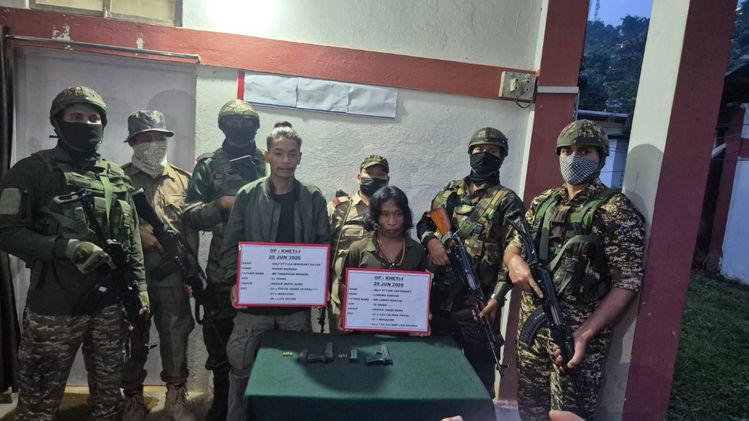
In a significant development in the ongoing efforts to restore peace and curb insurgency in the Northeast, two cadres of the NSCN-K (Nikki Sumi) faction surrendered before security forces in Arunachal Pradesh’s Tirap district. The surrender is being viewed as another positive step in the government’s sustained campaign to encourage militants to renounce violence and return to the mainstream through peaceful means.
According to officials, the two insurgents voluntarily laid down their arms before security personnel following continuous outreach efforts and intensified counter-insurgency operations in the region. The surrender reflects the combined impact of sustained security measures, confidence-building initiatives, and rehabilitation policies aimed at encouraging members of insurgent groups to embrace peaceful civilian life.
Authorities said the surrender would further strengthen peace-building efforts in Tirap and neighbouring districts, which have witnessed insurgent activities over the years.
Voluntary Surrender Before Security Forces
Officials stated that the two NSCN-K (Nikki Sumi) cadres surrendered during a coordinated operation involving security agencies deployed in Tirap district.
The insurgents reportedly chose to abandon the path of violence and voluntarily came forward before the authorities. Their surrender followed continuous efforts by security forces to encourage militants to return to the mainstream by assuring them of rehabilitation opportunities under existing government policies.
Authorities described the development as a positive outcome of sustained engagement with local communities and ongoing counter-insurgency operations.
The surrendered cadres are expected to undergo the necessary legal and administrative procedures as prescribed under the government’s rehabilitation framework.
Boost to Counter-Insurgency Efforts
Security officials believe the surrender represents another important success in the government’s broader strategy to weaken insurgent networks operating in the region.
Counter-insurgency operations in Tirap and adjoining districts have been intensified over recent years through coordinated efforts involving the Indian Army, Assam Rifles, Arunachal Pradesh Police, and other security agencies.
Apart from intelligence-based operations, authorities have also focused on encouraging militants to surrender voluntarily by highlighting opportunities for rehabilitation, vocational training, and reintegration into society.
Officials noted that each surrender contributes to reducing the operational strength of insurgent organisations while promoting lasting peace in the region.
Importance of Tirap District
Tirap district, located in southeastern Arunachal Pradesh, has historically been one of the areas affected by insurgent activities due to its geographical proximity to inter-state and international borders.
The difficult terrain and dense forest cover have often presented operational challenges for security agencies combating militant groups.
Over the years, however, enhanced coordination among security forces, improved intelligence gathering, and greater cooperation from local communities have significantly strengthened counter-insurgency efforts.
Authorities have continued to maintain a strong security presence in the district while simultaneously promoting development initiatives aimed at addressing local socio-economic challenges.
Rehabilitation and Reintegration
The government has consistently encouraged members of insurgent organisations to surrender by offering rehabilitation and reintegration opportunities under established policies.
Such programmes typically include vocational training, financial assistance, counselling, education, and support for livelihood generation, enabling former militants to rebuild their lives peacefully.
Officials emphasised that rehabilitation remains an important component of the government’s comprehensive approach to resolving insurgency through both security operations and developmental initiatives.
The objective is not only to reduce violence but also to create sustainable opportunities that discourage individuals from returning to armed activities.
Authorities believe successful rehabilitation contributes significantly to long-term peace and stability.
Security Agencies Continue Vigilance
Despite the latest surrender, security forces continue to maintain heightened vigilance across Tirap and neighbouring districts.
Regular patrols, intelligence-based operations, area domination exercises, and surveillance activities are being conducted to prevent insurgent movements and maintain law and order.
Officials stated that security agencies remain committed to dismantling militant networks while ensuring the safety of local residents.
The surrender is expected to provide investigators with valuable information regarding insurgent activities, operational structures, and possible support networks, which may assist future security operations.
Authorities reiterated that coordinated action against insurgency will continue without interruption.
Community Participation Strengthens Peace
Officials acknowledged that cooperation from local communities has played a crucial role in improving the security situation across parts of Arunachal Pradesh.
Residents have increasingly supported peace initiatives by sharing information with security agencies and encouraging individuals involved in insurgent groups to return to the mainstream.
Community participation has also contributed to improving trust between local populations and government institutions, creating an environment more conducive to development and reconciliation.
Authorities stressed that lasting peace requires active collaboration among citizens, civil society organisations, and security agencies.
Such partnerships have become an important pillar of the state’s peace-building efforts.
Development as a Tool for Stability
The government continues to complement security measures with developmental programmes aimed at improving infrastructure, education, healthcare, connectivity, and employment opportunities in border districts.
Officials believe that socio-economic development plays an essential role in addressing the underlying factors that have historically contributed to insurgency.
Improved road connectivity, better educational facilities, enhanced healthcare services, and livelihood opportunities are expected to strengthen public confidence while reducing the appeal of extremist organisations.
Development initiatives are therefore viewed as integral to the broader strategy of ensuring sustainable peace across Arunachal Pradesh.
Government Reaffirms Commitment to Peace
Authorities reiterated that the government remains committed to restoring lasting peace through a balanced approach combining security enforcement, rehabilitation, and development.
Officials encouraged other members of insurgent organisations to surrender and take advantage of rehabilitation programmes designed to facilitate their peaceful return to society.
The administration also reaffirmed its commitment to maintaining law and order while ensuring that all citizens can live in a safe and secure environment.
Security agencies continue to coordinate closely with neighbouring states and central forces to prevent cross-border militant activities and strengthen regional stability.
Positive Sign for the Region
The surrender of the two NSCN-K (Nikki Sumi) cadres is being viewed as another encouraging development in Arunachal Pradesh’s ongoing efforts to combat insurgency and promote peace. Each voluntary surrender represents not only a reduction in militant strength but also a step towards reconciliation and social reintegration.
As security forces continue their operations alongside development and rehabilitation initiatives, officials remain optimistic that more insurgents will choose the path of peace. The government’s continued emphasis on dialogue, rehabilitation, community participation, and strong security measures is expected to further strengthen stability across Tirap and other sensitive districts.
With sustained cooperation between security agencies, local communities, and government institutions, Arunachal Pradesh continues to move towards a future marked by greater peace, security, and inclusive development.