

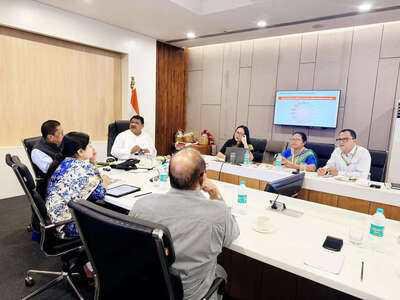
Union Tribal Affairs Minister Jual Oram held discussions on the long-pending demand for granting Scheduled Tribe (ST) status to six communities in Assam, stating that the process requires compliance with constitutional provisions and cannot be expedited without completing the prescribed legal procedures. Addressing the issue during his visit to Assam, the minister said the inclusion of any community in the Scheduled Tribe list under Article 342 of the Constitution involves multiple stages of scrutiny and approval by constitutional authorities.
The remarks come amid renewed demands from various organisations representing the six communities seeking ST recognition. The minister emphasised that while the Central government is aware of the aspirations of these communities, the proposal must proceed through the established constitutional framework before any final decision can be taken.
Constitutional process central to ST recognition
Jual Oram explained that the inclusion or exclusion of communities in the Scheduled Tribe list is governed by Article 342 of the Constitution and involves a detailed examination by multiple authorities.
According to the minister, proposals submitted by state governments are first examined by the Office of the Registrar General of India (RGI), followed by scrutiny by the National Commission for Scheduled Tribes (NCST). Only after these stages are completed can the matter be considered by the Central government before being placed before Parliament through the necessary legislative process.
He noted that the constitutional safeguards are intended to ensure that every proposal is examined thoroughly before any amendment to the Scheduled Tribe list is made.
Six Assam communities continue to seek ST status
The demand for Scheduled Tribe status has been raised for six major communities in Assam—Tai Ahom, Chutia, Koch-Rajbongshi, Moran, Matak, and Tea Tribes (Adivasis). These communities have been seeking constitutional recognition for several years, arguing that ST status would provide greater protection for their social, cultural, educational, and economic interests.
The issue has remained an important socio-political subject in Assam, with successive state and Central governments holding consultations and examining various proposals aimed at addressing the longstanding demand.
Community organisations have repeatedly urged the government to complete the process at the earliest while ensuring that their constitutional aspirations are fulfilled.
Centre reiterates commitment to due process
The Union minister clarified that the Central government remains committed to examining the proposal in accordance with constitutional provisions.
He stated that every recommendation received from the state government must pass through the prescribed institutional mechanisms before any legislative action can be initiated.
Officials observed that the process is designed to maintain transparency, protect the constitutional rights of all stakeholders, and ensure that decisions are supported by comprehensive administrative and anthropological assessments.
The minister added that constitutional procedures cannot be bypassed, irrespective of the length of time the demand has been pending.
Discussions held with state representatives
During his visit, Jual Oram interacted with Assam government representatives and officials to review matters relating to tribal welfare and the pending proposal concerning ST status.
The discussions also focused on issues affecting tribal communities in the state, implementation of welfare schemes, and measures aimed at promoting inclusive development.
Officials briefed the minister on developments relating to the proposal and the administrative processes undertaken so far.
The meeting reflected continued coordination between the Centre and the state government on matters relating to tribal affairs and constitutional recognition.
Importance of Article 342
The minister highlighted that Article 342 of the Constitution provides the legal framework for notifying Scheduled Tribes in different states and Union Territories.
Under the constitutional mechanism, any modification to the list of Scheduled Tribes requires a detailed review followed by parliamentary approval through appropriate legislation.
Officials explained that the process ensures that decisions are based on established constitutional criteria and comprehensive examination rather than administrative discretion alone.
The constitutional safeguards are intended to preserve the integrity of the Scheduled Tribe classification while ensuring fairness to all communities concerned.
Balancing aspirations and existing safeguards
The issue of granting ST status has generated extensive discussions because of its social, administrative, and constitutional implications.
Officials have consistently maintained that any proposal must carefully balance the aspirations of communities seeking recognition with the constitutional protections already available to existing Scheduled Tribe communities.
The government has reiterated that all stakeholders’ interests will be considered while examining the proposal under the applicable legal framework.
This approach is intended to ensure that any future decision contributes to social harmony while complying with constitutional requirements.
Community organisations seek early resolution
Representatives of the six communities have continued to press for early completion of the constitutional process.
Various organisations have argued that Scheduled Tribe recognition would strengthen opportunities in education, employment, political representation, and socio-economic development while helping preserve their cultural heritage.
The demand has remained one of the major issues raised by community groups over the years, with repeated appeals to both the state and Central governments for timely action.
Officials acknowledged the importance of continued dialogue while reiterating that constitutional procedures remain essential before any final decision can be taken.
Focus remains on constitutional and legal procedures
The Union minister’s remarks indicate that the government intends to continue processing the proposal through the established institutional framework.
Authorities emphasised that cooperation between the Assam government, constitutional bodies, and the Central government will remain important for completing the various stages required under Article 342.
The Centre also reiterated its commitment to ensuring that all proposals relating to Scheduled Tribe status are examined objectively and in accordance with the Constitution.
Long-standing issue awaits constitutional completion
Union Tribal Affairs Minister Jual Oram’s discussion on the demand for Scheduled Tribe status for six Assam communities has once again brought attention to one of the state’s longest-pending constitutional issues. While acknowledging the aspirations of the communities, the minister emphasised that the proposal must undergo the complete constitutional process involving the state government, the Registrar General of India, the National Commission for Scheduled Tribes, the Central government, and Parliament before any final approval can be granted.
As consultations and administrative procedures continue, the focus remains on ensuring that any decision is consistent with constitutional provisions while addressing the longstanding aspirations of the communities seeking Scheduled Tribe recognition.