

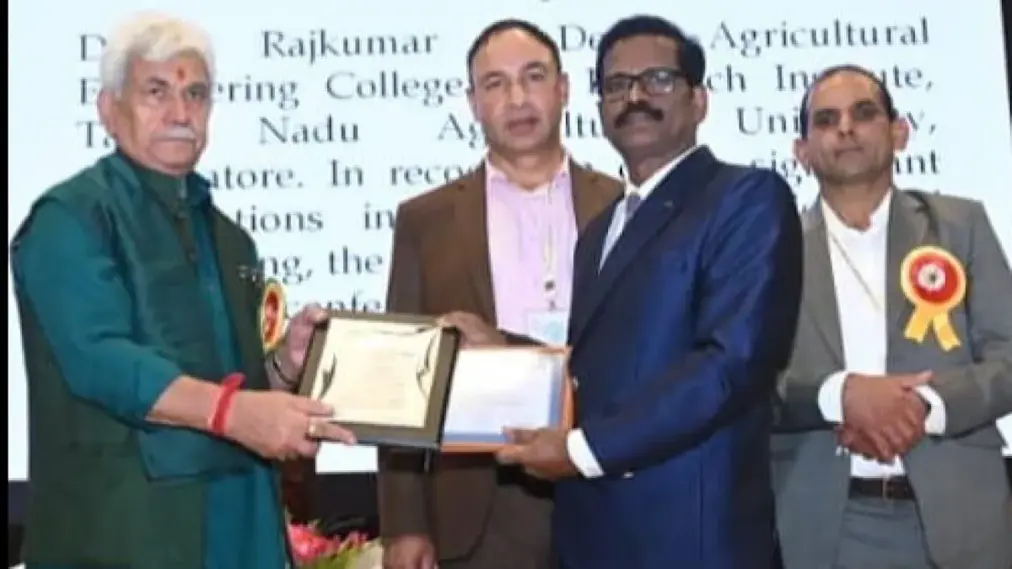
Jammu and Kashmir Lieutenant Governor Manoj Sinha has emphasised the growing role of women, artificial intelligence and robotics in shaping the future of smart farming and transforming the agricultural sector.
Addressing an agriculture-focused event, Sinha said modern technology must be integrated with farming to improve productivity, reduce costs and create new opportunities for farmers.
He highlighted the importance of empowering women farmers and entrepreneurs while encouraging young people to explore emerging technologies in agriculture.
AI Can Transform Agriculture
Sinha said artificial intelligence has the potential to significantly change the way farming is carried out.
AI-based tools can help farmers analyse weather patterns, identify crop diseases, monitor soil conditions and make better decisions about irrigation and fertiliser use.
The use of data-driven technology can also help farmers improve resource management and reduce losses caused by unpredictable weather conditions and crop diseases.
According to Sinha, the integration of technology into agriculture should ultimately focus on improving farmers’ incomes and making farming more sustainable.
Robotics to Support Farmers
The Lieutenant Governor also highlighted robotics as an emerging technology that could play a greater role in agriculture.
Robotic systems can assist with activities such as sowing, harvesting, spraying and crop monitoring. Automation can reduce the physical burden on farmers while improving precision and efficiency.
The adoption of agricultural robotics could become particularly important as the sector faces challenges related to labour availability and the need for greater productivity.
Sinha stressed that Jammu and Kashmir should remain open to such technological developments as it seeks to modernise its agricultural economy.
Women at the Centre of Agricultural Transformation
Sinha placed particular emphasis on the contribution of women to the agricultural sector.
Women are involved in several areas of farming and allied activities, including horticulture, dairy, livestock management, food processing and rural entrepreneurship.
He said empowering women with access to technology, training, financial support and markets could strengthen rural economies and improve household incomes.
Women’s participation in technology-driven agriculture can also create opportunities for them to move beyond traditional agricultural roles and become entrepreneurs and decision-makers.
Youth and Technology in Farming
The Lieutenant Governor also called for greater participation of young people in the agricultural sector.
With agriculture increasingly incorporating artificial intelligence, drones, robotics, sensors and data analytics, the sector is developing new opportunities for technology-oriented entrepreneurs.
Young people with skills in engineering, data science and digital technologies can contribute to developing solutions tailored to local farming conditions.
Sinha said innovation and entrepreneurship should be encouraged so that agriculture becomes a more attractive career option for the younger generation.
Technology Can Improve Farm Productivity
Smart farming combines traditional agricultural knowledge with modern technology to improve the efficiency of farming operations.
Technologies such as precision irrigation, satellite imagery, drones and Internet-connected sensors can help farmers monitor crops and use resources more efficiently.
AI can analyse the information collected from farms and provide insights that can help improve decision-making.
Such technologies can be particularly useful in horticulture and high-value crops, where timely intervention can have a significant impact on quality and profitability.
Focus on Sustainable Agriculture
The push for smart farming is also closely connected with environmental sustainability.
Efficient irrigation systems can reduce water consumption, while precision application of fertilisers and pesticides can minimise unnecessary chemical use.
Technology can also help farmers monitor soil health and respond to changing weather conditions.
Sinha emphasised that agricultural modernisation should not only increase production but also ensure that farming remains sustainable over the long term.
Jammu and Kashmir’s Agricultural Potential
Agriculture and horticulture remain important components of Jammu and Kashmir’s rural economy. The region is known for products including apples, saffron, walnuts and a range of other horticultural crops.
The adoption of modern agricultural technologies could help improve productivity, quality and market access for farmers.
Better use of technology could also strengthen supply chains and reduce post-harvest losses, allowing farmers to receive greater value from their produce.
Building the Future of Smart Farming
The emphasis on women, AI and robotics reflects a broader shift towards technology-driven agriculture.
For Jammu and Kashmir, smart farming could provide an opportunity to combine the region’s agricultural traditions with modern tools and techniques. Empowering women, involving young entrepreneurs and adopting advanced technologies can contribute to a more productive and sustainable agricultural sector.
The future of smart farming will depend on how effectively farmers can access technology, training, finance and markets. With continued investment in innovation and human skills, AI and robotics could become important tools in the next phase of agricultural development.