

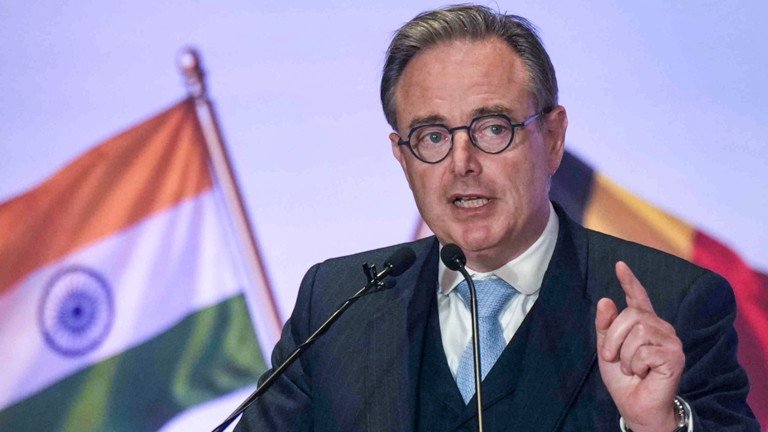
Belgian Prime Minister Bart De Wever drew cheers from the audience in Mumbai after making a veiled reference to US President Donald Trump while criticising what he described as arbitrary and economically illogical tariff policies.
De Wever made the remarks during the India-Belgium High-Level Dialogue on the proposed India-European Union Free Trade Agreement (FTA). Without directly naming Trump, the Belgian Prime Minister referred to leaders who impose tariffs unpredictably and frequently reverse their decisions.
“More and more voices today are calling for barriers to go up, for markets to be shut off, for tariffs to be imposed,” De Wever said. He added that some decisions appeared to change within days, prompting him to tell the audience, “You all know who I am talking about.” His remarks drew a positive response and cheers from those present.
Belgian PM Criticises Arbitrary Tariff Policies
De Wever used the Mumbai event to warn against growing protectionism and unpredictable trade policies.
He said some governments were increasingly calling for higher barriers, closed markets and tariffs. However, he criticised the manner in which certain tariff decisions were made.
According to De Wever, some leaders appeared to impose tariffs without a clear economic rationale. He also referred to situations where decisions were announced, withdrawn and later reinstated within a short period.
The Belgian Prime Minister did not mention Donald Trump by name. However, his comments were widely interpreted as a reference to the US President and his approach to tariffs.
The indirect nature of the criticism became the highlight of the event when De Wever told the audience that they already knew whom he was referring to.
‘You Know Who I Am Talking About’ Draws Cheers
De Wever’s most memorable comment came when he described the unpredictable nature of certain tariff decisions.
He said some leaders could make a decision on one day, revoke it shortly afterwards and then bring it back again.
“You all know who I am talking about,” De Wever said, adding that he would not mention any name.
The comment triggered cheers from the audience in Mumbai.
His remarks reflected wider concerns among governments and businesses about uncertainty in global trade.
Frequent changes in tariff policies can affect companies, investors and supply chains. Businesses often make long-term investment decisions based on expected trade conditions.
Sudden policy reversals can therefore create uncertainty and increase costs.
De Wever argued that tariffs should not become arbitrary political tools without sound economic reasoning.
India-EU FTA Highlighted as Alternative to Protectionism
The Belgian Prime Minister linked his criticism of protectionist trade policies to the importance of the proposed India-EU Free Trade Agreement.
He said stronger economic cooperation between India and the European Union could help both sides become more resilient against disruption and coercion.
The proposed FTA could create greater opportunities for businesses and investors on both sides.
It could also help India and European countries strengthen their commercial relationship during a period of increasing global economic uncertainty.
De Wever’s remarks suggested that predictable trade partnerships were becoming more important as several countries reconsider their approach to tariffs and market access.
He presented the India-EU trade relationship as an example of cooperation that could offer greater stability to businesses.
The dialogue in Mumbai focused on strengthening economic engagement between India and Belgium while also supporting broader India-EU trade cooperation.
Growing Concerns Over Global Protectionism
Protectionism has become an increasingly important issue in global economic discussions.
Several countries have adopted policies designed to protect domestic industries or reduce dependence on foreign suppliers.
Tariffs often form an important part of these policies.
Governments may use tariffs to support local manufacturers or respond to trade imbalances.
However, higher tariffs can also increase costs for businesses and consumers.
They can trigger retaliatory measures and affect international supply chains.
De Wever’s remarks highlighted concerns about the unpredictable use of such measures.
His criticism focused not simply on the existence of tariffs but on decisions that businesses may find difficult to anticipate.
Predictability remains important for companies involved in international trade.
Businesses need stable rules when planning investments, production and supply chains.
Frequent policy changes can make these decisions more complicated.
Piyush Goyal Calls India-EU FTA a Win-Win
Union Commerce and Industry Minister Piyush Goyal also addressed the India-Belgium dialogue in Mumbai.
He described the proposed India-EU FTA as an arrangement that could benefit all sides.
The agreement could expand opportunities for trade and investment between India and European countries.
India and the European Union have been working to deepen their economic partnership.
A comprehensive agreement could affect several sectors and create new opportunities for businesses.
Goyal’s remarks reflected India’s interest in developing stronger economic partnerships with Europe.
The proposed FTA could also provide companies with greater access to markets.
Supporters of the agreement believe it could strengthen supply chains and encourage investment.
The discussions in Mumbai underlined the importance both sides place on advancing the India-EU economic relationship.
Maharashtra Seeks Key Role in FTA Implementation
Maharashtra Chief Minister Devendra Fadnavis also spoke at the event.
He said the India-EU FTA could fundamentally reshape the relationship between India and the European Union.
Fadnavis also expressed the view that Maharashtra could play an important role in demonstrating how the agreement could work in practice.
Maharashtra is one of India’s leading economic and industrial centres.
Mumbai serves as a major financial and commercial hub.
The state has strong links with international businesses and investors.
These factors could make Maharashtra an important location for companies seeking to benefit from stronger India-EU trade ties.
The state’s participation in discussions surrounding the FTA reflects the potential importance of regional governments in supporting international trade agreements.
Belgium Sees India as an Important Economic Partner
The India-Belgium High-Level Dialogue provided an opportunity for leaders to discuss the future of economic cooperation.
Belgium has traditionally maintained strong commercial links with India.
The relationship includes trade, investment and cooperation across several industries.
A stronger India-EU trade agreement could create additional opportunities for Belgian and Indian companies.
Business leaders are particularly interested in greater market access and predictable regulatory conditions.
The discussions also reflected Europe’s wider interest in strengthening economic partnerships with India.
As global trade patterns continue to change, countries are seeking to diversify their economic relationships.
India’s growing economy makes it an increasingly important partner for European businesses and governments.
Veiled Trump Dig Highlights Global Trade Uncertainty
De Wever’s remarks received attention because they highlighted the broader uncertainty surrounding global trade.
Although he did not name Trump, his reference was widely understood as criticism of the US President’s tariff approach.
The Belgian Prime Minister’s comments also reflected concerns among some international leaders about sudden shifts in trade policy.
Businesses can adapt to tariffs when policies remain clear and predictable.
However, frequent changes can make it difficult for companies to plan for the future.
The Mumbai audience’s reaction showed that De Wever’s indirect reference resonated strongly during the discussion.
His comments became one of the most widely discussed moments of the India-Belgium dialogue.
India-EU Trade Ties Gain Greater Importance
The discussion comes at a time when countries are looking for ways to strengthen reliable economic partnerships.
The proposed India-EU FTA could become an important part of this effort.
India offers European companies access to one of the world’s largest and fastest-growing major markets.
European countries, meanwhile, remain important trading and investment partners for India.
A successful agreement could strengthen commercial cooperation across multiple sectors.
It could also help both sides reduce the risks created by global trade disruptions.
The Mumbai dialogue highlighted the growing strategic importance of economic partnerships.
Trade agreements increasingly carry wider significance beyond the movement of goods.
They can influence investment, supply chains and geopolitical relationships.
Belgian PM’s Remarks Put Focus on Predictable Trade
Bart De Wever’s veiled criticism of Trump became a memorable moment at the Mumbai event, but his larger message focused on the importance of predictable and economically sound trade policies.
The Belgian Prime Minister warned against arbitrary tariff decisions and growing protectionism.
He argued that stronger trade partnerships could help countries protect themselves against disruption and coercion.
The proposed India-EU FTA featured prominently in that discussion.
Leaders at the event presented the agreement as an opportunity to deepen economic cooperation and create benefits for businesses and consumers.
De Wever’s comment — “You know who I am talking about” — may have drawn the loudest cheers, but it also highlighted a serious concern facing the global economy: uncertainty in trade policy.
As India and the European Union continue discussions on their economic partnership, the Mumbai dialogue reinforced the importance of stable trade rules, stronger international cooperation and predictable policies in an increasingly uncertain global environment.