

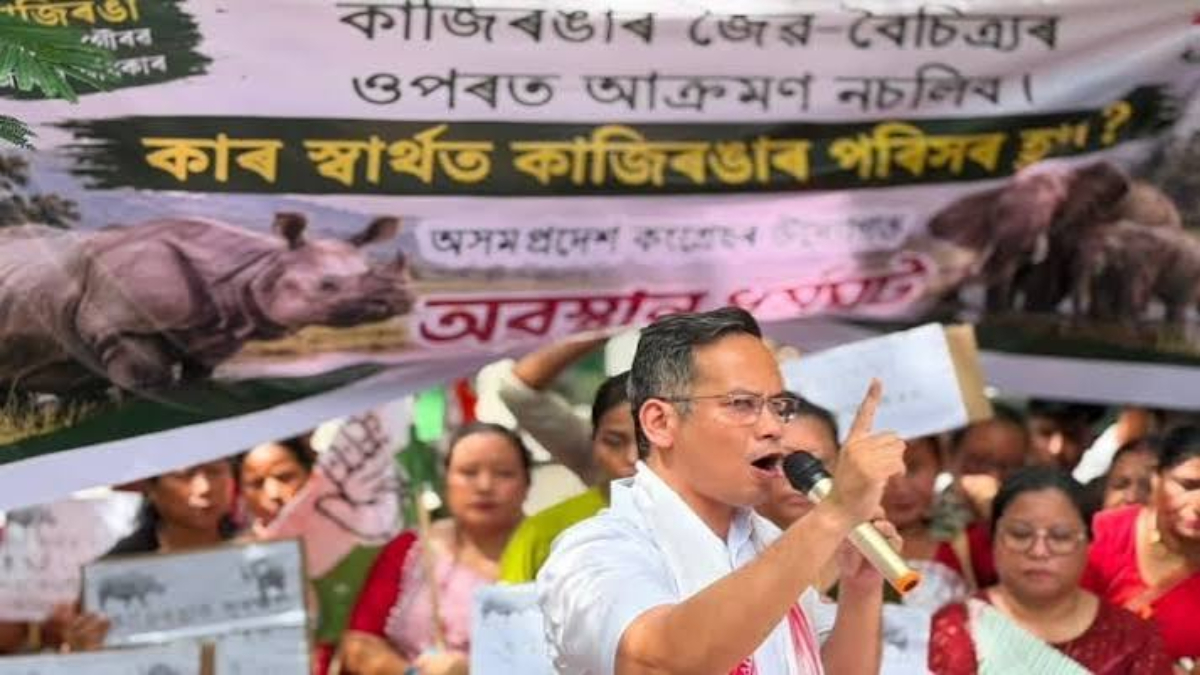
Kaziranga ESZ has triggered a fresh political and public dispute in Assam after the Karbi Students’ Association (KSA) protested remarks by Congress leader Gaurav Gogoi over the proposed changes to the eco-sensitive zone around Kaziranga National Park and Tiger Reserve. The student body has strongly opposed any move that it believes could affect the land rights and interests of indigenous communities in Karbi Anglong.
The dispute comes amid a wider controversy over the Assam government’s proposal to rationalise the protected zone around Kaziranga. The state has proposed an ESZ of around 1–3 km at different locations instead of the default 10-km framework currently applicable in the absence of a final notification.
Karbi Students’ Association defends land rights
The KSA’s objection reflects a long-standing concern among sections of Karbi society about the impact of conservation regulations on traditional settlements and land ownership.
The association has maintained that Karbi land cannot be compromised in the name of environmental protection or development. Its position follows earlier concerns raised by the KSA about the impact of the Kaziranga eco-sensitive zone on villages located close to the national park.
In 2022, the KSA had sought clarity from the government over the status of indigenous residents living around Kaziranga. The organisation said several villages in and around Karbi Anglong could be affected by the proposed 10-km zone and questioned whether residents would be able to continue cultivating land and constructing houses.
The association had also argued that environmental protection should not result in the loss of land rights for indigenous communities.
Kaziranga ESZ debate intensifies after Gogoi remarks
The latest protest comes after Gaurav Gogoi and the Assam Congress opposed the state government’s proposal to reduce the ESZ. Gogoi has argued that a wider protective buffer is needed to safeguard Kaziranga’s wildlife and prevent environmentally damaging activities.
The Congress staged a protest at Kohora on August 17, demanding withdrawal of the proposed reduction. Gogoi alleged that weakening the protective zone could provide a legal pathway for mining and other activities that may harm the park’s ecosystem.
The controversy has therefore created an unusual divide. While conservation groups and the opposition have raised concerns about environmental protection, sections of communities living around Kaziranga have backed the government’s proposal, saying restrictions linked to the existing framework affect their daily lives and development opportunities.
Assam government defends proposed ESZ changes
Chief Minister Himanta Biswa Sarma has defended the proposed changes, arguing that the ESZ does not need to extend uniformly to 10 km around the park.
The government has said the proposed 1–3 km framework would be based on local conditions and scientific assessment. Sarma has also stressed that the boundary of Kaziranga National Park itself would not be altered.
The government has further argued that a blanket 10-km restriction creates difficulties for people living in areas such as Bokakhat and Kaliabor. Hundreds of residents from fringe areas, including Bagori and Kuthori, recently rallied in support of the proposed reduction. They said the existing restrictions had created problems for livelihoods and development.
Conservation versus community interests
At the centre of the Kaziranga ESZ dispute is a difficult question: how can wildlife conservation be strengthened without undermining the rights and livelihoods of communities living around the protected landscape?
Kaziranga is internationally recognised for its biodiversity and one-horned rhinoceros population. Its surrounding areas also contain wildlife movement routes and habitats that are important during seasonal floods.
At the same time, the landscape is home to communities whose lives and economic activities predate many of the present conservation regulations. The KSA’s current position reflects that concern, particularly regarding Karbi land and indigenous rights.
The KSA has previously taken a different position on the geographical expansion of conservation measures. In 2018, one KSA faction opposed further extension of the eco-sensitive zone into Karbi hills adjoining Kaziranga and cited concerns over its impact on the region.
Political battle grows over Kaziranga
The latest dispute has expanded beyond environmental policy into a broader political confrontation. Agriculture and Irrigation Minister Pijush Hazarika recently accused critics of the proposed reduction of political inconsistency and defended a site-specific ESZ approach.
The CPI has also opposed the proposed reduction, warning that shrinking the protected buffer could increase pressure from construction, mining and other activities. It has called for scientific assessment, transparency and public consultation before any final decision.
For the Karbi Students’ Association, however, the issue is also about protecting community interests and preventing any perception that indigenous land can be sacrificed without consultation.
The Assam government’s proposal is yet to settle the wider debate. As the Centre considers the proposed framework, competing demands for wildlife protection, sustainable development and indigenous land rights are likely to remain central to the Kaziranga ESZ controversy. Any final decision will need to address both ecological concerns and the legitimate interests of communities living around one of Assam’s most important protected landscapes.
Inspiring Triumph: Arunachal women scale Mt Kun, Create History in Ladakh